DAVERN
The surname Davern is unquestionably of Irish provenance, deriving from the Gaelic patronymic Ó Dáibhírín, meaning “descendant of Dáibhírín.” The personal byname Dáibhírín is a diminutive of Dáibhí, the Irish equivalent of the given name David; consequently the name translates literally as “descendant of the little David” or “son of David.”
Over the centuries the spelling of the name has varied widely. In contemporary documents the forms Davoren, Daveren and Daveran are frequently encountered. These are Anglicised versions of the older Gaelic O' Dabhoireann, a name that itself was derived from Dubhdabhoireann – a compound of “dubh” (black or swarthy) and “boireann” (the Burren of County Clare). The prefix O signifies a male descendant, a feature common to many Irish surnames.
The earliest extant record of the surname is found in the 14th‑century chronicle known as the Annals of the Four Masters. In 1345, a chief Brehon of Corcomroe named Gillananaev O' Duibhdabhoireann is noted; the term Brehon (from breitheamh) refers to a judge operating within the Gaelic legal system that prevailed before the Norman invasion. Subsequent accounts describe the Daverns as a learned Brehon family, seated at Lisdoonvarna where they maintained a literary and legal school. A mortuary chapel associated with the family is recorded in the now‑lost church of Noughaval in north County Clare.
Throughout the medieval period the Daverns were linked to the region of the Burren, as evidenced by the 1317 reference to Coradh mic Dabhoirenn in the “Wars of Torlough.” The surname has also been recorded in Leinster since the thirteenth century, where it is believed to have evolved from the Gaelic term Daibheara, meaning “perseverance.” Bearers of the name from that time were reputed to be historians, warriors, politicians and faith leaders who exemplified steadfastness in the face of adversity.
In the centuries that followed the name spread beyond County Clare to other parts of Ireland, notably Dublin, where it ranks as the eighty‑fourth most common surname. It also appears with reasonable frequency in Limerick, Galway, Cork, Monaghan and other counties. The Irish diaspora brought the name to England, Scotland, Wales and even Brittany in France, where it remains associated with families of Irish descent.
Modern demographic data indicate that while the proportion of individuals bearing the surname Davern is modest compared with more ubiquitous surnames, it remains recognisable within the societies where it occurs. Its persistence reflects a continuity of lineage that has preserved a sense of place and identity across generations and continents.
The multiplicity of variant spellings – including Davon, Devinney, Dever and many others – attests to the fluidity of Irish surnames as they were adapted into English orthography. Nevertheless, each spelling retains the core etymological roots in the Gaelic patronymic tradition, encapsulating a legacy of descent from a “little David” or from a man of perseverance tied to the rugged landscapes of the Burren. The name Davern, therefore, stands as a testament to the enduring cultural and historical fabric of Ireland.
Typical given names associated with the Davern surname
Male
- Christopher
- Eamon
- Fergal
- Finian
- Gerard
- John
- Michael
- Patrick
- Paul
- Philip
- Ray
- Raymond
- Tony
- William
Female
- Catherine
- Christina
- Edith
- Elizabeth
- Evelyn
- Laura
- Linda
- Lisa
- Mary
- Nadine
- Nicola
- Patricia
- Rachel
Similar and related surnames
Related and similar names are generated algorithmically based on the spelling, and may not necessarily share an etymology.
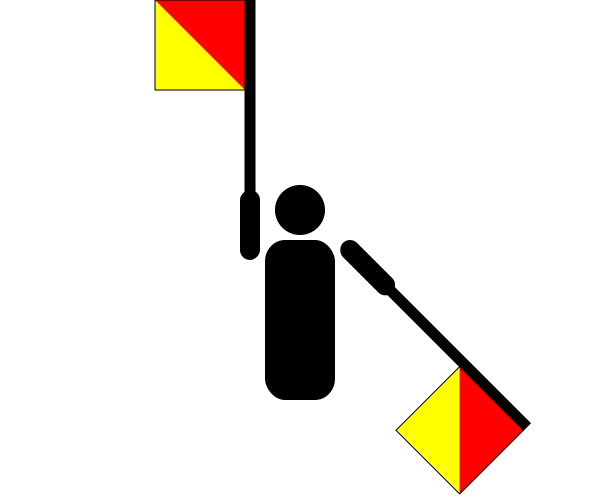
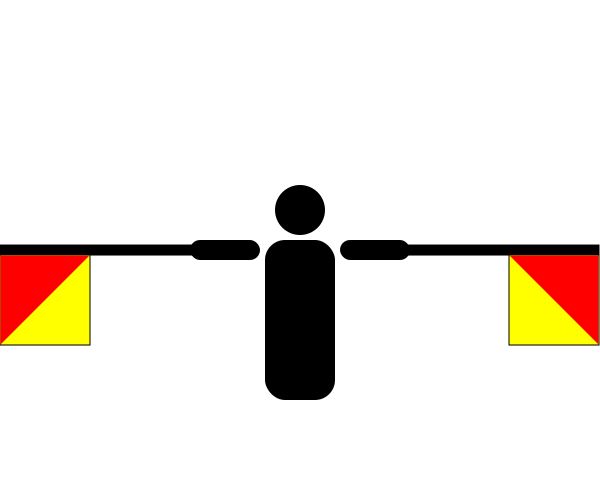
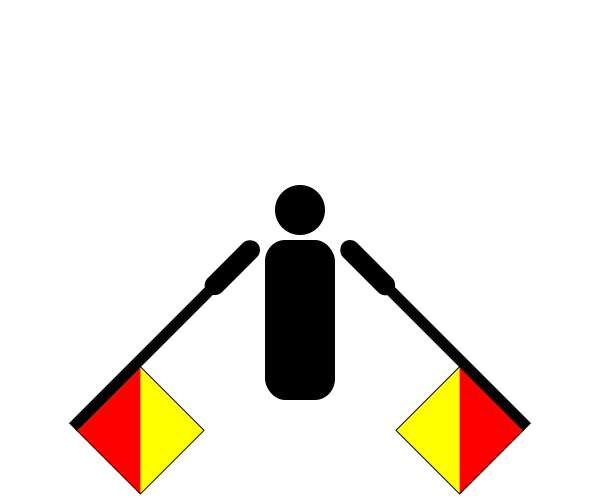
How to communicate the surname Davern in...
Braille
⠙⠁⠧⠑⠗⠝
Morse
-...-...-..-.-.
Semaphore



There are approximately 144 people named Davern in the UK. That makes it one of Britain's least common surnames. Only around two in a million people in Britain are named Davern.
Origin: Celtic
Region of origin: British Isles
Country of origin: Ireland
Religion of origin: Christian
Language of origin: Gaelic
