DABNEY
Dabney is a surname of English and Old French provenance. It entered the recorded history of the British Isles during the 11th century, following the Norman Conquest of 1066, and has remained comparatively uncommon.
Historically, the name is a development of the Old French personal name Aubigne, meaning white or fair, and is linked to the Gallo‑Roman term Albinius derived from albus (white). The locational element ‑acum denotes a settlement, so that the original form signified a person from a village called Aubigny in northern France. The Norman family that migrated to England adopted the habitational surname de Aubigny, which evolved into variants such as Daubeney, Daubeny and eventually Dabney.
The earliest recorded bearer of a name derivative of Aubigny was an attendant to William the Conqueror, whose entry appears in the Domesday Book of 1086 under the appellation William de Albini. Subsequent medieval records—the 1273 Hundred Rolls—contain individuals such as William de Aubeni (Nottinghamshire), Ordnell de Daubeny (Leicestershire) and John Daubini (Lincolnshire). In the 17th century, the spelling Dobney survived, with baptisms recorded in London (1672) and Leicestershire (1686).
The surname has been spelt in numerous forms, including Daubeny, Daubney, Dabney, Dobney, D’Aubney, Dabny, Dabnie, Dabni, Dabneyy and others. Each reflects regional orthographic preferences at the time of recording.
Coats of arms historically connected to the family feature four silver lozenges arranged in a fess on a red field, with a crest depicting a mullet on a tree. These heraldic symbols appear in early grants awarded to bearers of the Daubeney or de Albini name.
In England the surname remains quite rare, with the most extensive concentrations found in the rural counties of Yorkshire, Nottinghamshire, Leicestershire and Lincolnshire during the medieval period. In the United States, by contrast, the name is relatively common, especially along the Eastern seaboard in Virginia, Maryland and the Carolinas, reflecting 17th‑century emigration from England and relations with the early colonial elite.
Today the surname is primarily used as a family name, though it occasionally appears as a given name. Its distribution outside of the United Kingdom is largely limited to North America, where the name persists in historical records and contemporary censuses. The diversity of spelling has not altered the fundamental link to its Norman origins derived from the French settlements of Aubigny and surrounding regions. Dabney therefore remains a surname of clear historical depth, rooted in medieval Norman migration and preserved through a lineage of recorded bearers.
Typical given names associated with the Dabney surname
Male
- Ian
- Jimmy
- John
- Nick
Female
- Eliza
- Elizabeth
- Jackie
- Julia
- Kathleen
Similar and related surnames
Related and similar names are generated algorithmically based on the spelling, and may not necessarily share an etymology.
How to communicate the surname Dabney in...
Braille
⠙⠁⠃⠝⠑⠽
Morse
-...--...-..-.--
Semaphore


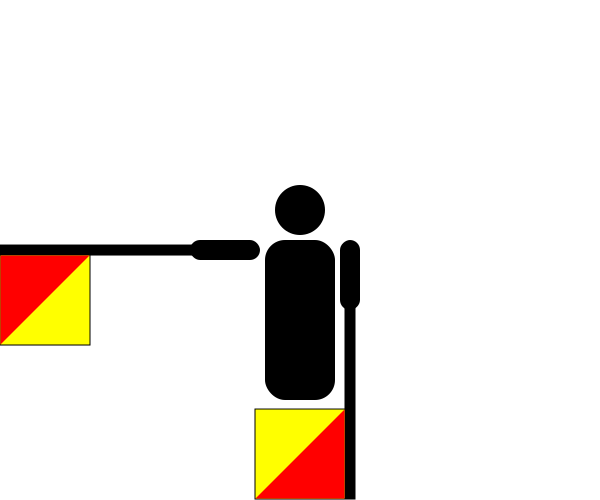
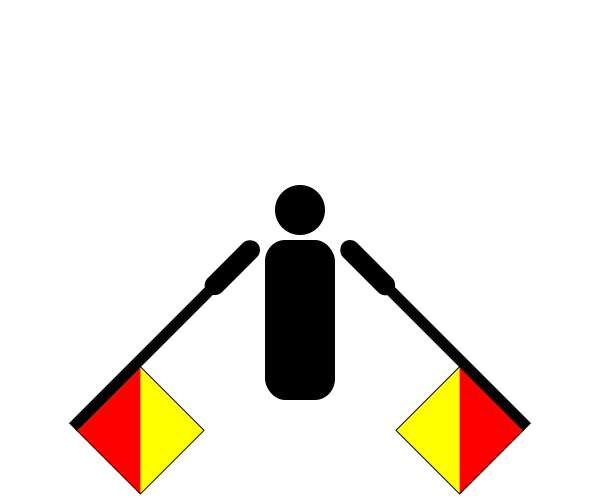

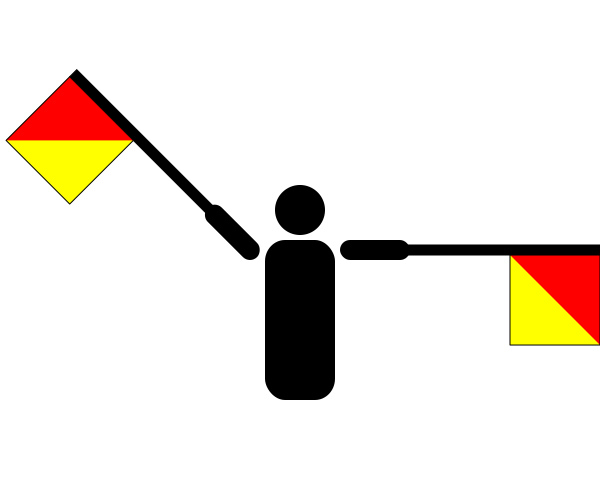
There are approximately 62 people named Dabney in the UK. That makes it one of Britain's least common surnames. Only around one in a million people in Britain are named Dabney.
Origin: English
Region of origin: British Isles
Country of origin: England
Religion of origin: Christian
Language of origin: English
