CUNLIFFE
Cunliffe is a surname of English origin, traditionally associated with the British Isles and, more specifically, the county of Lancashire in England. The name has endured for many centuries, appearing in a range of historical documents and continuing to be borne by people today across the United Kingdom, Ireland, and the wider world.
The etymology of Cunliffe derives from two Old English words: cunnan, meaning “to know”, and leof, meaning “dear” or “beloved”. From this root, the name can be interpreted as “beloved one who possesses knowledge” or “dear one who is wise.” The original bearer of the surname was likely a person of learning or esteem within a local community, and the nickname or term of endearment was subsequently adopted as a family name.
In addition to its nickname origin, the surname is also locational. It is recorded as having arisen from a hamlet north‑west of Rishton in Lancashire, now known simply as Cunliffe. The place name appears in the Pipe Rolls of Lancashire for the year 1246 as “Kuneclive” and later as “Cundcliff.” The etymology of the place derives from the pre‑7th‑century Old English word cunde, meaning a cleft, combined with clif, a steep slope; consequently the meaning is “the cleft slope.” Locational surnames such as this were typically given either to the local lord of the manor or to inhabitants who moved elsewhere and were identified by their place of origin.
Historical records provide several early instances of the name. In 1317, Adam de Cuncliffe appears in Baines History of Lancashire; a widow named Christabal Conliffe of Altham is recorded in the wills of Chester in 1595; Nicholas Cunliffe, a student at Oxford University, is noted in 1606; and Alice Cuncliffe was christened at Altham on 14 July 1614. A coat of arms granted to the family bears the blazon of a black shield charged with three silver conies, a silver greyhound crest, and the motto Fideliter—meaning faithfully. The first recorded spelling of the surname within the “Hundred Rolls of Yorkshire” is that of Robert de Cundeclif, dated 1273 during the reign of King Edward I.
Other derivations trace the surname to a Celtic or Old English origin. The compound cumb (valley) and leap (hill) give an alternative meaning of “hill by the water.” The earliest recorded spelling appears in the Domesday Book of 1085. It is also associated with the Irish surnames of Cuinliffe, derived from the ancient Gaelic name O'Connlaigh—the Gaelic word conla meaning hero. The surname is found in Scotland and can be spelled as Cuncliffe or Cunliff in that context.
Over time, numerous spellings have been recorded for the surname, reflecting changes in orthography and regional pronunciation. Variants include Cunliff, Cunlif, Cunliffe, Conliff, Conliffe, Conlif, Conliffe, Cuncliff, Cuncliffes, and Conclif. These all stem from the same linguistic roots and denote either the same family line or closely related branches.
Several individuals bearing the surname have achieved prominence. Sir William Cunliffe Brooks served as Governor of the Bank of England from 1885 to 1903, and Geoffrey Cunliffe played 102 matches for Worcestershire and 266 matches for Northamptonshire County Cricket Club between 1912 and 1937.
Today, the surname continues to be common in Northern England, particularly in Lancashire and Yorkshire, as well as in small towns throughout Ireland. It remains relatively widespread in Australia, largely due to the influx of Irish settlers in the 19th century, and in the United States, especially in Texas and other southern states, where English and Irish immigrants settled during the 18th and 19th centuries.
Through its storied history and continued presence, Cunliffe exemplifies the enduring nature of English surnames and their capacity to reflect both geographical origin and personal reputation across the centuries.
Typical given names associated with the Cunliffe surname
Male
- Christopher
- David
- James
- John
- Mark
- Michael
- Paul
- Peter
- Robert
- Stephen
Female
- Amanda
- Anne
- Debbie
- Elizabeth
- Emma
- Helen
- Joanne
- Julie
- Margaret
- Mary
- Patricia
- Sarah
- Susan
Similar and related surnames
Related and similar names are generated algorithmically based on the spelling, and may not necessarily share an etymology.
How to communicate the surname Cunliffe in...
Braille
⠉⠥⠝⠇⠊⠋⠋⠑
Morse
-.-...--..-......-...-..
Semaphore


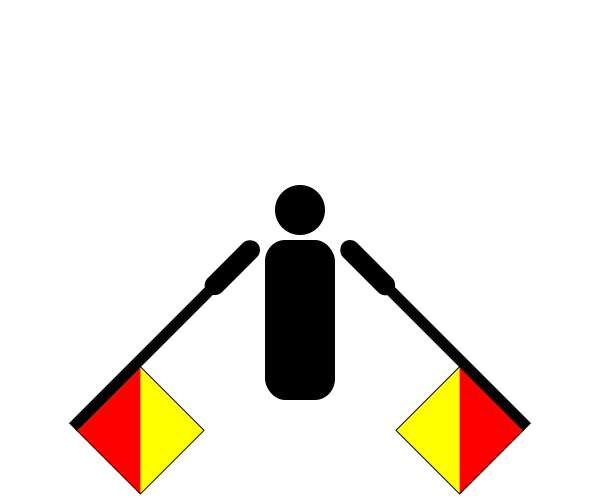

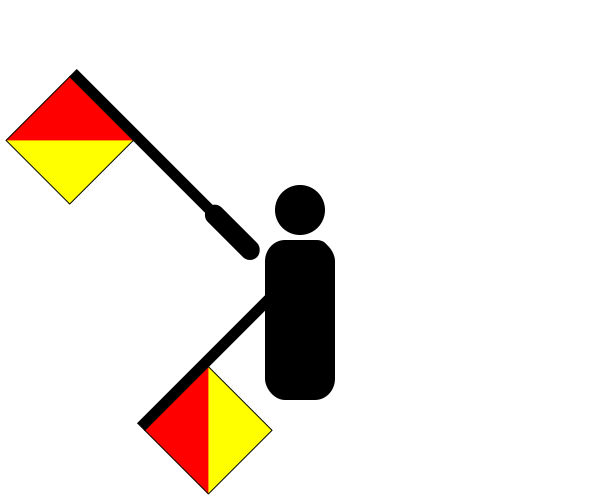
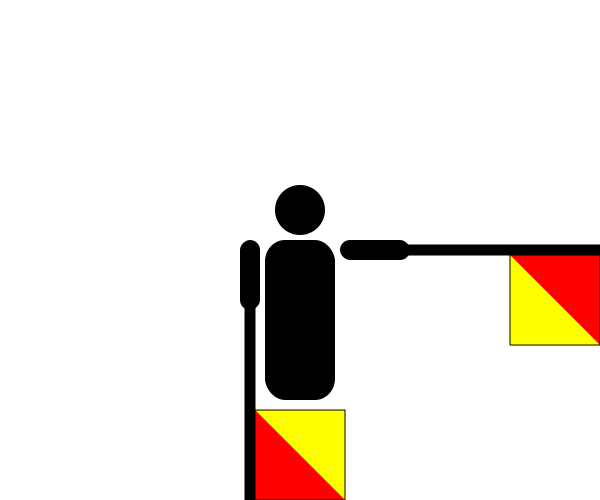

There are approximately 6,603 people named Cunliffe in the UK. That makes it roughly the 1,433rd most common surname in Britain. Around 101 in a million people in Britain are named Cunliffe.
Origin: English
Region of origin: British Isles
Country of origin: England
Religion of origin: Christian
Language of origin: English

Famous people named Cunliffe
- Barry Cunliffe - Archaeologist
- John Cunliffe - Writer (1933 to 2018)
- Jon Cunliffe - Civil servant
- Nancy Elizabeth Cunliffe - Singer-songwriter
- Stella Cunliffe - Statistician (1917 to 2012)
- Lawrence Cunliffe - Politician
- Jimmy Cunliffe - Football player (1912 to 1986)
- John Cunliffe - Football player born 1930 (1930 to 1975)
- Arthur Cunliffe - Football player (1909 to 1986)
- Robert Cunliffe - Cricketer
- Bobby Cunliffe - Football player (1928 to 2000)
- Whit Cunliffe - Singer (1875 to 1966)
- John Cunliffe - Football player
- Jack Cunliffe - Rugby league player (1921 to 1973)
- Bobby Cunliffe - Football player
- John William Cunliffe - American author (1865 to 1946)
- Charles Cunliffe - Cricketer (1858 to 1884)
Names and descriptions courtesy of Wikipedia, and may contain errors. This is not intended to be an exhaustive list of every famous person with this name.