CROSSER
Crosser is a surname of English origin with roots that extend into the early medieval period, tracing back to both English and French linguistic influences. The name derives from the Middle English word crosse, meaning cross, and reflects an occupational or locational trait associated with this Christian symbol.
Historically, the surname was borne by those involved in the production or carriage of crosses for ecclesiastical use, as well as by clergy who carried a bishop’s crook – a stylised cross – during processions. The term may also have been applied to individuals who lived near a prominent stone cross or at a crossroads, which were often marked by a cross or cross‑shaped signpost and were important waymarks on medieval roads.
In the medieval period the name appears in several forms. The earliest recorded spellings include William le Croyser dated 1264 in the Eynsham Cartulary during the reign of King Henry III. Variants such as Croyser, Crosier, and later Crosser demonstrate the evolution of the surname through linguistic adaptation and regional pronunciation.
By the early eighteenth century, baptisms and parish registers recorded individuals such as Joseph Crozier, christened 30 March 1713 at St. Botolph, Bishopsgate, London. The surname’s spelling during this period reflects the broader trend toward standardisation of English names, yet retains echoes of its French antecedent Croïrier, itself a derivative of the Old French Crois (cross) and later associated with Croce (crook).
The heraldic traditions associated with the name are documented in the blazon of a blue escutcheon bearing a silver fess flanked by three gold crosslets placed saltireways, with three black martlets situated between them. The crest is described as an arm vested erect holding a gold crosier. These symbols underscore the religious and ecclesiastical connections historically linked to the surname.
Population data indicate that the name remains uncommon within the United Kingdom and is more widely represented in the United States, particularly in the states of Ohio and Pennsylvania. The distribution of the surname is indicative of migration patterns from Britain to North America, and its presence in Anglo‑Saxon societies such as England and Australia reflects the broader diaspora of English families.
Variants of the surname include Croser, Crosier, Crosar, Crowser, Crozer, and occasionally Crosar. These differences arise from dialectal pronunciation, regional spelling conventions, and the anglicisation of names during immigration processes. Related surnames such as Cross, Crosse, Croce, and even Crusier may share phonetic similarities, but each retains its distinct genealogical lineage.
Scholars regard Crosser as a patronymic representation of a person’s occupation or dwelling place associated with a cross. The surname exemplifies how medieval naming practices linked individuals to physical landmarks or professional roles, thereby creating enduring family identities that persist in contemporary records.
Typical given names associated with the Crosser surname
Male
Female
Similar and related surnames
Related and similar names are generated algorithmically based on the spelling, and may not necessarily share an etymology.
How to communicate the surname Crosser in...
Braille
⠉⠗⠕⠎⠎⠑⠗
Morse
-.-..-.---........-.
Semaphore

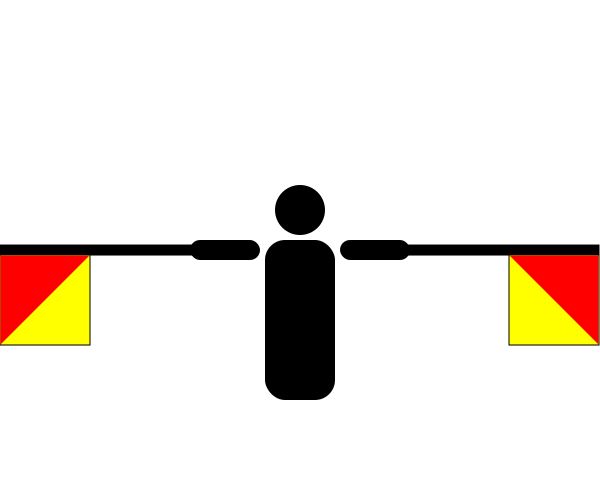
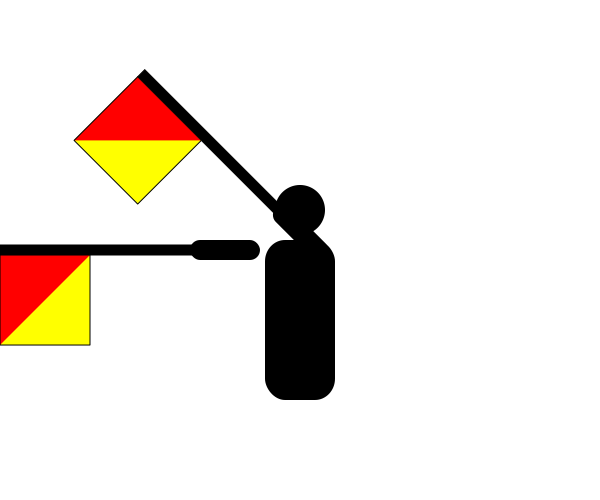


There are approximately 17 people named Crosser in the UK. That makes it one of Britain's least common surnames. Fewer than one in a million people in Britain are named Crosser.

Famous people named Crosser
- Robert Crosser - American politician (1874 to 1957)
Names and descriptions courtesy of Wikipedia, and may contain errors. This is not intended to be an exhaustive list of every famous person with this name.