CROSLAND
Crosland is an English habitational surname with roots in the Old Norse personal name krosslātr, meaning “cross lath” or “cross beam.” The name originally applied to those who lived near a cross-shaped landmark or to those who worked with or manufactured crosses, making it a topographic identifier in the English countryside.
The surname derives specifically from a locality in West Yorkshire. The place that now bears the name South Crosland was recorded in the 1086 Domesday Book as “Croisland,” a Norman rendering, and later in the 1200 Charter Rolls of Yorkshire as Crosland. The place name itself comes from the Old English element cros “cross” and land “territory,” describing a settlement that was centred on a significant cross or boundary marker post.
Early documentary evidence of the name dates back to the early thirteenth century. The court rolls of the manor of Wakefield in Yorkshire list Christiana de Crosselande in 1308, during the reign of King Edward the First, 1307–1327. The Yorkshire Poll Tax Rolls of 1379 contain the entries of Thomas de Crosslande and Wilelmus de Crossland, indicating that the name was in use by individuals in the region by that time.
Throughout the Middle Ages the surname appears in a variety of spellings, including Crossland, Croisland, Crosseland, Croslin, and Croseland. The presence of the particle de before the name in some early records indicates a “of” or “from” relationship, further emphasising its locational character. Variations arose from regional dialects, phonetic spelling, and the transliteration of spoken forms into written records.
Documentary evidence also records a “North Crosseland” in the fourteenth century, with a Ricardus de Crosselande documented in 1379. Scholars believe this early settlement is one of the many medieval villages now regarded as lost within the British Isles. The disappearance of these villages was often due to depopulation, economic change or other social factors.
Notable early bearers of the name include George Crosland, mentioned in the Coroner’s Roll of Nottingham in 1538, and William Crosland, recorded as a victualler who was buried in 1720 at St Dionis Backchurch in London. The name’s association with the local gentry is exemplified by the special mention of Crosland of Crosland Hall near Huddersfield, whose coat of arms was granted in the heralds’ visitation of 1665 and described as quarterly silver and red, a cross botonee counterchanged.
The heraldic description indicates that the Crosland family held a status that allowed the granting of a personal coat of arms, a privilege typically reserved for families of the manorial or landholding class. The existence of a hired lord in the manor suggests that the earliest bearers of the surname were the lords of the manor, a common pattern whereby a locational surname indicated ownership of land rather than migration from elsewhere.
During the sixteenth century, members of the Crosland family were noted for their participation in the textile industry. The wool trade, an important economic sector in northern England, provided the conditions for the family of Crosland Hall to become prominent in the local economy. Their involvement in the wool trade is the most documented occupational association with the name.
Over the centuries, through both internal migration within England and emigration overseas, the surname has spread into other English‑speaking countries. Records show a steady presence in the United Kingdom, Canada, Australia, and the United States. The most significant concentration of people named Crosland remains in northern England, especially in Yorkshire, which continues to exhibit the highest density of bearers of the name.
Today, the surname Crosland continues to be a marker of ancestral connection to the Yorkshire locality, stretching back to the medieval period. Its persistence as a family name reflects the enduring nature of local identity and the historical importance of geographic associations in the formation of English surnames.
Typical given names associated with the Crosland surname
Male
- Andrew
- Daniel
- David
- James
- John
- Michael
- Paul
- Peter
- Richard
- Robert
- Thomas
Female
- Alison
- Christine
- Elizabeth
- Emma
- Jane
- Lucy
- Margaret
- Rachel
- Rosemary
- Sally
- Sarah
- Susan
Similar and related surnames
Related and similar names are generated algorithmically based on the spelling, and may not necessarily share an etymology.
How to communicate the surname Crosland in...
Braille
⠉⠗⠕⠎⠇⠁⠝⠙
Morse
-.-..-.---....-...--.-..
Semaphore

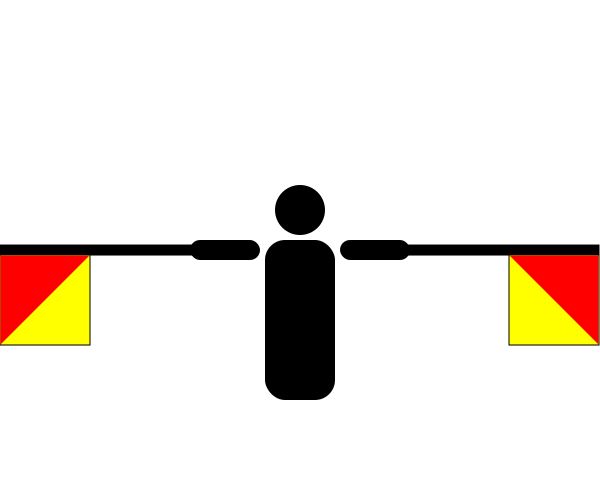
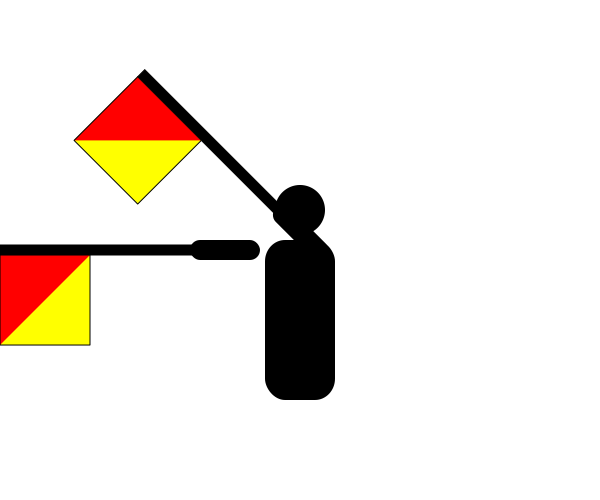


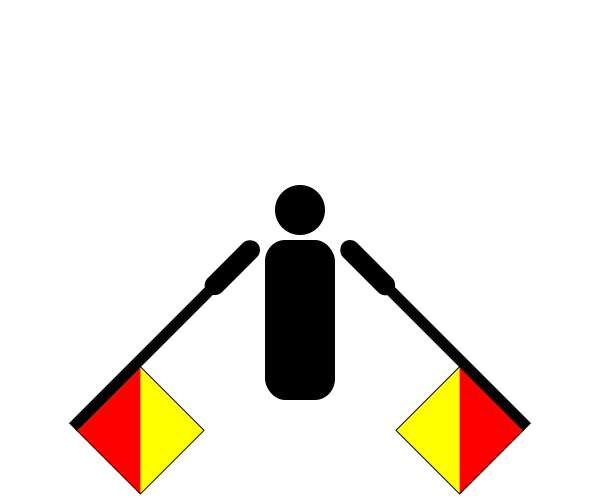

There are approximately 807 people named Crosland in the UK. That makes it roughly the 8,709th most common surname in Britain. Around 12 in a million people in Britain are named Crosland.
Surname type: Location or geographical feature
Origin: English
Region of origin: British Isles
Country of origin: England
Religion of origin: Christian
Language of origin: English

Famous people named Crosland
- Anthony Crosland - Politician (1918 to 1977)
- Neisha Crosland - Textile designer
- John Crosland - Football player (1922 to 2006)
- Philip Crosland - Journalist (1918 to 2012)
Names and descriptions courtesy of Wikipedia, and may contain errors. This is not intended to be an exhaustive list of every famous person with this name.