CROOKE
Origin - The surname Crooke is firmly rooted in English ancestry. It appears in the Domesday Book of 1086 under the form “Rainald Croc” in Hampshire, indicating the name’s presence shortly after the Norman Conquest.
The name is derived from the Old Norse word krokr, meaning “hook,” “bend,” or “crook.” This root entered Middle English as crok and was subsequently adopted into the English-speaking world. The Norse influence reflects the Viking presence in parts of England from the 9th to the 11th centuries.
Etymology - Two principal interpretations exist for the surname. One treats it as a topographical surname: it was assigned to individuals who resided near a prominent bend or curve in a road or river, or on land that displayed a hook-like shape. The other interprets it as a metonymic occupational surname, designated for a maker, seller or user of hooks, or for a shepherd who used a crook in tending animals. A third sense, though less common, is that of a nickname for a person with a physically crooked feature or, historically, for someone employing deceit.
Historical Records - The earliest recorded instance of the name appears in the Domesday Book, recorded as “Croc.” Later medieval documents cite the surname in its Latinised or Anglicised forms, such as Crook or Crooks. Notable marriages include Thomas Crooke and Ellen Barnefeeld at St. Dunstan’s, Stepney on 21 January 1588, and William Crooke and Ann Powell at St. Mary Aldermary, London on 7 October 1618. In 1635, an early emigrant named William Crooke departed London on the ship *Thomas and John* bound for Virginia, illustrating the name’s transatlantic reach during the early colonial period.
Geographical Distribution - In England the surname is most frequently found in the northern and south‑western regions. In contemporary statistics it remains a comparatively uncommon name, ranking among the lowest tier of common surnames worldwide. In the United States, it is present chiefly in southern and western states, and it also appears in smaller numbers across Canada, Australia and New Zealand. Variants such as Crook, Crooks, Croke, Cruick, Crucke, Cruck, Crouk and Crouke are recorded, reflecting regional pronunciation differences and orthographic evolution.
Variants and Prefixes - Historical documents sometimes list the surname with the Middle‑English prefix Atte (e.g., “Atte Crooke”) or with patronymic suffixes such as -son (e.g., “Crookson”), a practice common in medieval England. These forms, while no longer in regular use, demonstrate the flexibility with which surnames were adapted in vernacular records.
In all, the surname Crooke exemplifies a family name that developed from a simple natural or occupational feature, persisted through successive linguistic stages, and spread from medieval English counties across the Atlantic, maintaining a distinct identity while generating a variety of orthographic forms.
Typical given names associated with the Crooke surname
Male
- Andrew
- Christopher
- David
- James
- John
- Martin
- Matthew
- Michael
- Paul
- Peter
- Sean
Female
- Anna
- Annabel
- Elaine
- Elizabeth
- Helen
- Janet
- Kathleen
- Marcia
- Margaret
- Michelle
- Mk
- Patricia
- Rebecca
- Susan
- Tracy
Similar and related surnames
Related and similar names are generated algorithmically based on the spelling, and may not necessarily share an etymology.
How to communicate the surname Crooke in...
Braille
⠉⠗⠕⠕⠅⠑
Morse
-.-..-.-------.-.
Semaphore

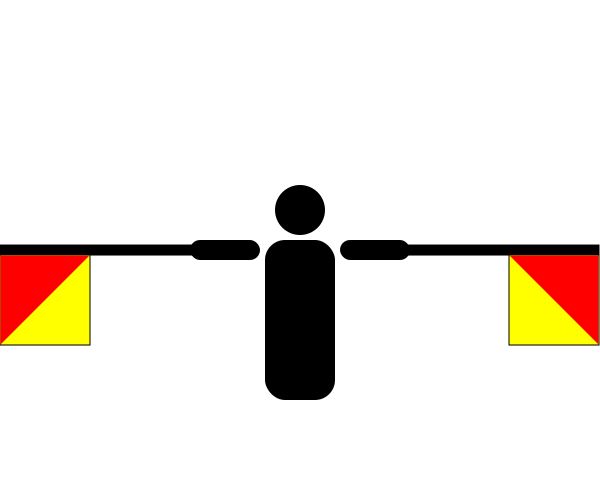
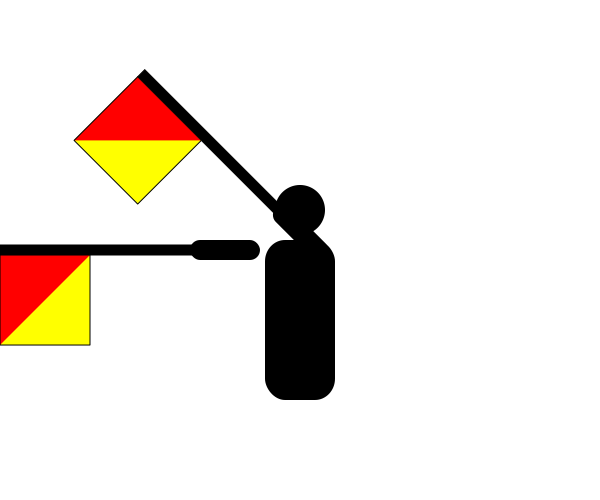
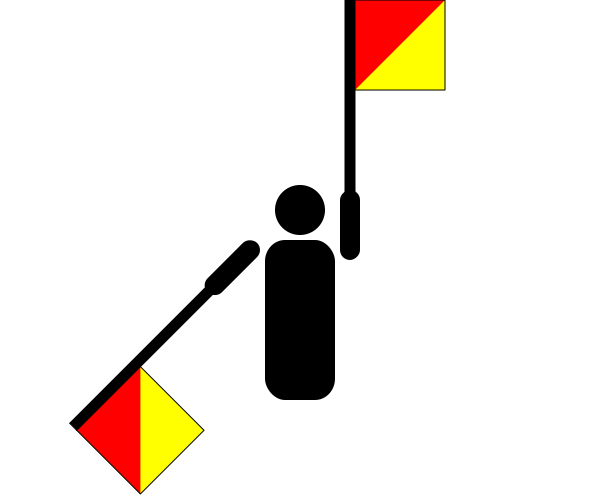

There are approximately 598 people named Crooke in the UK. That makes it one of Britain's least common surnames. Only around nine in a million people in Britain are named Crooke.
Surname type: Location or geographical feature
Origin: English
Region of origin: British Isles
Country of origin: England
Religion of origin: Christian
Language of origin: English
