CROMER
Originating from the British Isles and firmly rooted in England, the surname Cromer is a locational name that derives from placenames within Norfolk and Hertfordshire. It is believed to have evolved from the Old English elements *crumb*, meaning “a bend or crook,” and *mere*, meaning “a lake or pool,” and thereby referred to an individual who lived near or was associated with a bend in a lake or pool.
Alternate etymological analysis links the surname to Old English pre‑7th Century terms *Crawe*, a crow, and *mere*, a lake, giving the original sense of a lake inhabited by crows. The place-name itself, also inherited by the surname, is associated with the coastal town of Cromer in North Norfolk where the name entered common use in the medieval period.
The earliest documented spelling of the name appears in 1539 with Barnabas Cromer of St. Stephens in Norwich, recorded during the reign of King Henry VI, the monarch commonly referred to as “Good King Hal.” By the late sixteenth century, for example, Elizabeth Cromer married William Earle in 1579 in Westmill, Hertfordshire, exemplifying the period’s practice of adopting placenames as personal identifiers.
In the same era, a heraldic achievement was granted to a member of the family: three ravens proper placed upon a black chevron engrailed that bears three silver annulets upon a silver shield. This coat of arms underscores the standing of the Cromer family within the local gentry.
During the Middle Ages, migration from villages became increasingly common, and the surname spread beyond its original locales. Consequently, bearers of the name appeared in other parts of the United Kingdom and later in colonies such as the United States, Canada, Australia and New Zealand.
Today, the name is still most frequently encountered in Norfolk, especially along the east coast of England, and is also found in various parts of the United Kingdom, including North Norfolk, Cromer South, and North Norwich. In the United States, census data from 2020 place the surname in the states of Ohio, Pennsylvania, Kentucky, Texas and Virginia, reflecting the historical migration patterns of emigrants from England.
Outside of the United Kingdom, the surname appears sporadically in the Netherlands, particularly in the province of Zuid-Holland, and in limited numbers in Germany. In Canada, it is mainly recorded in Alberta and British Columbia, while in Australia it is concentrated in New South Wales and Victoria.
Variants of the surname, such as Cromer, Creeamer, Cromare, Crummar, Crumme, Crummey, Kromer, Krumer, and Crummear, have arisen over time. Related surnames of similar origin include Crummer, Crummett, Crammer, Cramer, Krammer, Kramar, Kramerer, Kramarz, Chromer, Chrumer, Chomar, Chrumar, Grummer, Grummet, Grummett and Grummel, each reflecting subtle regional orthographic differences in the distant past.
Thus, the surname Cromer remains a testament to England’s place‑based naming conventions, illustrating how a simple geographic descriptor has endured across centuries and continents, maintained by those who carry it in numerous regions of the world today.
Typical given names associated with the Cromer surname
Male
- Earl
- George
- Keith
- Raymond
- Rex
Female
- Carol
- Charlotte
- Ellen
- Kirsten
- Lisa
Similar and related surnames
Related and similar names are generated algorithmically based on the spelling, and may not necessarily share an etymology.
How to communicate the surname Cromer in...
Braille
⠉⠗⠕⠍⠑⠗
Morse
-.-..-.-----..-.
Semaphore

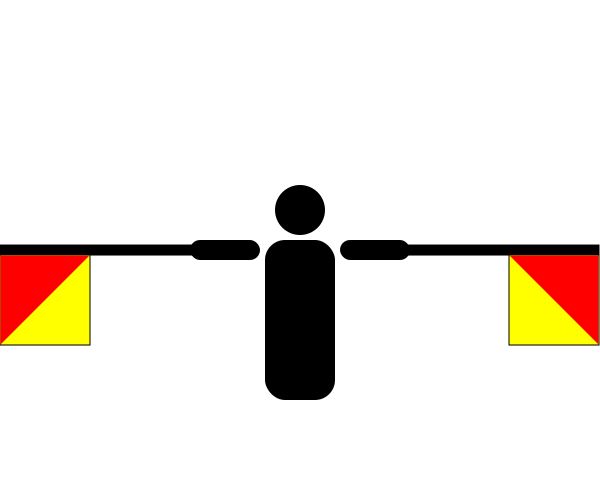
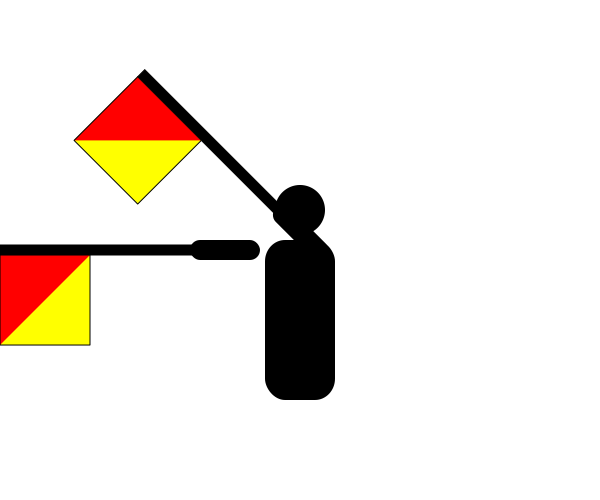
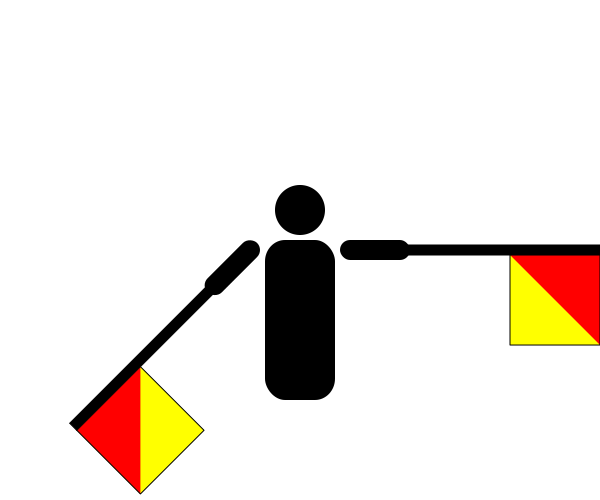

There are approximately 82 people named Cromer in the UK. That makes it one of Britain's least common surnames. Only around one in a million people in Britain are named Cromer.
Origin: English
Region of origin: British Isles
Country of origin: England
Religion of origin: Christian
Language of origin: English
