CROCKET
Origins of the surname Crocket are firmly rooted in the Gaelic-speaking regions of Scotland. The name is derived from the Gaelic term crotach, which means “humpbacked” or “bent”. Historically this term was employed as a nickname to describe an individual who possessed a physical characteristic such as a hunchback or a stooped posture. From this descriptive origin the surname evolved into a range of orthographic forms, most commonly Crocket, Crockett, Crokett and Crockette.
In the 15th to 17th centuries variations such as Croket and Crok(k)at appear in official documents. The earliest recorded spelling is attributed to Huwe Croket of Kameslank (Cambeuslang) in 1296, when he rendered homage during the reign of King John Balliol of Scotland. The name also appears in a 1634 record in Achinkyle (now Achnacloich) where John Crokkit was charged with various misdemeanours.
Alternative derivations for the surname are acknowledged. One theory associates the name with the Medieval English noun croket, meaning a large curl, which suggests a nickname for a person sporting distinctive curled hair. Another hypothesis links the surname to the Scottish Galloway family name Crockett, which is derived from Macriocaird, the Gaelic form of “son of Rickard” (Richard). The region of Dumfries, near the town of Crocketford, is also cited as a potential place‑based origin, the name itself stemming from the Middle English craket or Old Norse kráka, both meaning “crow”.
Historical evidence suggests that the name was at times associated with the craft of stone masonry or sculpture, as the term crocket also denotes a hook‑shaped decorative element in Gothic architecture. Individuals involved in the creation of such ornaments might have adopted the surname in connection with their occupation; however, this remains a descriptive possibility rather than definitive proof.
The Coat of Arms granted to the family features three Cornish choughs proper on a silver shield, with a crest depicting a Cornish clough proper. This heraldic emblem provides a visual representation of the family's heritage and is recorded in the earliest extant rolls for Scottish families.
During the 20th century the surname received widespread popular recognition through the fictional character Davy Crockett, the King of the Wild Frontier, portrayed in television programmes and films. The character’s fame contributed to the name’s familiarity in English‑speaking countries, though the original Scottish lineage remained distinct.
Population records indicate that bearers of the surname have migrated extensively. Large despatches of people bearing the name Crocket moved from Scotland to England, and subsequently to North America, Australia and New Zealand. Consequently, the name can now be found across the United Kingdom, the United States, Canada, Australia and New Zealand, with a particularly strong presence in Scotland and within the broader British Isles.
In sum, the surname Crocket encapsulates a tapestry of linguistic, topographical and occupational origins, all underpinned by a verifiable historical record that extends back to the late 13th century. Its evolution through various spellings and its spread across continents testify to the enduring legacy of a family name rooted firmly in Scottish heritage.
Typical given names associated with the Crocket surname
Male
- Alastair
- Alexander
- Andrew
- David
- Douglas
- George
- James
- John
- Patrick
- Peter
- Richard
- Simon
- William
Female
- Aimi
- Eileen
- Helen
- Jacqueline
- Joanne
- Julia
- Karen
- Kirsty
- Maureen
- Melanie
- Rosslyn
- Ruth
- Samantha
- Sarah
- Sheila
Similar and related surnames
Related and similar names are generated algorithmically based on the spelling, and may not necessarily share an etymology.
How to communicate the surname Crocket in...
Braille
⠉⠗⠕⠉⠅⠑⠞
Morse
-.-..-.----.-.-.-.-
Semaphore

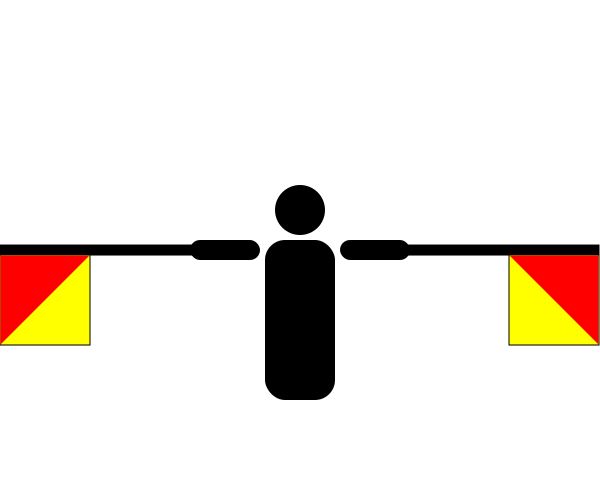
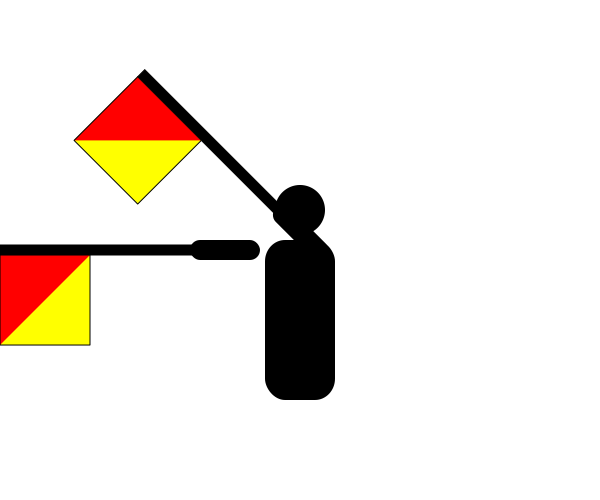
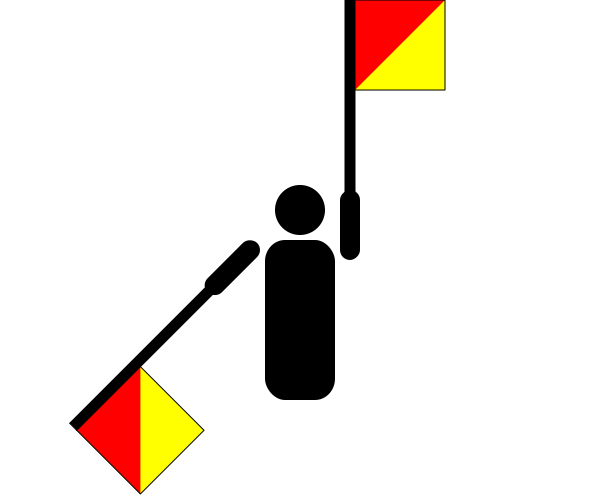

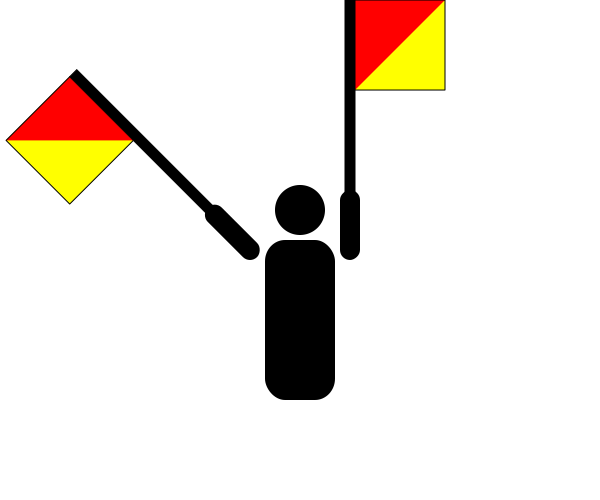
There are approximately 186 people named Crocket in the UK. That makes it one of Britain's least common surnames. Only around three in a million people in Britain are named Crocket.
Origin: Celtic
Region of origin: British Isles
Country of origin: Scotland
Religion of origin: Christian
Language of origin: Gaelic
