CRESSEY
The surname Cressey is traditionally regarded as of English origin, though scholarly work suggests a more complex genealogical history that includes both Anglo‑Saxon and French elements.
From an Old English perspective the name appears to derive from the word cres, meaning “cross,” combined with the suffix -ey, which denotes an island or a place of dwelling. In this interpretation Cressey could therefore be understood as a “dweller at the cross” or as a person who lived near a landmark of cross‑shaped significance, such as a crossroads where two roads intersected.
Alternative etymology stems from the linguistic traditions of continental Europe. One hypothesis proposes that Cressey is a locational surname originating in France, linked to the village of Crecy in Picardy. The Battle of Crecy in 1346 gave the place its notoriety, and families who migrated to England from that region may have adopted the name of their native settlement for identification.
A further variant posits a Provencal root in the word cres (or gres), used as a topographic descriptor for someone residing on a stony patch of ground. In any of these French‑derived theories the surname would have entered English usage through migration, with bearers often retaining the original place name as their identifier.
Documentary evidence attests to the presence of the name in England as early as the twelfth century. The earliest known spelling appears in the Pipe Rolls of Lancashire under the reign of King Henry the Builder (1154–1189), where Hugo de Creissi is recorded in 1171. Later records illustrate the spelling taking several forms: Creas(e)y, Cressy, and Creassey. In 1182 an individual named Alexander de Crecy is mentioned in charters related to the Gilbertine houses, and in 1185 a Alexander de Cressi appears in the records of the Knight Templars in Lancashire. The name also surfaces in the same county in the mid‑seventeenth century, with Beatrix Cressy noted in contemporary documents.
By the seventeenth century the surname had established a presence in several regions of England. A record from St. Giles, Cripplegate, London documents the christening of Elizabeth Cressey in 1673, illustrating the persistence of the name through subsequent generations. Subsequent to this period the surname became fairly common particularly in the counties of Lincolnshire, Norfolk and Suffolk, suggesting a strong local concentration that may reflect both migration patterns and the retention of family identity in rural communities.
Thus, the surname Cressey demonstrates a multifaceted heritage encompassing Anglo‑Saxon linguistic roots and potential French locational origins, with a documented presence in England stretching back to the early twelfth century and continuing into modern times with distinct concentrations in East Anglia and the Midlands.
Typical given names associated with the Cressey surname
Male
- Andrew
- Anthony
- David
- Ian
- John
- Michael
- Paul
- Robert
- Roger
- Stephen
- Steven
Female
- Alison
- Angela
- Catherine
- Elizabeth
- Emma
- Julie
- Kerry
- Lindsay
- Margaret
- Nicola
- Patricia
- Samantha
- Sarah
- Susan
Similar and related surnames
Related and similar names are generated algorithmically based on the spelling, and may not necessarily share an etymology.
How to communicate the surname Cressey in...
Braille
⠉⠗⠑⠎⠎⠑⠽
Morse
-.-..-.........-.--
Semaphore

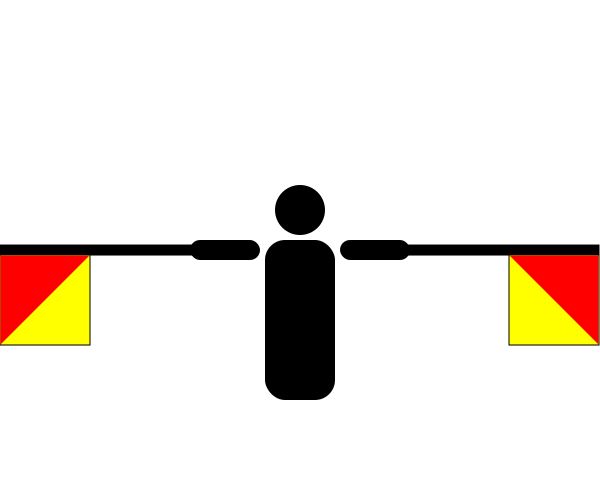


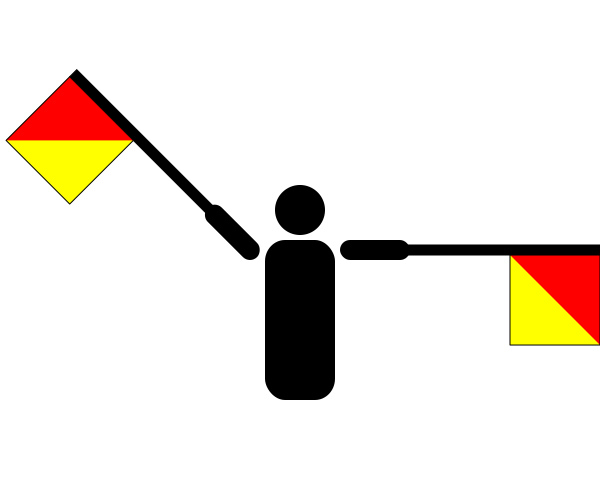
There are approximately 981 people named Cressey in the UK. That makes it roughly the 7,483rd most common surname in Britain. Around 15 in a million people in Britain are named Cressey.
Surname type: Location or geographical feature
Origin: English
Region of origin: British Isles
Country of origin: England
Religion of origin: Christian
Language of origin: English
