CRANSHAW
Cranshaw is a surname of English and Scottish provenance, traditionally classified as a locational or habitational name. The linguistic roots lie in Old English, with the elements cran meaning “crane” and sceaga meaning “wood” or “grove” Cranshaw therefore originally denoted a dweller near a woodland frequented by cranes, or a tall, slender individual resembling the bird.
The earliest documentary evidence of the name dates to 1308, when a “John de Crowschaugh” was recorded in Wakefield, Yorkshire, during the reign of Edward I (Edward of Caernarfon, 1307‑1327). In Lancashire, the place-name Croweshagh appears in the Inquests of 1324, giving rise to the variant Cranshaw or Crawshaw for people who migrated from that hamlet to other parts of the country. The shift from Croweshagh to Cranshaw illustrates the common medieval practice of adopting one’s place of origin as a personal identifier.
Throughout the Middle Ages, the surname spread beyond its initial locality. The marriage of a Crownshaw (a recognised variant) to John Phillips on 23 April 1781 in St. Giles, Cripplegate, London, is one of the earliest references to the name in the capital. By the early modern period, records of the name exist in London, Somerset, Durham and other English counties, indicating its wide dispersal among the rural folk and emerging urban communities.
In the modern era, Cranshaw remains strongly associated with England. Census data from 2011 show over 1,000 bearers in England and Wales, mainly situated in the midlands. The surname is also found in the United States, where it is most common in the Midwest and South—Kentucky, Tennessee, Indiana and Arkansas—accounting for more than 9,000 individuals. In Canada, nearly 500 people carry the name, with the greatest concentration in the Greater Toronto Area and British Columbia. Australian and New Zealand records are comparatively sparse but confirm the continued global spread of the name.
Spelling variations of the surname are numerous: Craneshaw, Cransey, Cranshay, Cransee, Crane-Hay, Curanshaw, among others. Some forms, such as Cranshay, display a slightly higher frequency in Scotland, suggesting historic inter‑regional migration during or after the Middle Ages. Related names include Cranesee and Cranesh. Despite these variants, Cranshaw remains the predominant orthography in England and North America.
Most contemporary bearers of the name are descendants of English farmers who emigrated to North America during the 17th and 18th centuries. Marriage records in Derbyshire and Warwickshire, dated to the late 1600s, document families named Cranshaw who moved to the Thirteen Colonies, and later to Canada and Australia, establishing the surname across the Anglo‑Saxon diaspora.
Overall, Cranshaw exemplifies a classic English locational surname that has survived centuries of linguistic change and migration. Its persistence across diverse regions—ranging from rural Lancashire to metropolitan London, and across the Atlantic to the United States, Canada, Australia and New Zealand—attests to the enduring nature of place-based family identities within the Anglo‑Scottish heritage.
Typical given names associated with the Cranshaw surname
Male
- Alan
- Andrew
- David
- Ellis
- Eric
- Ian
- James
- Joel
- John
- Mark
- Martin
- Nigel
- Peter
- Simon
- William
Female
- Alison
- Catherine
- Emma
- Lucy
- Lynda
- Margaret
- Mary
- Michelle
- Nicola
- Pamela
- Philippa
- Sarah
- Zoe
Similar and related surnames
Related and similar names are generated algorithmically based on the spelling, and may not necessarily share an etymology.
How to communicate the surname Cranshaw in...
Braille
⠉⠗⠁⠝⠎⠓⠁⠺
Morse
-.-..-..--.........-.--
Semaphore

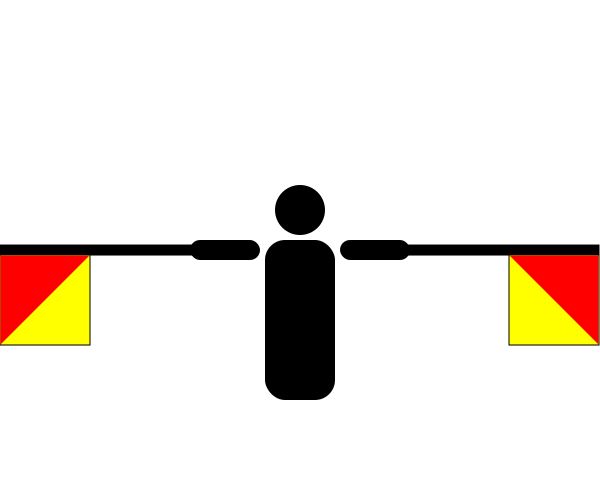

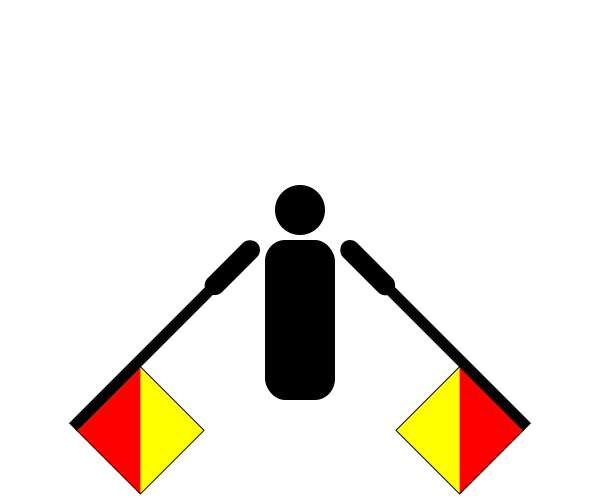


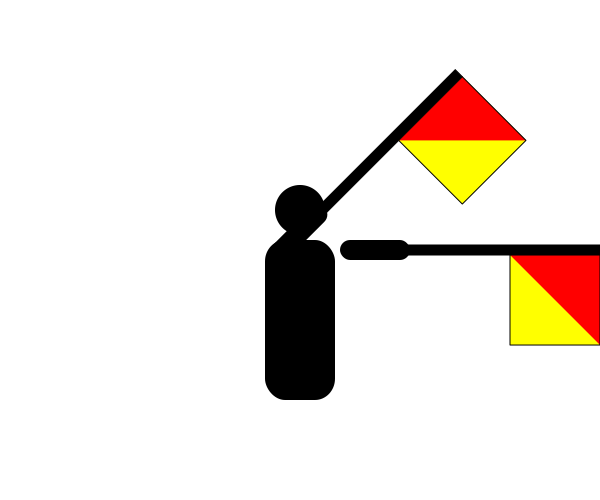
There are approximately 291 people named Cranshaw in the UK. That makes it one of Britain's least common surnames. Only around four in a million people in Britain are named Cranshaw.
Surname type: Location or geographical feature
Origin: English
Region of origin: British Isles
Country of origin: England
Religion of origin: Christian
Language of origin: English
