CRACE
Crace is a surname of English provenance. The original form is recorded in the Domesday Book of 1086 as Crassus and is believed to derive from the Old English word cræc, meaning a crow or a raven. The name was typically assigned to persons who lived near a place where crows or ravens were common, or for whom the birds had symbolic significance. It may also have been used as a nickname for an individual with a dark complexion or dark hair, following the habit of identifying people by physical traits.
The surname also appears in early English records as a variant of the word creas, a pre‑7th century Old English term that evolved into Middle English crease and meant fine or elegant. In that context, Crace was used as a nickname for someone who dressed in finely made clothes. A further explanation, drawn from 12th and 13th‑century documents, proposes a derivation from Old French crass, meaning big or fat, again suggesting a nickname origin. The different historical forms are reflected in spellings such as Crass, Crase, Craise, Crease, Crees and Creese.
Records of the name appear consistently from medieval times onward. In 1130 a person named Hervey le Cras is recorded in Staffordshire in Sir Christopher Hatton’s Book of Seals; in 1203 the Curia Rolls of Leicestershire mention Rogerus Crassus; and in 1277 the Book of Ely lists Robert Krase in Suffolk. Later entries include the marriage of Alles and Peter Crasse in Camborne, Cornwall, on 13 October 1546, and the christening of Redigonn, daughter of Phillip and Margaret Craze, at Luxulyan, Cornwall, on 7 December 1628. These documents confirm that the surname was used in a variety of regional contexts across England from the 12th to the 16th century.
In modern times the surname remains uncommon, although it is more frequently observed in English‑speaking nations. The United Kingdom has a modest concentration of bearers, especially in Northumberland and London, while the United States and Australia show a comparatively stronger presence. Two notable individuals with the surname are the British author Jim Crace, whose literary works have received critical acclaim, and the Australian politician James Crace, after whom the suburb of Crace in Canberra is named. Despite these prominent representatives, the name is still relatively rare on a global scale.
The surname Crace is also closely linked to several other spellings, some of which are found in medieval documents and others that appear in modern genealogical records. The variants include Crass, Crase, Crase, Craze, Craise, Crease, Creese, Crees and Creas. Each of these forms has been documented in different contexts, providing evidence of the surname’s historical breadth and the diversity of its linguistic evolution.
Typical given names associated with the Crace surname
Male
- Andrew
- Patrick
- Paul
Female
- Caroline
Similar and related surnames
Related and similar names are generated algorithmically based on the spelling, and may not necessarily share an etymology.
How to communicate the surname Crace in...
Braille
⠉⠗⠁⠉⠑
Morse
-.-..-..--.-..
Semaphore

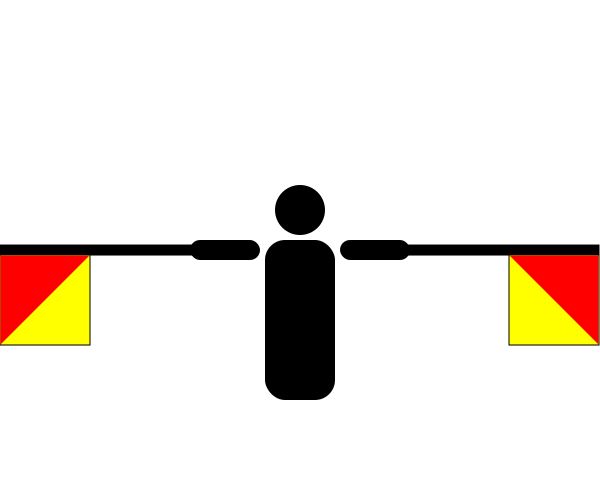


There are approximately 121 people named Crace in the UK. That makes it one of Britain's least common surnames. Only around two in a million people in Britain are named Crace.

Famous people named Crace
- Jim Crace - Novelist, short story writer and playwright
- Lauren Crace - Actress
Names and descriptions courtesy of Wikipedia, and may contain errors. This is not intended to be an exhaustive list of every famous person with this name.