COURSE
Course is a surname of French provenance that entered the British Isles during the medieval era. The name is derived from the Old French term cours, meaning “race” or “running course,” and it originally denoted either a person linked to horse racing, a rapid runner, or an inhabitant of a locale adjacent to a race‑course.
In England, early documentation of the surname appears in the late sixteenth and early seventeenth centuries. The first known spelling was that of Samuell Corse, who was christened on 6 November 1562 at St. Peter's, Thornhill, London, during the reign of Queen Elizabeth I. Subsequent records include Robert Course, a witness at St. Lawrence Jewry on 29 March 1638, and David Corss, christened at St. Sepulchre's, London, on 9 November 1750. A landmark entry is Jacop Corselles, recorded at the French Huguenot Church, Threadneedle Street, on 2 March 1623, indicating the arrival of Huguenot refugees who carried the name to English soil.
Beyond England, the surname also arose in France and the Netherlands as a habitational name for those residing at an enclosure in a wood, originating from the Latin cohors and the medieval French courte. In both French and Dutch contexts, the name bears aristocratic associations, exemplified by figures such as the Count Cours de Pauilhac and the Count Cours Van den Hemert, with at least four distinct coats of arms granted to bearers of the name.
The distribution of Course has historically been concentrated in the United Kingdom, particularly within Buckinghamshire in the southeast of England, where the name first gained prominence in the Middle Ages. Over the centuries, migration patterns saw the surname spread across the United Kingdom and subsequently reach the United States, Canada, and Australia with English settlers. Today it remains most common in English‑speaking countries, although it is relatively infrequent compared to more ubiquitous surnames.
Variant spellings of the surname include Coursey, Cours, Courseau, Courseaux, and Courson. The name may also appear within longer surnames such as Courser, Courseault, or Coursen. Such variations arose from phonetic spelling changes as literacy increased and records were kept by clerks who rendered names as they were pronounced.
In summary, the surname Course illustrates a blend of topographic, occupational, and locational origins, rooted in French language and culture, and firmly established within the British Isles through both indigenous development and the influence of Huguenot immigration. Its persistence across centuries and continents attests to the enduring nature of surnames that reflect personal attributes or places of origin.
Typical given names associated with the Course surname
Male
- Alan
- Andrew
- Anthony
- Charles
- David
- James
- John
- Jonathan
- Kevin
- Matthew
- Neil
- Philip
- Stephen
Female
- Angela
- Anja
- Dawn
- Gillian
- Helen
- Jane
- Jean
- Lisa
- Margaret
- Mary
- Nicola
- Rachel
- Sharon
- Susan
Similar and related surnames
- Carse
- Caress
- Coors
- Carsey
- Coarse
- Causse
- Carss
- Cours
- Carce
- Cores
- Cors
- Corsa
- Corse
- Corsey
- Corsh
- Corsi
- Corsie
- Corso
- Corss
- Corus
- Coure
- Couris
- Courser
- Coursey
- Coursh
- Courshee
- Coursy
- Curse
- Cursey
- Cursi
- Cursue
- Korse
- Kurse
- Corsei
- Corser
- Cour
- Coursens
- Cures
- Curzey
- Karse
- Kearse
- Kerse
- Kierse
- Kirse
- Causey
- Crosse
- Cruise
- Cruz
- Gorse
- Grass
- Keers
- Kraus
- Kruse
Related and similar names are generated algorithmically based on the spelling, and may not necessarily share an etymology.
How to communicate the surname Course in...
Braille
⠉⠕⠥⠗⠎⠑
Morse
-.-.---..-.-.....
Semaphore

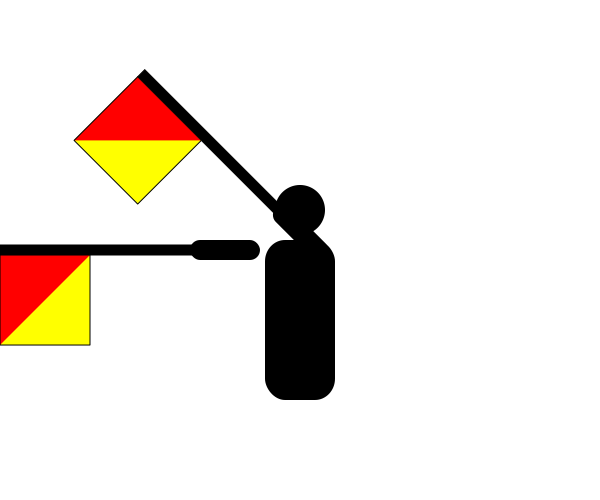

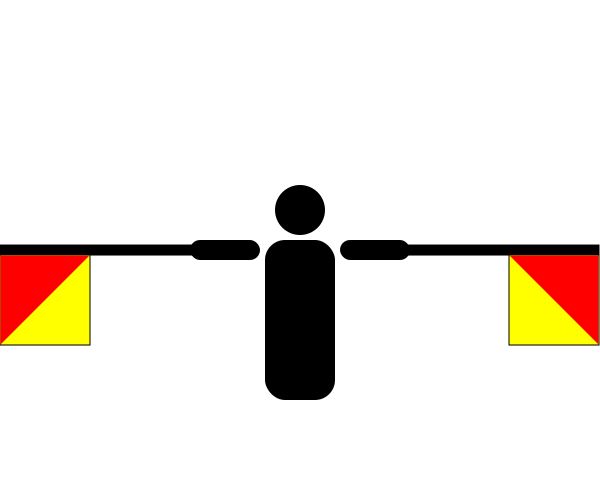


There are approximately 468 people named Course in the UK. That makes it one of Britain's least common surnames. Only around seven in a million people in Britain are named Course.
Origin: English
Region of origin: British Isles
Country of origin: England
Religion of origin: Christian
Language of origin: English