COSTE
Coste is a surname of French origin. It is derived from the Old French word coste, meaning “rib” or “side”. In the context of toponymic surnames, it came to signify a person who lived on a slope, hillside or coastal area.
As a topographic name, the surname reflected the natural surroundings of its bearer. Those who dwelt close to a coast or a ridge on a hillside were often identified as Coste. In some cases the name was used as a nickname for an individual whose nose or chin protruded in a manner reminiscent of a hill or slope.
The spelling of the name varies across Europe. In French it appears as Coste, Cote, Lacoste, Delacoste and Delcote, while in Provencal it is rendered Costa or Costes. Spanish and Portuguese forms include Acosta, Costa and Cuesta; the Catalan versions are Costa and Costas; Italian variants comprise Costa, Costi and Da Costa. Diminutives in French have been recorded as Costel, Costeau, Cousteau, Cotteaux, Costiou, Coustet, Couston, Coustille, Costy and, in Spain, Costilla. In England the forms Cost, Coste and Costa are usually not derived from the Latin costa but represent a shortened nickname of the Greek personal name Constantine, introduced by Crusaders in the twelfth century.
Recorded instances of the surname in different countries provide a glimpse of its dispersion. The earliest example found in England records a marriage between Thomas Coste and Elizabeth Showner at All Hallows, London, in 1547. In Spain, Sebastia Fortia Costa married Eluaria Matona at Bagur, San Pedro, Gerona, on 10 March 1613, while Pierre de la Coste married Maria Dupuys in La Rochelle, France, on 13 April 1614. A later instance notes the christening of Mary Catherine Costa in San Francisco, California, USA, on 12 July 1875. The first dated appearance of the family name is that of Miguel Martinez Costa, christened at Miranda de Arga, Navarra, Spain, on 21 March 1612, during the reign of King Philip the Eleventh of Spain (1598–1621).
The heraldic device associated with the surname consists of a blue field, a gold chevron pierced by a gold mans rib, beneath two red roses. On a gold chief a black imperial eagle displayed. The blazon is often reproduced in families that claim descent from the original bearers of the name.
In the French south, particularly in the regions of Languedoc and Provence, Coste remains a common surname. Migration and colonisation have carried it abroad, establishing significant concentrations within Canada, especially Quebec, and extending into the United States where the name is most prevalent in New York. In Spanish‑speaking countries, the form Coste is also occasionally found, often as a variant of the Spanish surname Costa.
Variations of the surname include Costes, De Coste, DeCoste, Costeau, Costé, Costey, Costie, Couste, and, with prefixes or suffixes, LaCoste, De la Coste or Coste‑Loyrette. In English‑speaking contexts the name may be translated to Coast or Cost. Comparably, surnames such as the Dutch Koster, German Köster or Koster – deriving from the medieval church sexton profession – and the English Custer share phonetic similarity but distinct etymologies.
While the history of a particular family line can often be clarified through genetic testing or thorough examination of parish records, the enduring presence of the surname Coste across multiple linguistic and national contexts reflects its ancient toponymic roots and the migration patterns of those who once lived by a coast or hillside.
Similar and related surnames
Related and similar names are generated algorithmically based on the spelling, and may not necessarily share an etymology.
How to communicate the surname Coste in...
Braille
⠉⠕⠎⠞⠑
Morse
-.-.---...-.
Semaphore

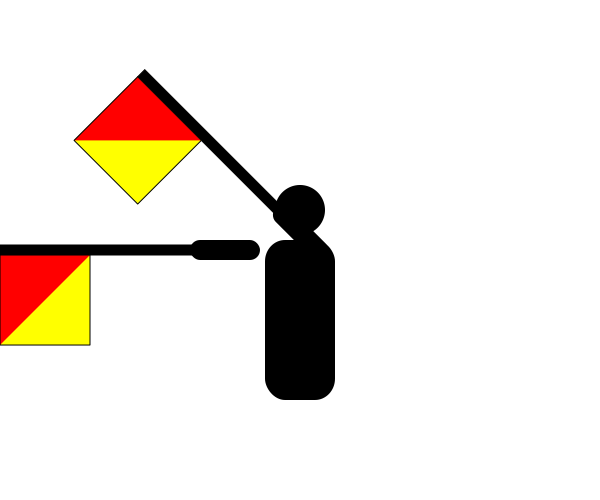

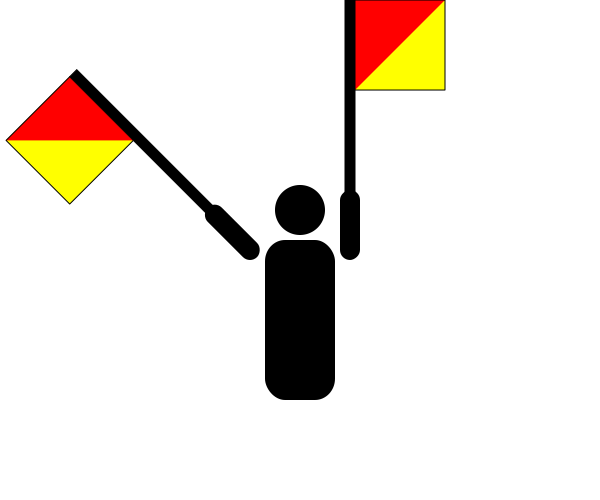

There are approximately 71 people named Coste in the UK. That makes it one of Britain's least common surnames. Only around one in a million people in Britain are named Coste.
