COPLAND
Copland is a surname whose origins lie in the north of the British Isles, where it evolved from both Old Norse and Old English influences. The name appears to have emerged as a locational identifier as well as an occupational label, reflecting the diverse contexts in which families bearing the name were situated.
The name first appears with a Scottish heritage. The earliest recorded spelling, William de Copland, dates to c. 1160 in the Early Medieval Records of Scotland, during the reign of King Malcolm I (1153–1165). In that era, the surname may have referred to a local landholder or a resident of a place called Copeland in Cumberland or Coupland in Northumberland. These places were known by the Old Norse term kaupland, meaning “bought land” – a noteworthy notion in a Middle‑Age society where land transfer by sale was uncommon.
In Scotland the Gaelic language and Christian faith shaped the cultural milieu in which the surname developed. The surname is categorised as a Celtic origin in genealogical classifications, and it is often linked to the region of the British Isles, specifically Scotland. The name was frequently associated with the local character of the land, a feature recorded as a geographical element in historical documents.
From both linguistic and occupational standpoints, the word Kolbrandr – a personal name of Old Norse origin meaning “coal‑burning” or “charcoal burner” – has been identified as the root of the surname in Scottish tradition. Consequently, many early bearers of the name were likely engaged in the production or trade of charcoal, a craft of local significance. It is also plausible that the name denoted individuals residing near a site where charcoal was produced, thereby giving rise to the locational form of the surname.
Notable early examples evidence the use of the surname throughout the early 13th century. Individuals such as Thomas de Coupland and Rodbert de Copland were recorded in Greenlaw, Roxburghshire, around 1200; Samson de Copland appears in Northumberland in 1204; and John de Coupland, distinguished at the Battle of Neville's Cross in 1346, underscored the social standing and martial reputation of the family.
The Copland heraldry, preserved in Scottish genealogical records, is set on a red shield bearing three gold stars. The crest consists of a knight in armour, gripping a sword in the right hand, and holding an imperial crown in the left. This coat of arms encapsulates the noble aspirations of the family and its association with landholding and knighthood.
In England the surname arises from Old English elements. The root cop conveys a “top of a hill”, a description of the topography shared by several localities named Coppeland or Copeland. The surname is therefore also a patronymic, reflecting descent from an ancestor named Cop or a diminutive thereof, an early Anglo‑Saxon custom intended to honour a respected elder. Accordingly, the name has been linked to the distinctions of industriousness and loyalty commonly associated with English families of the period.
Contemporary census data illustrate the continued geographic dispersion of the surname from its points of origin. In Australia the 2016 census recorded 447 Copland households, the majority residing in New South Wales and Victoria, which together accounted for 41 % of the population. In Canada the 2016 census counted 255 households; Ontario and British Columbia led the distribution, comprising 28 % and 25 % of the total respectively. New Zealand’s 2018 estimate placed the surname in 545 households, chiefly on the North Island. In the United States, the 2018 census reported 29,286 households named Copland, with Virginia and Texas representing 24 % of the total. These figures attest to the surname’s sustained presence across the English‑speaking world.
Variants of the surname—such as Coplin, Copling, Cople, Cope, Copeland, Copelan, Coplen, Copin, and Copping—have arisen through regional pronunciation differences and orthographic preferences. In Scotland the spelling Coupland and its variants appear, whereas in England the form Copland predominates. Despite the orthographic diversity, all contemporary bearers share a common ancestral origin under the umbrella of the Copland name.
In sum, the Copland surname exemplifies the interplay of occupational, locational, and linguistic factors that have shaped British naming traditions. Its roots in Old Norse and Old English, its documented use by landowners and craftsmen, and its modern-day distribution underscore the enduring legacy of a family name that has travelled through centuries of social and geographic change.
Typical given names associated with the Copland surname
Male
- Alan
- Alexander
- Andrew
- Brian
- David
- George
- James
- John
- Michael
- Paul
- Robert
- William
Female
- Catherine
- Elizabeth
- Fiona
- Jane
- Janet
- Jean
- Karen
- Linda
- Lorna
- Margaret
- Mary
- Sarah
- Susan
Similar and related surnames
Related and similar names are generated algorithmically based on the spelling, and may not necessarily share an etymology.
How to communicate the surname Copland in...
Braille
⠉⠕⠏⠇⠁⠝⠙
Morse
-.-.---.--..-...--.-..
Semaphore

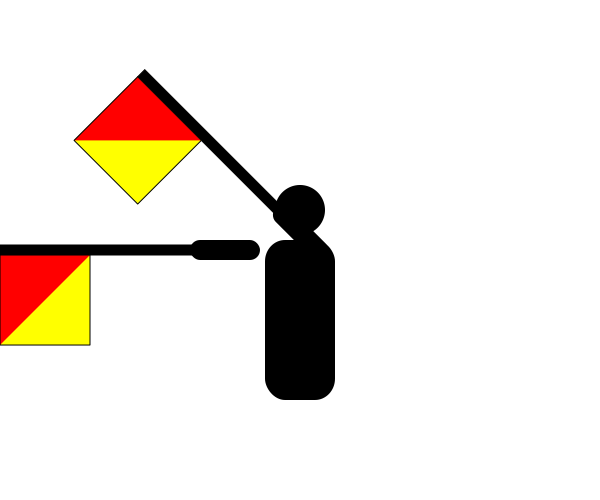


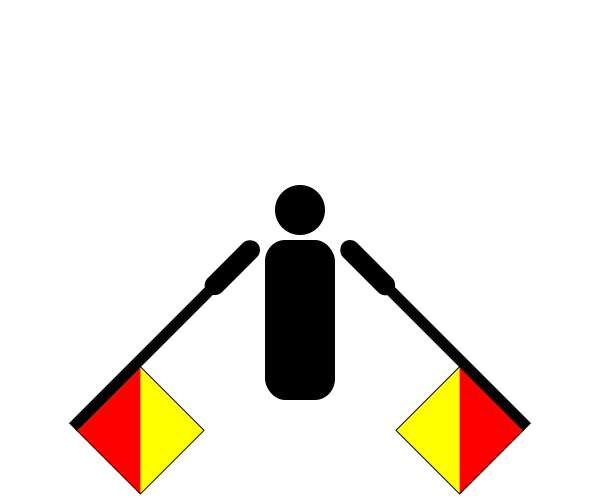

There are approximately 2,586 people named Copland in the UK. That makes it roughly the 3,424th most common surname in Britain. Around 40 in a million people in Britain are named Copland.
Surname type: Location or geographical feature
Origin: Celtic
Region of origin: British Isles
Country of origin: Scotland
Religion of origin: Christian
Language of origin: Gaelic
