COMINS
Comins is a patronymic surname that can be traced back to several linguistic and geographical origins across the British Isles and the wider Celtic world. The name itself reflects the historical practice of identifying individuals by the given name of an ancestor or by a descriptive characteristic that became hereditary over time.
The earliest recorded derivation of Comins is from the Welsh personal name Cynfyn, meaning chief or leader. In this context, the surname originally served to denote the descendants of a person named Cynfyn. The transition from Cynfyn to the modern spelling Comins illustrates the natural linguistic evolution that occurs over centuries, yet the essential patronymic function remains undiminished.
A separate Breton origin is also documented, particularly for variants such as Commins, Commings and Cuming. These forms derive from a Breton personal name formed from the element cam, meaning bent or crooked, combined with the diminutive suffix in. The name was widespread in the 12th and 13th centuries, especially in Norfolk, Lincolnshire and Yorkshire, as a consequence of Breton immigration following the Norman conquest. Early documentary evidence includes the appearance of Hugh Coumini in 1157 in France, and John Comin in the late 1170s within Lincolnshire. The record of William Comyn in 1133 as a churchman and chancellor to King David I of Scotland further anchors the surname in the early medieval period.
In the Scottish and Irish contexts, families bearing the Comins surname are believed ultimately to descend from a companion of William the Conqueror who arrived from the vicinity of Rouen, an area noted for strong Breton influence. Furthermore, a locational interpretation suggests a link to Comines, a town near Lille, which may have contributed to the surname’s diffusion in the British Isles and beyond.
Additional Celtic derivations add depth to the surname’s heritage. In Irish Gaelic, the ancient name Ó Comáin—meaning descendant of Comán, with Comán interpreted as little hollow—was Anglicised to Coman and subsequently to Comins through phonetic spelling adjustments. In Scottish Gaelic, the name MacComaidh translates as son of Comadh, where com may refer to kind. These morphemic elements highlight how the same surname could arise from distinct linguistic lineages yet converge phonetically under English influence.
Variations in spelling—including Commins, Commings, Cumming, Cummins, Coombs and Combs—are attributable to regional accent differences, varying literacy rates, and the evolution of orthographic conventions. In older manuscripts, the shapes of the letters u, n and m were frequently similar, which could lead to misinterpretation of names in archival records. Consequently, genealogical research often requires an inclusive approach that accepts all plausible variants of the surname when tracing family histories.
Contemporary bearers of the Comins surname, and its variants, are found predominantly in Wales, as well as in other parts of the United Kingdom, the Republic of Ireland, and Scotland where Celtic roots are strongest. The surname has also spread throughout English‑speaking countries such as the United States, Canada and Australia, reflecting historical patterns of migration from the British Isles during the modern era.
In sum, the surname Comins encapsulates a complex tapestry of Welsh, Breton, Irish and Scottish linguistic influences, and traces its lineage back to patronymic, locational and descriptive origins that have persisted through successive centuries of cultural and social change.
Typical given names associated with the Comins surname
Male
- Andrew
- Charles
- Chris
- Christopher
- David
- John
- Michael
- Peter
- Robert
- Simon
- Stephen
- Thomas
Female
- Amy
- Angela
- Beatrice
- Chantelle
- Christine
- Claire
- Elizabeth
- Julie
- Mandy
- Melissa
- Pauline
- Rosamund
- Sandra
- Victoria
- Yvonne
Similar and related surnames
Related and similar names are generated algorithmically based on the spelling, and may not necessarily share an etymology.
How to communicate the surname Comins in...
Braille
⠉⠕⠍⠊⠝⠎
Morse
-.-.-----..-....
Semaphore

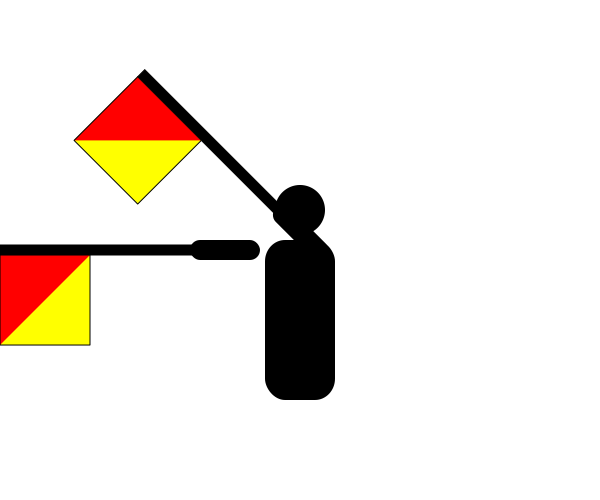
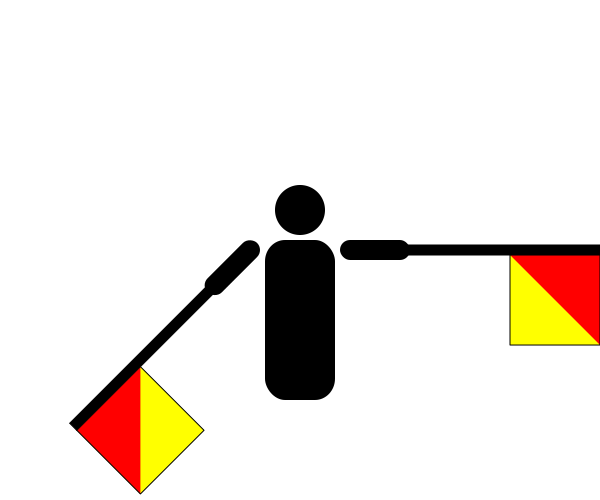
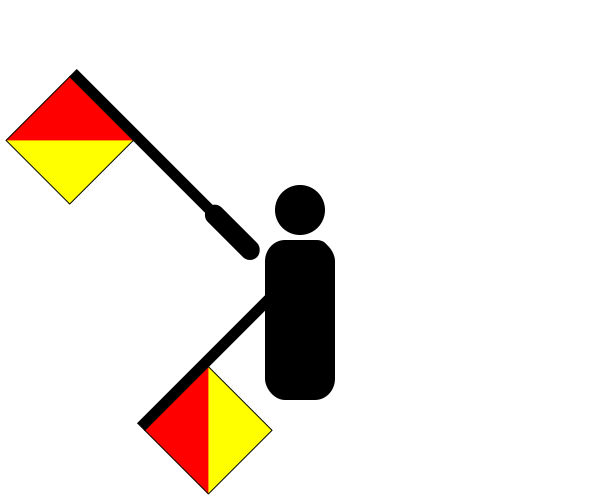
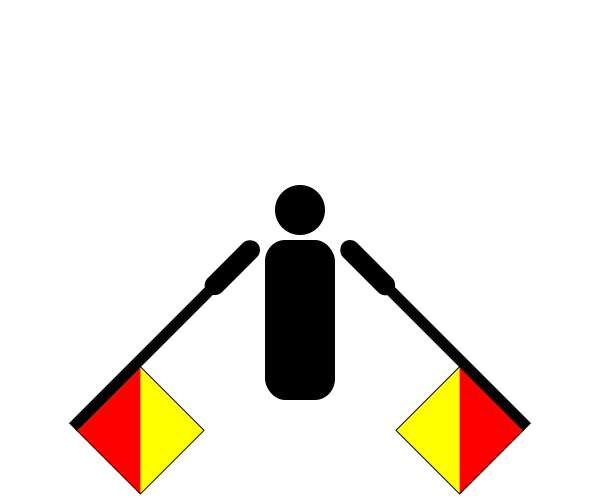

There are approximately 252 people named Comins in the UK. That makes it one of Britain's least common surnames. Only around four in a million people in Britain are named Comins.
Origin: English
Region of origin: British Isles
Country of origin: England
Religion of origin: Christian
Language of origin: English
