COLLAR
Origin and Etymology
The Collar surname is predominantly of English origin, initially emerging in the British Isles during the early medieval period. The name is derived from the Middle English word col(l)er, which denotes a collar or neckband. It is reasonably inferred that the surname originated as an occupational label, applied to those who manufactured or traded in collars, or as a nickname for an individual noted for wearing a distinctive collar.
Alternative etymological accounts point back to the Old English pre‑7th‑century root col, meaning charcoal. In this context, the suffix (i)er is a marker for a person who works with a particular material, producing the occupational form denoted in early records as John le Collier or John le Collyer. Early written references to the surname appear in the Somersetshire Pipe Rolls of 1172, where Bernard le Coliere is recorded, followed by Henry le Collier in the Buckinghamshire Hundred Rolls of 1275 and John le Collier in the London Patent Rolls of 1280. Such early attestations reflect the surname’s antiquity and its link to iron or coal-related occupation.
French influence is also evident; the Old French term colier meaning necklace or collar offered another source for occupational usage, largely in reference to a maker or dealer of collars or a jeweller. Consequently, the surname has been documented under many spellings including Coller, Collier, Colyer, Collyer, Colliar, Colliard, and Colleer, all recognised variations traced through medieval church registers and administrative documents.
Historical Record and Distribution
Beyond the domestic palimpsest, the Collar surname can be found in the Danelaw registers of Lincolnshire, where a Ranulf Colier is noted in 1150 during the reign of King Stephen (1135-1154). In the greater London area, parish records illustrate vital events such as the marriage of John Collyer to Awdrey Parteridg at St. Dunstans in East, Stepney on 19 April 1561 and the union of Thomas Coller with Elizabeth Prowes at St. Bartholomew the Less on 26 May 1583. The 16th‑century distribution data illuminate the surname’s settlement within the London basin, while later censuses reveal a broader presence across England.
While the name is chiefly associated with England, variant spellings such as Collard and Coller appear in Scottish registers. A number of scholars propound a Scottish origin, citing an ancient Dalriadan lineage that might have derived the name from the personal name Collegan or the Gaelic cuilean, meaning whelp or young cub. Nonetheless, these claims remain secondary to the more robust evidence favouring an English provenance. Contemporary demographic records indicate that the surname, including its variants, remains common in the United Kingdom, in parts of Australia, and in select American states such as Texas, California, and Michigan.
Heraldry and Symbolism
Hereditarily, a collar family has been granted a coat of arms described as a red shield with a silver chevron, upon which stand three red roses stalked and leaved green, situated between three silver wolves’ heads erased. This heraldic description accords with the tradition that names signifying occupation often adopt emblematic symbols that reflect the nature of the trade. The use of a chevron and roses here could signify aspiration or belonging to a noble or significant family lineage, while the wolves’ heads might indicate vigilance or martial valor.
Conclusion
In sum, the Collar surname demonstrates a complex linguistic and occupational heritage, stretching from the earliest English coal and iron works to late medieval French trade nomenclature. Its orthographic diversity and documented presence in ecclesiastical, legal, and civic rolls reflect a long-standing familial transmission across several centuries. While secondary theories propose a Scottish origin, the preponderant academic evidence places the name firmly within the historical fabric of England and its medieval economic practices. The surname remains an active and recognised family name within the United Kingdom and beyond, evidencing the enduring nature of occupational surnames in social history.
Typical given names associated with the Collar surname
Male
- Adam
- Andrew
- David
- Mark
- Michael
- Neil
- Nigel
- Peter
- Raymond
- Richard
- Robert
- Stephen
- Trevor
- William
Female
- Catherine
- Christine
- Elizabeth
- Jennifer
- Julia
- Kathryn
- Margaret
- Marion
- Mary
- Rachel
- Sarah
- Sheila
- Tracey
- Victoria
Similar and related surnames
- Callear
- Caller
- Cleare
- Cleere
- Coaler
- Coghlaw
- Cohler
- Cola
- Colahar
- Colairo
- Colar
- Colard
- Colau
- Colaw
- Colear
- Coleiro
- Coler
- Colery
- Colier
- Colierr
- Colla
- Collad
- Collaire
- Collam
- Collan
- Collaran
- Collard
- Collarest
- Collars
- Collart
- Collary
- Collas
- Collaway
- Collay
- Collear
- Colleary
- Colleer
- Colleir
- Coller
- Colleran
- Collern
- Collers
- Collert
- Collery
- Colliar
- Collier
- Colliers
- Colliery
- Collir
- Colllier
- Collor
- Collord
- Collour
- Collura
- Collyar
- Collyear
- Collyer
- Colyar
- Colyer
- Cowlard
- Cowler
- Galer
- Gallier
- Gowler
- Guyler
- Kalra
- Kaylor
- Keller
- Kohlar
- Kohler
- Kolar
- Kolare
- Kolari
- Kolaru
- Kolarz
- Koler
- Kollar
- Kollara
- Kollaros
- Koller
- Kollier
- Kolluri
- Kolluru
- Kolur
- Kowler
Related and similar names are generated algorithmically based on the spelling, and may not necessarily share an etymology.
How to communicate the surname Collar in...
Braille
⠉⠕⠇⠇⠁⠗
Morse
-.-.---.-...-...-.-.
Semaphore

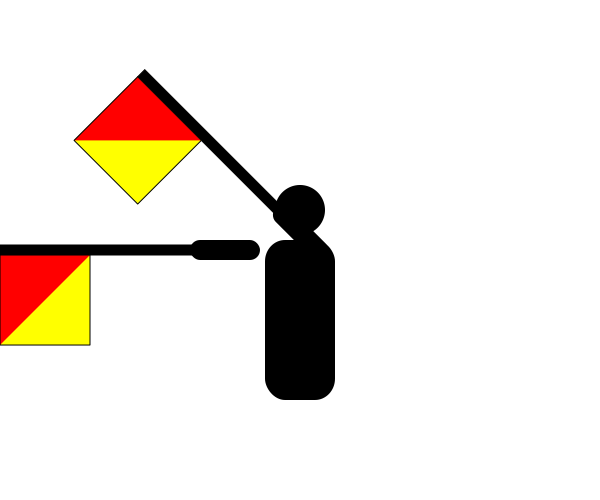


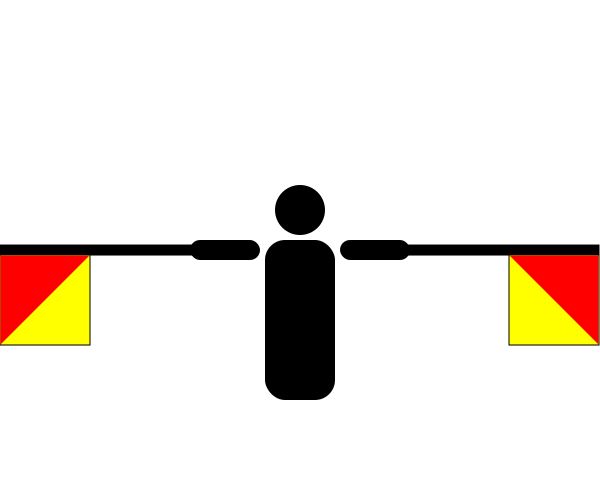
There are approximately 385 people named Collar in the UK. That makes it one of Britain's least common surnames. Only around six in a million people in Britain are named Collar.
Origin: English
Region of origin: British Isles
Country of origin: England
Religion of origin: Christian
Language of origin: English

Famous people named Collar
- Will Collar - Football player
Names and descriptions courtesy of Wikipedia, and may contain errors. This is not intended to be an exhaustive list of every famous person with this name.