CLEVER
CleVER is a surname of English provenance that has been borne by individuals in different contexts across several centuries. Its earliest attestations are found in the Middle Ages, and it has subsequently spread beyond the British Isles to continental Europe and the New World.
The primary derivation of the name is from the Middle English word clever, meaning skilful, shrewd or keen. In the medieval period this term was applied as an occupational surname to those who were regarded as exceptionally skilful in a trade or profession. Those bearing the surname were often noted for their problem‑solving abilities or quick wit, attributes that were highly valued in a society in which craft and trade were essential to economic life.
An alternative, topographic origin is documented for the surname. The same Middle English word also conveyed the meaning of a cleft or ravine. Consequently, the name was sometimes applied to a person who lived near such a geographic feature, or to a landowner who had established himself in a new area characterised by a noticeable cleft. In this sense the surname could denote a person connected with a particular physical landmark rather than with an occupation.
A further source of the surname is of German origin. The name has appeared in historical records as Klauer, Kleuer or simply Clever, stemming from the place called Kleve in the Rhine‑Limburg region. The town’s name itself means “the place on the marshlands”. Thus the surname in German contexts described someone who resided in or were from Kleve. Several early individuals, such as Michael Klewer, who was christened in Westmoreland, Pennsylvania in 1797, illustrate the name’s migration to America, where it has often been anglicised as Clower.
Numerous variants of the surname are attested. These include Claver, Cleever, Cleaford, Cleavar, Clere, Clewar, Cleworth and Clievor. In Scotland, Clever has been anglicised from the Gaelic MacLabhruinn, itself derived from a word meaning “talkative”. Other Germanic variants such as Klug, Kluge and Kluger are cognates that share the meaning of wise or astute, indicating the semantic breadth of the root across languages.
In contemporary times the surname is most common in the United Kingdom, especially England; it also retains a notable presence in Germany, particularly in Bavaria, Thuringia, Saxony and Baden‑Wurttemberg. In the United States it is primarily found in the Eastern and Mid‑Atlantic states, though it does appear in the Midwest. The name can also be found in Australia, New Zealand, Canada and other former British colonies, reflecting the patterns of migration that have dispersed traditional English surnames worldwide.
A prominent modern bearer of the surname is the German actor Heinz Reincke, renowned for his performance in the 1937 film Der Herrscher. He exemplifies the surname’s continued relevance in contemporary cultural spheres.
Thus the surname Clever encapsulates a rich linguistic heritage that spans occupational, topographic and geographical origins. Its persistence across centuries and continents testifies to the enduring relevance of the attributes it denotes—skill, wit, and a keen understanding of one’s environment.
Typical given names associated with the Clever surname
Male
Female
Similar and related surnames
Related and similar names are generated algorithmically based on the spelling, and may not necessarily share an etymology.
How to communicate the surname Clever in...
Braille
⠉⠇⠑⠧⠑⠗
Morse
-.-..-......-..-.
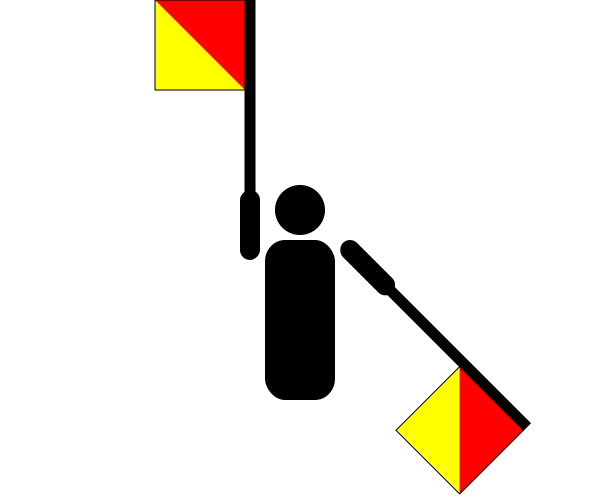
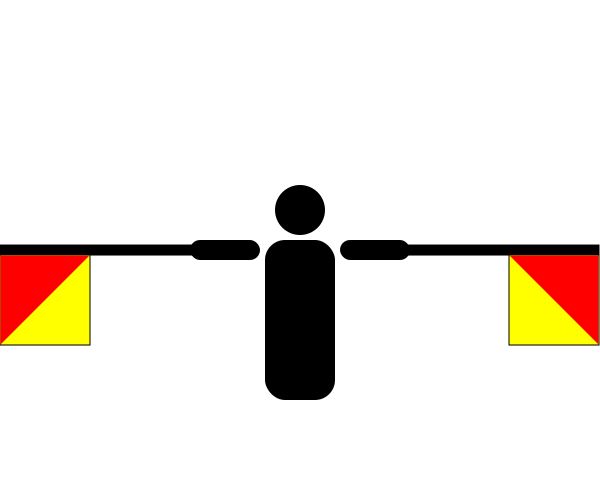
Semaphore


There are approximately 18 people named Clever in the UK. That makes it one of Britain's least common surnames. Fewer than one in a million people in Britain are named Clever.
