CLERK
Clerk is a surname that can be traced back to the islands of Britain, with its roots firmly established in both England and Scotland. The name is occupational in origin, deriving from the Middle English word clerk or clerc, which itself comes from the Late Latin clericus. Historically, the term denoted a priest or a scholar, and by the medieval period it had broadened to describe any literate individual, particularly those employed in scribe or secretarial capacities within religious or legal contexts.
In early English usage the word clerk was restricted to members of the clergy, the small group in the Middle Ages who possessed the knowledge and skill to read and write. The clerics of minor order could marry, and as a result families bearing the name emerged. The surname then passed from one generation to the next, often within families that served the church or the court, cementing its status as a hereditary surname in certain locales.
The surname is not limited to English spelling. Variants such as Clark, Clarke, Clerc, de Clerk, de Cler(c)q, and De Klerk have appeared in records. These alternative forms arose through linguistic evolution, migration, and the anglicisation of foreign spellings. The Dutch and Flemish form de Clerck was brought to England by Huguenot refugees fleeing persecution in their homeland during the 16th century.
Evidence of this migration can be found in marital records from London in the late 1590s. On April 17th 1597, Iscar de Clerck and Lucynken Van Mierbeke were married, and on June 24th 1600, Pieter de Clerck and Lynken Engebusch were married by civil licence in the same city. The earliest documented spelling associated with the family appears in July 1591, when Cahtelyne de Clerck, marrying Pieter T’Loers, appears in a London parish register. These documents support the view that the surname entered the English lexicon during the reign of Queen Elizabeth I.
Over the centuries, the occupational aspects of the name have become less literal. While originally identifying a cleric or scribe, modern bearers of the surname are found across a wide spectrum of professions. The common thread is often a connection to detailed record‑keeping or administrative duties, echoing the original function of the medieval clerk.
Today, the name Clerk is widely distributed within the English‑speaking world. It remains common in Britain, particularly in cities with strong historical ties to the royal court or the church, such as London, Edinburgh, York, Dublin, and Cork. In the United States it ranks highly in several states – for example, it is the fourth most common surname in Rhode Island, the fifth in South Carolina, and the ninth in Massachusetts – reflecting migration patterns from the British Isles during the colonial era and beyond.
The surname also appears in other former British colonies, including Canada, Australia, and New Zealand. In Quebec, the French spelling Clerc is often encountered, reflecting the bilingual heritage of the province. In Scotland, the variant Clark is especially prevalent, and the name can sometimes be found in records as a Gaelic anglicisation such as mac an Charcaigh, which translates literally to “son of the Clerk.”
There is a wide range of spelling variations that have arisen over time, including Clerke, Clerkson, Clerkshay, Clery, Clerkman, and Clerkosh. These differences are largely orthographic, reflecting regional accents and the evolution of English spelling. Despite the diversity of forms, the root meaning remains unchanged: a person involved in writing, record‑keeping, or clerical work.
Historical society studies indicate that the name is still most commonly associated with professional domestic and public service roles that demand precision and reliability. The persistence of the name in contemporary administrative fields – such as secretaries, accountants, and clerical technicians – underscores the enduring legacy of its medieval progenitor.
In conclusion, the surname Clerk exemplifies how an occupational designation can evolve into a hereditary family name, spreading from the clerical halls of medieval Britain to modern global communities, while retaining a connection to the meticulous art of record‑keeping that defined its origin.
Typical given names associated with the Clerk surname
Male
- David
- Douglas
- George
- Jeffrey
- John
- Martin
- Nicholas
- Paul
- Peter
- Robert
Female
- Agatha
- Caroline
- Charlotte
- Edith
- Elizabeth
- Faye
- Fiona
- Gillian
- Honor
- Janice
- Julia
- Nicola
- Susan
Similar and related surnames
Related and similar names are generated algorithmically based on the spelling, and may not necessarily share an etymology.
How to communicate the surname Clerk in...
Braille
⠉⠇⠑⠗⠅
Morse
-.-..-....-.-.-
Semaphore


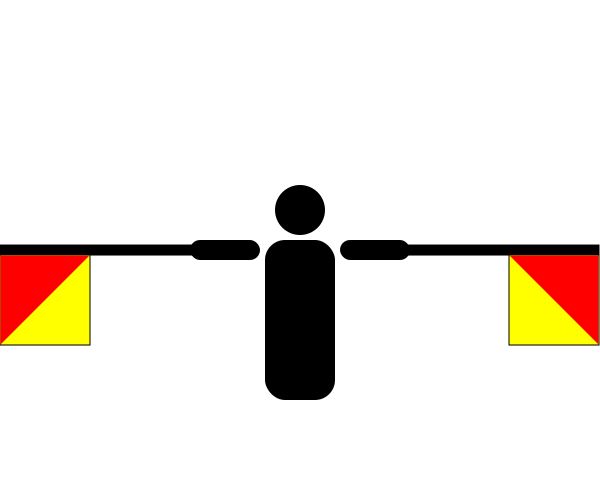
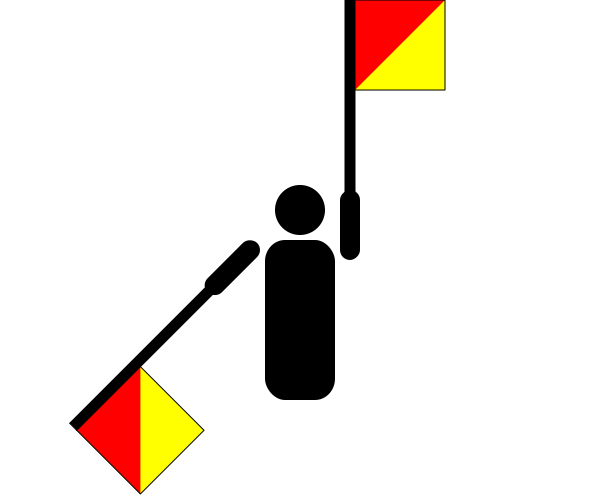
There are approximately 160 people named Clerk in the UK. That makes it one of Britain's least common surnames. Only around two in a million people in Britain are named Clerk.
Surname type: Occupational name
Origin: English
Region of origin: British Isles
Country of origin: England
Religion of origin: Christian
Language of origin: English

Famous people named Clerk
- Dugald Clerk - Engineer (1854 to 1932)
- George Clerk - Diplomat (1874 to 1951)
Names and descriptions courtesy of Wikipedia, and may contain errors. This is not intended to be an exhaustive list of every famous person with this name.