CLELLAND
The surname Clelland is a Scottish name of Gaelic origin. It derives from the patronymic element Mac Gille Fhaolain, which means “son of the servant of St Fillan.” St Fillan was a 7th‑century Irish missionary celebrated for his healing work and is considered a saint within the Christian tradition of Scotland.
In its earliest form the name was a straightforward patronymic, identifying an individual as the descendant of a devotee of St Fillan. Over time, the Gaelic element was shortened and the pronunciation altered, producing the modern spelling Clelland. The transition from the original Gaelic form to its present Anglicised version was gradual and is recorded from the late medieval period forward.
There is also a locational explanation for the surname. It is linked to the place now known as Cleland, a former township near Motherwell in Lanarkshire, Scotland. The place name itself comes from the Old English word claeg meaning “clay” and the word land, so the literal meaning of the place is “clay land.” In the Middle Ages, people often adopted the name of their former village as a surname when they migrated for economic reasons. The earliest documented instance of the name in this context is that of Alexander Kneland in 1275, recorded in the Scottish archives during the reign of King Alexander III. The seal of a later bearer, Andrew Cleland, a bailie of Edinburgh in 1612, bears the inscription S'andree Kneland.
The surname is also found in Ireland as an Anglicised form of Mac Giolla Fhaolain, again meaning “son of the servant of Faolán” – Faolán being a diminutive of “faol,” the word for “wolf.” The name entered Anglo‑Irish records in the latter half of the thirteenth century. Marriages recorded in the 17th and 18th centuries, such as that of Agnes Cleland to John Roger in Edinburgh in 1602 and the marriage of John Cleland to Susanna Smith in Saintfield in 1750, confirm the name’s usage outside Scotland. The family’s coat of arms, granted during the same period, features a blue shield and a silver hare saliant with a green hunting horn, crowned by a falcon standing upon a sinister hand glove. The motto associated with the crest is “Non sibi,” translated as “Not for himself.”
Although historically concentrated in Scotland – notably in Lanarkshire and the southern region of Galloway – the name Clelland is now dispersed across the United Kingdom and in former British colonies such as the United States, Australia, Canada and New Zealand. Over the centuries the spelling of the surname has varied, with forms such as Cleland, Cleiland, Cleveland and others being recorded. These variations reflect changes in pronunciation, the lack of standardised spelling in early records and the phonetic spellings employed by officials during immigration processes.
Typical given names associated with the Clelland surname
Male
- Andrew
- David
- George
- James
- John
- Neil
- Paul
- Robert
- Steven
- Thomas
- William
Female
- Catherine
- Elizabeth
- Emma
- Helen
- Jean
- Joyce
- Linda
- Margaret
- Mary
- Michelle
- Sarah
- Susan
Similar and related surnames
Related and similar names are generated algorithmically based on the spelling, and may not necessarily share an etymology.
How to communicate the surname Clelland in...
Braille
⠉⠇⠑⠇⠇⠁⠝⠙
Morse
-.-..-....-...-...--.-..
Semaphore


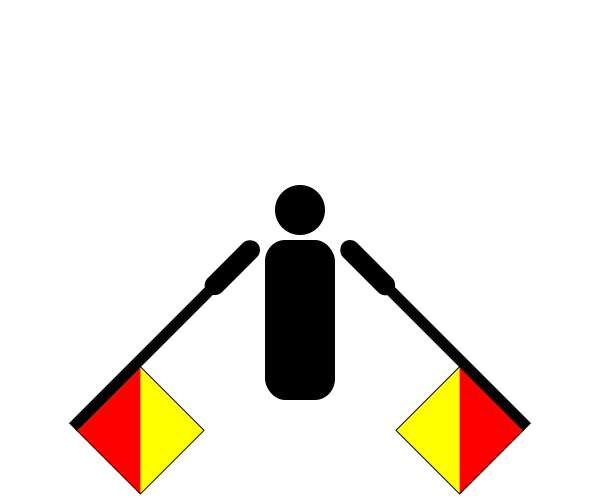

There are approximately 2,118 people named Clelland in the UK. That makes it roughly the 4,005th most common surname in Britain. Around 33 in a million people in Britain are named Clelland.
Surname type: From given name or forename
Origin: Celtic
Region of origin: British Isles
Country of origin: Scotland
Religion of origin: Christian
Language of origin: Gaelic

Famous people named Clelland
- Lana Clelland - Scottish football player
- David Clelland - Politician
- Shirley Clelland - Pentathlete
- Sarah Clelland - Football player
Names and descriptions courtesy of Wikipedia, and may contain errors. This is not intended to be an exhaustive list of every famous person with this name.