CHEEK
Cheek is a surname of English origin, traceable to the early medieval period of the British Isles. Its etymology derives from the Old English word ceace – pronounced approximately “cheac,” meaning “jaw” or “cheek.” In this context the name began as a descriptive nickname for an individual who possessed prominent or distinctive cheeks, a physical trait readily noticed within a small community. Over time, these affectionate, observational nicknames evolved into hereditary surnames, a common practice in the Middle Ages when surnames were being firmly established in England.
The earliest known documentary reference to the name is in the Feudal Documents of the Abbey of Bury St. Edmunds, dated around 1095. The individual recorded is Aeluric Chec, a spelling variant that evidences the fluid orthography of the period. By the late 11th century, the name had become fixed within a lineage that would later spread to various counties in southern England.
Records indicate that the Cheek family held a manor on the Isle of Wight during the reign of King Richard I (1189–1199). A notable occupant of this manor was Richard Cheke, who unequivocally links the name to the estate of Motteston. Church registries further document the matrimonial alliance of Richard Cheeke and Barbara Day on 10 September 1575, an event held at St. Margaret Pattens in London. These marriages bring the surname into preserved ecclesiastical records of the 16th century, a period when accurate parish accountancy became more widespread.
In the 17th century, the surname is captured in a parish register in Romford, Essex, where a christening for Charles, son of Thomas Cheek is recorded on 21 February 1629. These entries illustrate the name’s penetration into settled communities of Essex, Hampshire, and the Isle of Wight—a distribution pattern that mirrors the broader historical settlement movements following the Norman Conquest and the subsequent enclosure of common land in the Anglo‑Saxon plains.
The Cheek coat of arms offers further insight into the family’s heraldic identity. The escutcheon is silver (argent), bearing three cinquefoils, each partitioned per pale into green (vert) and red (gules). The arms were formally granted to a Cheek family, signalling a recognisable status within the local gentry. This heraldic grant provides a visual imposition of the surname’s prestige, an artifact of the era’s focus on lineage and social standing.
Geographically, the surname is most firmly established in the West Country, Essex, Hampshire and the Isle of Wight. Beyond these regions it is comparatively uncommon, though sporadic instances of the name surface in other parts of the British Isles. In modern times, similar patterns persist, with the surname remaining a relatively rare one within the United Kingdom yet still concentrated in its traditional heartlands.
Variants of the surname are well documented and include Cheeke, Cheaks, Cheake, and Cheekes. Phonetic differences across dialectal accents produced these spellings, reflecting the adaptive nature of surname orthography during a period of limited standardised spelling. Related surnames – especially those arising from the same semantic root – include Cheyne, Cheney, and Cheekin. While these names share a common etymological theme of cheek or jaw, they are genealogically distinct in most documented cases, with no definitive linkage between the families.
There is evidence that the surname also survived in Anglo‑Saxon England in the guise of an occupational or locative derivative, as suggested by one source’s claim that the Old English word acic, meaning “oak,” may have prompted the nickname in certain instances. While the evidence for this alternate derivation is weaker and originates from a later analysis, the proposition illustrates how surnames could acquire complex, multi‑layered origins.
Across the Atlantic, the Cheek surname arrived in North America during the 17th century. Colonists bearing the name settled predominantly in Virginia, a migration trend that has led to a higher concentration of the surname within the Southern United States when compared to other regions. Although this demographic detail reflects a diaspora rather than an English origin, it underscores the transference and resilience of the surname across centuries and continents.
In sum, the Cheek surname is a historically grounded English name, rooted in an Old English description of a physical characteristic. Its documented presence from the 11th century to contemporary records, alongside its heraldic recognition and geographical distribution, demonstrates the enduring nature of surnames that originated as simple nicknames during the formative years of English society.
Typical given names associated with the Cheek surname
Male
- Alan
- Andrew
- Christopher
- David
- James
- John
- Martin
- Michael
- Peter
- Robert
- Simon
- Thomas
Female
- Amanda
- Caroline
- Claire
- Emma
- Jacqueline
- Joan
- Julie
- Laura
- Marie
- Mary
- Maureen
- Sarah
- Susan
Similar and related surnames
- Check
- Chick
- Cheak
- Chak
- Chack
- Chaka
- Chalk
- Checa
- Chac
- Cheake
- Chec
- Checko
- Chee
- Cheeke
- Cheeks
- Chees
- Cheik
- Cheikh
- Chek
- Cheke
- Chelk
- Cheque
- Schieck
- Sheak
- Sheck
- Sheek
- Sheik
- Shek
- Shiek
- Chacks
- Chaki
- Cheakey
- Checo
- Cheeso
- Chege
- Cheiake
- Chekka
- Cheok
- Cherek
- Chescoe
- Chese
- Schack
- Schalk
- Schielke
- Sheeka
- Sheekay
- Sheekey
- Sheekh
- Sheeky
- Shelke
- Chalke
- Chugg
Related and similar names are generated algorithmically based on the spelling, and may not necessarily share an etymology.
How to communicate the surname Cheek in...
Braille
⠉⠓⠑⠑⠅
Morse
-.-.......-.-
Semaphore


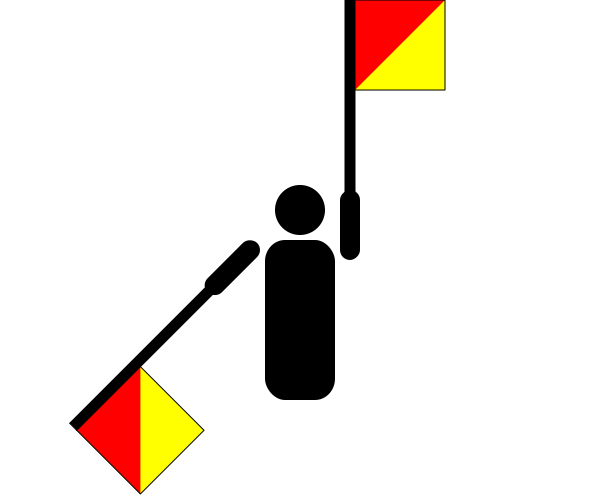
There are approximately 1,073 people named Cheek in the UK. That makes it roughly the 6,991st most common surname in Britain. Around 16 in a million people in Britain are named Cheek.
Origin: English
Region of origin: British Isles
Country of origin: England
Religion of origin: Christian
Language of origin: English

Famous people named Cheek
- Malvina Cheek - Artist (1915 to 2016)
- Arthur Marcus Hill Cheek - East India Company Officer (1840 to 1857)
Names and descriptions courtesy of Wikipedia, and may contain errors. This is not intended to be an exhaustive list of every famous person with this name.