CHAUDRY
The surname Chaudry is primarily associated with Arabic-speaking Muslim communities, where it is traditionally considered a title of respect for individuals who were regarded as leaders or headmen within their localities.
Its etymology can be traced to the Arabic words chaudhary or chowdhury, which, when interpreted in the Arabic linguistic context, denote leader or headman. These terms have long been employed to describe persons who exercised authority over a group or village, and the surname has therefore carried an implicit connotation of responsibility and governance.
In addition, there exists a Sanskrit-derived strand of the surname, whereby Chaudry is linked to the word chattra, meaning umbrella. This connection associates the name with the Rajput warrior class of India, whose descendants were reputedly respected in the 11th and 15th centuries for their martial prowess and for serving as retainers of local royalty. Over time, these Rajput lineages migrated to the Punjab region and adopted the surname with its attendant prestige.
There are numerous orthographic variants of the name, many of which reflect regional linguistic differences. These include Choudhary, Chowdhary, Chaudhury, Choudhuri and Chaudhuri, each arising from distinct pronunciations in Punjabi, Hindi, Bengali and the Urdu orthographical tradition. The root in every case is a form of the Sanskrit or Arabic word for a community head, and the variants are often used interchangeably within families that have migrated across linguistic borders.
Geographically, the surname is most prevalent in South Asia, where it is found in India, Pakistan and Bangladesh. Within India it occurs extensively in the northern states of Uttar Pradesh, Rajasthan, Bihar and Punjab, as well as in the eastern state of Bengal. In Pakistan, the name is common in Punjab and Khyber Pakhtunkhwa. In Bangladesh it is common in Chittagong and the Dhaka region. Outside the subcontinent, Chaudry has a notable presence in the Middle East, especially in the Gulf states of the United Arab Emirates, Kuwait, Qatar, Saudi Arabia and Yemen, where it is often borne by families who migrated for trade or professional opportunities.
In the United Kingdom and other European countries, the surname is comparatively uncommon but has increased in visibility since the latter part of the 20th century. It can be found in the United Kingdom, Portugal, Spain, and Germany, typically introduced by immigrants or dual‑heritage families. In the Americas, first‑generation immigrants from South Asia and the Middle East have carried the name to Canada and the United States, where the U.S. Census Bureau recorded roughly five thousand individuals bearing the surname in 2020.
Both Muslim and Hindu communities employ the surname, though the social functions attached it often differ. In Muslim societies it historically denoted communal leadership, a role that included the administration of local affairs and the representation of their district in broader political assemblies. In Hindu contexts, individuals bearing the surname were sometimes engaged in priestly duties, religious education or the custodianship of temple organisations, thereby perpetuating a tradition of spiritual stewardship.
Historical records show that early bearers of the name served as weavers or agriculturists under the patronage of regional rulers, accruing status as they contributed to the economic fabric of their kingdoms. With the expansion of the British colonial administration, members of the Chaudry families were recruited into the Indian army, attaining the ranks of honorary generals and receiving appointments in colonial governance. Such appointments were later mirrored in independent India and Pakistan, where several holders of the surname served in ministerial posts, as well as in the judicial and legislative branches of the state.
The linguistic heritage of the name, whether derived from Arabic or Sanskrit, has consistently conveyed values of leadership, learning and authority. The term has been used as an honourific within various cultural settings, and its legacy endures in contemporary organisations that value community cohesion and social responsibility.
In modern times the surname Chaudry continues to be a marker of distinguished lineage, resonating across diverse ethnic, religious and geographical boundaries while retaining its historical association with service, stewardship and communal governance.
Typical given names associated with the Chaudry surname
Male
- Abdul
- Abid
- Asif
- Harjinder
- Imran
- Khalid
- Mohamed
- Mohammad
- Mohammed
- Muhammad
- Omar
- Tahir
- Wasim
- Zafar
Female
- Ayesha
- Farah
- Farzana
- Fozia
- Nasreen
- Noreen
- Robina
- Sadia
- Saima
- Shazia
Similar and related surnames
- Chadry
- Chadury
- Chary
- Chatry
- Chattery
- Chaud
- Chaudary
- Chaudhari
- Chaudhary
- Chaudhaury
- Chaudhery
- Chaudhri
- Chaudhry
- Chaudhuri
- Chaudhury
- Chaudoir
- Chaudri
- Chaudury
- Chaundry
- Chawdhary
- Chawdhry
- Chawdhury
- Choudary
- Choudery
- Choudray
- Choudrey
- Choudry
- Choudury
- Chouhdry
- Chowdary
- Chowdery
- Chowdrey
- Chowdry
- Chowdury
- Chudary
- Chudoory
- Chudry
- Chuhadry
- Shatry
Related and similar names are generated algorithmically based on the spelling, and may not necessarily share an etymology.
How to communicate the surname Chaudry in...
Braille
⠉⠓⠁⠥⠙⠗⠽
Morse
-.-......-..--...-.-.--
Semaphore


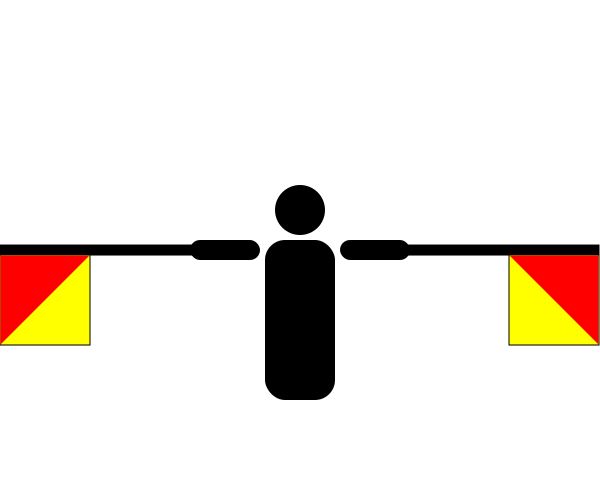

There are approximately 1,509 people named Chaudry in the UK. That makes it roughly the 5,319th most common surname in Britain. Around 23 in a million people in Britain are named Chaudry.
