CAVENDISH
The surname Cavendish is firmly rooted in the English tradition, with its earliest origins traced to a village in Suffolk. The settlement was first recorded in the Domesday Book of 1086 as Kavandisc, and later attested in the early thirteenth century as Cavenedis. Its composition comprises an early personal name and a topographical element: the personal name is considered either the Anglo‑Saxon Cafna, meaning ‘bold, daring’, or the Old Norse Kalfi; the suffix ‘edisc’ translates as ‘enclosure’ or ‘pasture’. Taken together, the name denotes ‘Cafna’s pasture’ or ‘Kalfi’s enclosure’, a description that conveys the sense of a pastoral holding set apart for cultivation or use.
As with many English locational surnames, the adoption of Cavendish as a family name likely followed the movement of individuals who had migrated from the village. They were subsequently identified by the place of their birth or by the estate that had provided them with land or status. The earliest documented spelling of the family name is that of Simon de Cavendis, dated 1201, found in the Records of Pleases before the King in Suffolk. It was during this period that the name entered the annals of the local gentry, gradually accruing a reputation high enough to be noted in legal and clerical documents.
By the fifteenth and sixteenth centuries, the Cavendish name had become synonymous with influence and prestige. Sir William Cavendish (d. 1597) was a prominent courtier who secured the family’s standing at the royal court, and his descendants went on to hold substantial titles. Among them were the Dukes of Devonshire and the Dukes of Newcastle, whose seats at Chatsworth and other estates were seats of great wealth and political power. The hereditary nature of these titles has ensured the lasting visibility of the Cavendish surname in British history.
In addition to its aristocratic associations, the Cavendish name is linked to scientific advancement through Henry Cavendish (1731–1810). He is best remembered for his precise determination that the substance known as hydrogen was distinct from air and contributed significantly to the development of modern chemistry. His careful experiments, conducted under the guidance of his family’s patronage, cemented the Cavendish name in the annals of scientific achievement.
Another figure of historical importance bearing the surname is Thomas Cavendish (1560–1592), an explorer who circumnavigated the globe in the late sixteenth century. His voyages added to the knowledge of the world’s geography and demonstrated the adventurous spirit the name evoked when coupled with the ancient personal names upon which it was founded.
The surname has retained a degree of rarity within the United Kingdom, persisting mainly in the eastern counties of Suffolk and the Derbyshire region surrounding Chatsworth House. Census records under the twentieth century indicate a modest concentration of individuals bearing the name, yet the association with influential landed families has kept it prominent in the cultural memory of Britain.
Global diaspora stemming from the nineteenth-century emigration has disseminated the Cavendish name across the English‑speaking world. Concentrations can now be found in Australia, the United States, South Africa, and Canada, where descendants maintain a connection to their heritage through genealogical societies and the preservation of family records.
Modern spelling conventions favour the standardisation on Cavendish, and the variety of earlier forms such as Cavenedish, Cauendis, and Cavendische have largely fallen out of common use. Regional dialects and clerical variations are still occasionally discovered in archival material but do not alter the fundamental identity associated with the name today.
In sum, the Cavendish surname embodies a confluence of geographic origin, linguistic evolution, and historical prominence. Whether referring to the pastoral roots at the heart of Suffolk, the aristocratic lineages that have shaped British politics and society, or the scientific and exploratory achievements that have entered broader history, the name remains a distinctive marker of heritage and accomplishment.
Typical given names associated with the Cavendish surname
Male
- Andrew
- Edward
- James
- John
- Jonathan
- Mark
- Michael
- Paul
- Richard
- Robert
- Roger
- Rupert
- William
Female
- Alison
- Angela
- Anita
- Charlotte
- Denise
- Emma
- Helen
- Laura
- Lesley
- Lisa
- Lucy
- Sarah
- Susan
Similar and related surnames
Related and similar names are generated algorithmically based on the spelling, and may not necessarily share an etymology.
How to communicate the surname Cavendish in...
Braille
⠉⠁⠧⠑⠝⠙⠊⠎⠓
Morse
-.-..-...-.-.-...........
Semaphore


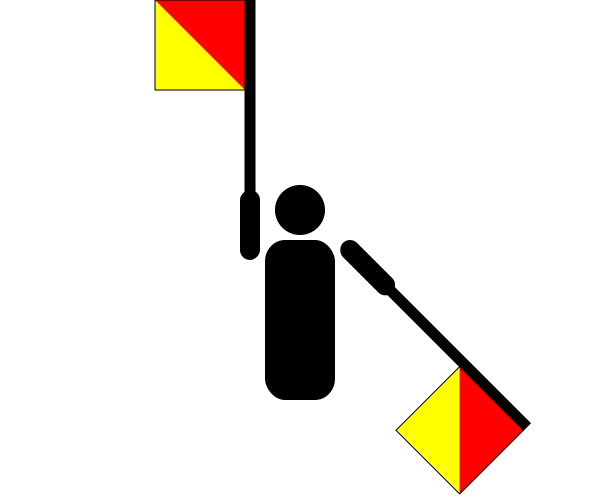

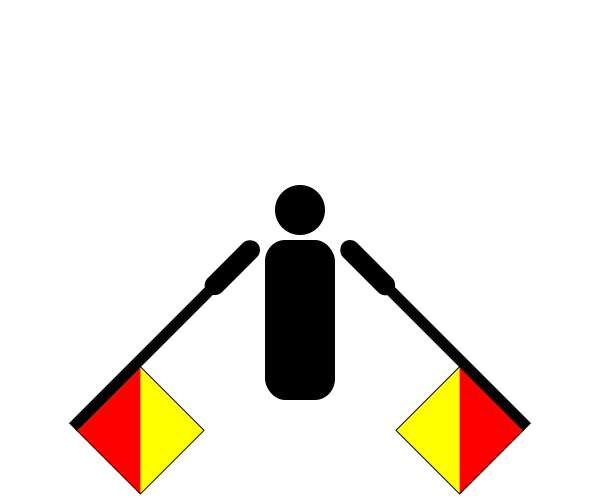

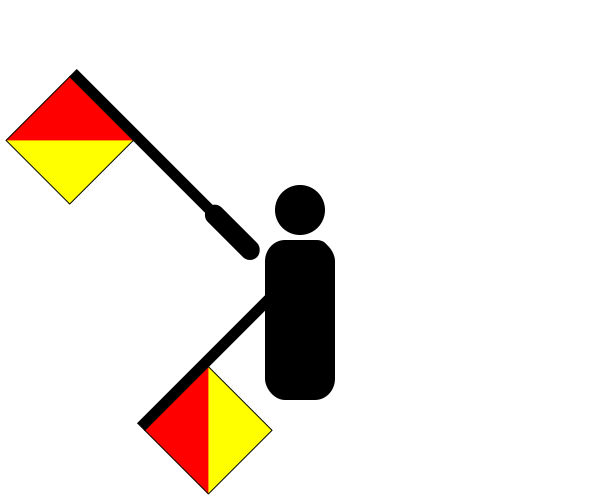


There are approximately 507 people named Cavendish in the UK. That makes it one of Britain's least common surnames. Only around eight in a million people in Britain are named Cavendish.
Surname type: Location or geographical feature
Origin: English
Region of origin: British Isles
Country of origin: England
Religion of origin: Christian
Language of origin: English

Famous people named Cavendish
- Georgiana Cavendish, Duchess of Devonshire - Socialite, style icon, author, and activist (1757 to 1806)
- Deborah Cavendish, Duchess of Devonshire - Writer (1920 to 2014)
- Mark Cavendish - Professional road racing cyclist
- Peregrine Cavendish, 12th Duke of Devonshire - Duke
- Andrew Cavendish, 11th Duke of Devonshire - Politician and duke (1920 to 2004)
- Elizabeth Cavendish, Duchess of Devonshire - Duchess of Devonshire (1759 to 1824)
- William Cavendish, Marquess of Hartington - Politician and soldier (1917 to 1944)
- Edward Cavendish, 10th Duke of Devonshire - Head of the Devonshire branch of the Cavendish family (1895 to 1950)
- Robin Cavendish - (1930 to 1994)
- Victor Cavendish, 9th Duke of Devonshire - Politician who served as Governor General of Canada (1868 to 1938)
- Mary Cavendish, Duchess of Devonshire - Duchess of Devonshire (1895 to 1988)
- Lord Charles Arthur Francis Cavendish - Banker and noble (1905 to 1944)
- William Cavendish-Bentinck, 3rd Duke of Portland - Politician (1738 to 1809)
- Evelyn Cavendish, Duchess of Devonshire - Wife of Victor Cavendish, 9th Duke of Devonshire (1870 to 1960)
- Lady Elizabeth Cavendish - Noble (1926 to 2018)
- William Cavendish-Bentinck, 6th Duke of Portland - Duke of Portland (1857 to 1943)
- William Cavendish-Bentinck, 7th Duke of Portland - Politician (1893 to 1977)
- Charles Cavendish-Bentinck - Great-grandfather of Queen Elizabeth II of the United Kingdom (1817 to 1865)
- Winifred Cavendish-Bentinck, Duchess of Portland - Humanitarian, reformer, animal rights advocate (1863 to 1954)
- Blanche Cavendish, Countess of Burlington - Duchess of Devonshire (1812 to 1840)
Names and descriptions courtesy of Wikipedia, and may contain errors. This is not intended to be an exhaustive list of every famous person with this name.