CAVALIER
Cavalier is a surname of Italian provenance, deriving from the Latin root caballus which means horse. The Italian word cavaliere and its French equivalent chevalier both translate into English as ‘knight’ or ‘horseman’, and the name was originally an occupational tag for individuals who were skilled riders or who served as mounted soldiers.
The surname has historically been employed as a status name or nickname for persons who displayed chivalric qualities or held noble bearings. In its earliest use it denoted a professional fighting man who served a lord or king on horseback, and it was sometimes given to messengers who rode swiftly across the land.
In England the name appears first in the mid‑sixteenth century, recorded in a 1554 London grant of Arms for Antony Cavaler. This earliest spelling is considered a direct derivative of the Italian cavallo. The granted Arms feature a silver horse upon a red field, a visual symbol that recognises the equestrian heritage of the family.
During the English Civil War of 1642 to 1651 the term Cavalier was applied by the Parliamentarians to the supporters of King Charles I. Initially used as an insult, the Royalists later appropriated the title as a badge of gentility, asserting a connection to the chivalrous tradition of knighthood.
Multiple spelling variations of the surname can be found in historical records, including Cavallier, Cavalliere, Cavaliero, Cavalieri, and Chevalier. Pre‑ and post‑norman influences, regional dialects and the process of anglicisation have produced further forms such as LeCavalier and DeCavalier, as well as variations found in southern Italy including Cavallaro and in Norway where derived forms appear among trading communities.
Although the surname remains relatively uncommon worldwide, it has spread through migration and diaspora. Significant concentrations are found in southern France—particularly in the regions of Provence‑Alpes‑Côte d'Azur and Occitanie— and in Italy, especially in the south. In English‑speaking countries it is occasionally encountered in the United Kingdom, the United States and Canada.
In conclusion, the surname Cavalier encapsulates a lineage that is both occupational and symbolic, reflecting a historical association with horsemanship, knighthood and noble service. Its enduring presence across Europe and beyond, coupled with its rich heraldic and historical associations, continues to render the name distinctive in genealogical and cultural studies.
Typical given names associated with the Cavalier surname
Male
- Anthony
- David
- Geoffrey
- John
- Lee
- Mark
- Nicholas
- Paul
- Peter
- Philip
- Richard
- Stephen
Female
- Angela
- Anne
- Eileen
- Emma
- Jacqueline
- Joanne
- Lesley
- Linda
- Lorna
- Margaret
- Mary
- Patricia
- Rachel
- Susan
- Yvonne
Similar and related surnames
Related and similar names are generated algorithmically based on the spelling, and may not necessarily share an etymology.
How to communicate the surname Cavalier in...
Braille
⠉⠁⠧⠁⠇⠊⠑⠗
Morse
-.-..-...-.-.-......-.
Semaphore


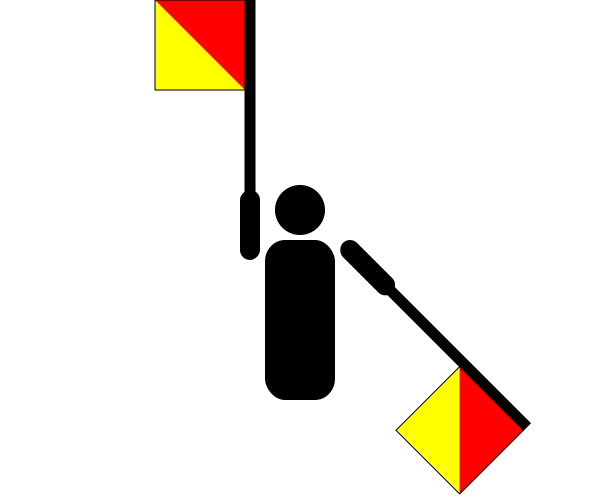

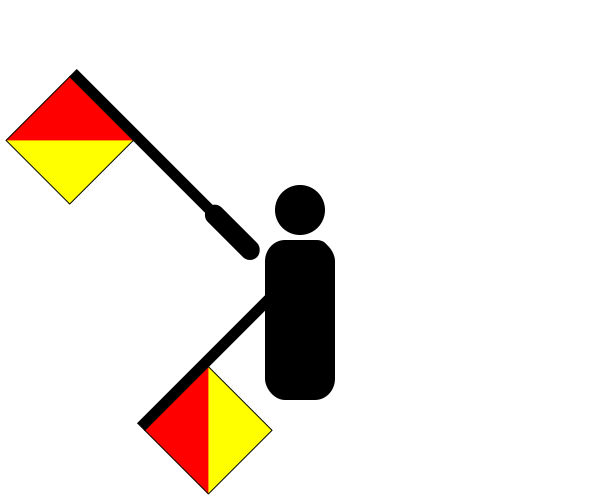

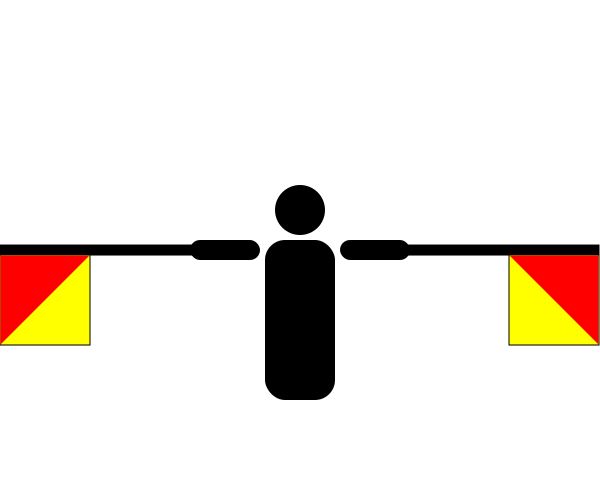
There are approximately 356 people named Cavalier in the UK. That makes it one of Britain's least common surnames. Only around five in a million people in Britain are named Cavalier.
Surname type: Occupational name
Origin: English
Region of origin: British Isles
Country of origin: England
Religion of origin: Christian
Language of origin: English
