CATHCART
Cathcart is a surname of strictly Scottish provenance, although its etymological roots are intertwined with both Celtic and Welsh linguistic traditions. The name originates from the district of Cathcart in Renfrewshire, south of Glasgow. The place itself was recorded in 1158 as Kerkert, a form that preserves the native elements of the toponym and provides a key insight into early medieval naming practices in the Lowlands.
The first component of the place name is derived from the Celtic word cath, meaning "battle", a term that appears in numerous ancient Brittonic and Gaelic placenames. The second element, cart, refers to the River Cart, which rises in the hills south of Glasgow and flows through the district. The river’s name is thought to be of pre‑Celtic origin and may be linked to the Indo‑European word kov, meaning "hard" or "stony". Consequently, the composite meaning can be rendered as "fort on the river of the battle" or, alternatively, "the fort at the point of the carts". Some scholars have suggested a Welsh derivation in which caeth, meaning "prisoner", and cardd, meaning "thicket" or "wooded place", co‑combine to give the sense "prisoner of the thicket". Either interpretation maintains the theme of settlement in a defensible, wooded or riverine environment.
Historical documents show that the surname was first borne by the landowners of that district during the twelfth century. The earliest recorded form of the name is as Reginaldus de Cathekert in the Register of Paisley Monastery dated to 1178, a period that coincides with the reign of King William the Lion (1165–1214). Subsequent Latinised spellings appear in the early fourteenth century – for example, Ranulfus de Ketkert in 1202 – indicating a Norman influence and the impetus for the surname’s Latinised usage in formal charters.
The family established itself as a recognised noble house in Renfrewshire and possessed substantial lands, including the ruins of Cathcart Castle. A significant historic event associated with these lands is the Battle of Langside in 1568, which took place near the castle and demonstrated the strategic importance of the region. The Cathcarts were consistently involved in Scottish military and political affairs, sometimes on the side of the Crown and at other times aligning with insurgent forces.
Notable bearers of the surname include Sir George Cathcart (1794–1854), who served as aide‑de‑camp to the Duke of Wellington at the Battle of Waterloo and was appointed a Knight Commander of the Order of the Bath in 1853. In the British honours system, the family also carries several peerage titles, including Lord Cathcart, Earl Cathcart and Viscount Cathcart. These honours reflect the family’s long-standing influence within the United Kingdom’s aristocratic and governmental structures.
The Cathcart coat of arms is rich with symbolism. The shield is blue and bears three cross‑crosslets fitchee issued from as many silver crescents. In chief is a man’s red heart ensigned with an imperial crown erected in proper colours. The crest includes a dexter hand couped at the wrist issuing from a wreath and holding up a silver crescent. These elements combine heraldic motifs to signify courage, loyalty, and a deep hereditary lineage.
In contemporary times, the surname remains relatively common within Scotland and among Scottish diaspora communities in the United States, Canada, Australia and South Africa. The spread of the name reflects historical emigration patterns that correspond to industrialisation, colonial expansion and economic opportunity. Despite the geographic dispersion, Cathcarts worldwide retain a shared identity rooted in the historical lands of Renfrewshire, the River Cart and the enduring legacy of the Scottish Lowlands.
Typical given names associated with the Cathcart surname
Male
- Alan
- Brian
- David
- Ian
- James
- John
- Paul
- Robert
- Simon
- William
Female
- Alison
- Anne
- Elizabeth
- Emma
- Helen
- Jane
- Jennifer
- Kathleen
- Lara
- Margaret
- Mary
- Sarah
- Susan
Similar and related surnames
Related and similar names are generated algorithmically based on the spelling, and may not necessarily share an etymology.
How to communicate the surname Cathcart in...
Braille
⠉⠁⠞⠓⠉⠁⠗⠞
Morse
-.-..--....-.-..-.-.-
Semaphore


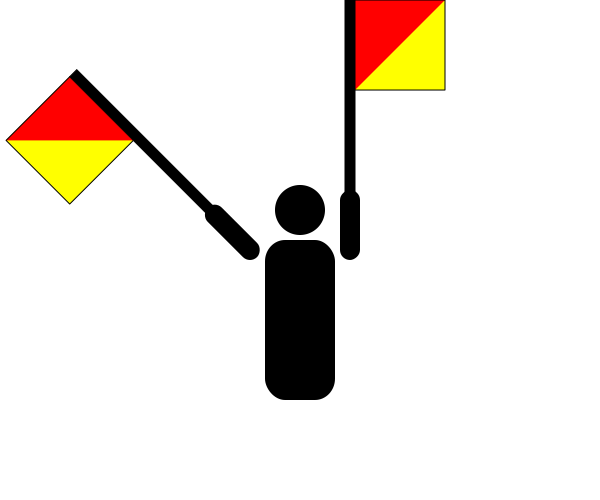

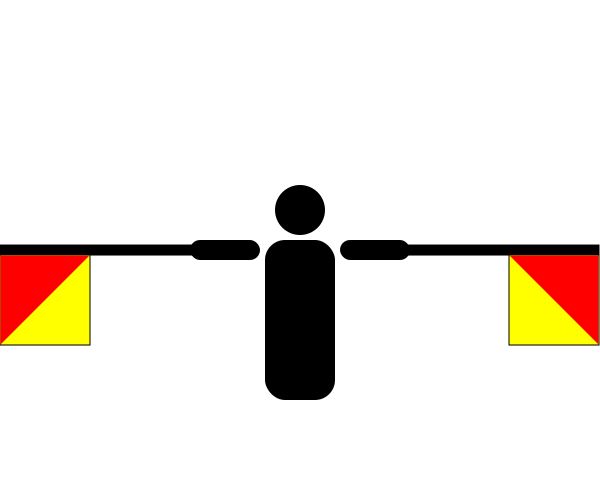
There are approximately 1,265 people named Cathcart in the UK. That makes it roughly the 6,147th most common surname in Britain. Around 19 in a million people in Britain are named Cathcart.
Origin: Celtic
Region of origin: British Isles
Country of origin: Ireland
Religion of origin: Christian
Language of origin: Gaelic

Famous people named Cathcart
- Craig Cathcart - Northern Irish football player
- Clare Cathcart - Northern Irish actress (1965 to 2014)
- Charles Cathcart, 7th Earl Cathcart - Peer
- Brian Cathcart - Journalist and writer
- William Cathcart, 1st Earl Cathcart - Scottish soldier and diplomat (1755 to 1843)
- Timothy Cathcart - Rally driver (1994 to 2014)
- Charles Cathcart, 9th Lord Cathcart - Army general (1721 to 1776)
- Charles Cathcart, 2nd Earl Cathcart - Army general and governor in Canada (1783 to 1859)
- Marie Cathcart, Countess Cathcart - Peeress and countess (1923 to 2015)
- George Cathcart - Army general (1794 to 1854)
Names and descriptions courtesy of Wikipedia, and may contain errors. This is not intended to be an exhaustive list of every famous person with this name.