CASTRO
Castro is a surname of Iberian provenance, with its roots in the ancient Latin word castrum, which translates literally as “fortress” or “castle.” The name developed as a toponymic identifier, signalling that the original bearers resided near, worked in, or were otherwise associated with a fortified place. The surname is most prevalent in Spain and Portugal, and has spread throughout the Spanish‑speaking world, where it often denotes a historical link to a castle or military stronghold.
In Spain, the surname is closely connected to the Christian tradition and the broader Iberian cultural milieu. During the Middle Ages, many individuals were recorded as de Castro, a pre‑positional form that emphasised their association with a particular fortress. The passage of time has produced a range of orthographic variants, including Castri and De Castri in Italian contexts, and the diminutive Castrillo in Spanish, which may suggest “the son of Castro” or a relative of the nameholder.
The historical record provides several key instances of the surname. The earliest documented appearance is attributed to Andreas Medina de Castro, dated 13 December 1556 in Valladolid, during the reign of King Charles I. Subsequently, clerical entries such as that of Antonia Sancta Castro in Valladolid on 12 December 1588, and the marriage of Augustin de Casto to Lucia Fernandez in San Pelago on 12 February 1810, illustrate the name’s continued usage into the early twentieth century, including periods of conflict such as the Peninsular War (1807‑1813).
In the New World, the Castro surname reached the United States early in the colonial era. A record of Macario Castro and his wife, former Maria Potenciana Ramierez, was registered at Santa Barbara, California on 17 February 1784. This early entry demonstrates the diaspora of Iberian families beyond continental Europe and into the Americas during the eighteenth century.
Stately families bearing the surname Castro were often granted coats of arms, a symbol of martial status and social distinction. One of the earliest grants for Castro de Aragon displayed six gold bezants on a red field, while the Castro de Castille arms featured six blue plates on a silver field. These heraldic motifs reflect the name’s association with defence and nobility, and underscore the surname’s enduring presence in European aristocratic contexts.
Today, the Castro surname remains widespread in Spanish‑speaking countries and carries an inherited sense of the strategic importance of fortifications in Iberian history. Its linguistic journey from Latin to modern usage, alongside the tangible evidence of church records, heraldic documentation, and early colonial registers, provides a comprehensive picture of the name’s evolution and significance.
Typical given names associated with the Castro surname
Male
- Antonio
- Arnold
- Carlos
- David
- Joao
- John
- Jose
- Luis
- Manuel
- Marcos
- Michael
- Miguel
Female
- Ana
- Emma
- Isabel
- Janet
- Julie
- Laura
- Maria
- Michelle
- Monica
- Pamela
- Patricia
- Sandra
- Sonia
Similar and related surnames
Related and similar names are generated algorithmically based on the spelling, and may not necessarily share an etymology.
How to communicate the surname Castro in...
Braille
⠉⠁⠎⠞⠗⠕
Morse
-.-..-...-.-.---
Semaphore


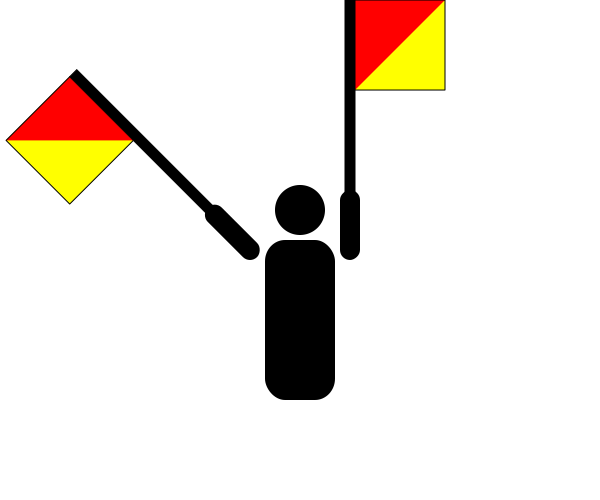
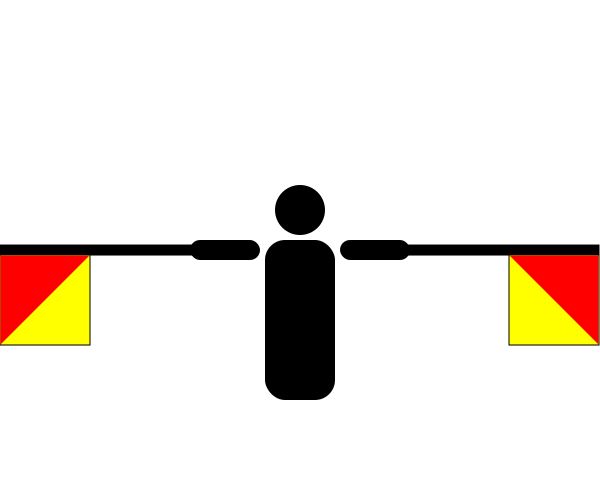
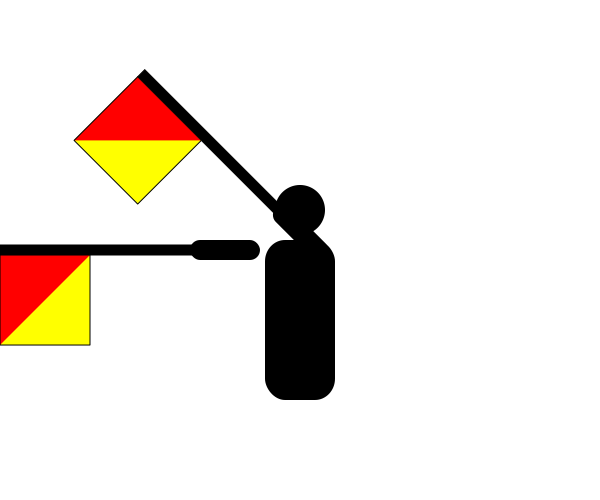
There are approximately 1,777 people named Castro in the UK. That makes it roughly the 4,641st most common surname in Britain. Around 27 in a million people in Britain are named Castro.
Origin: Iberian
Region of origin: Europe
Country of origin: Spain
Religion of origin: Christian
Language of origin: Spanish

Famous people named Castro
- Julian Castro - 16th Secretary of Housing and Urban Development and 181st Mayor of San Antonio
Names and descriptions courtesy of Wikipedia, and may contain errors. This is not intended to be an exhaustive list of every famous person with this name.