CASTLEMAN
Castleman is an English surname of medieval origin derived from the Middle English word castel, meaning “castle”, and the suffix -man, which denotes a person associated with or living near a fortified building. The name is therefore a topographical and occupational surname employed to describe someone who dwelt in or served at a castle.
Early documentary evidence shows the name in the early thirteenth century. The first recorded spelling appears as Richard Castel in the Records of Bec Abbey, Sussex, dated between 1148 and 1154 during the reign of King Stephen. Subsequent variations in the same century include Henry de Castell of Cambridgeshire (1260), John del Castel of Yorkshire (1307) and William ate Castele of Kent (1317). These variations illustrate the fluidity of spelling in the period and the influence of regional dialects on the orthography of the name.
The etymological construction of the surname reflects its dual character: castel or castell in Old English and Anglo‑Norman French signifies a fortified building, especially the residence of a feudal lord, while mann indicates a man. The combined form therefore identifies a man who is either a resident or a worker at such a site, a role that could encompass a servant, a retainer or a soldier stationed in the castle’s garrison.
During the medieval period, the name appears across a wide swathe of the British Isles, notably in Yorkshire, Lancashire, Kent and the Channel Islands. By the early modern era, it had become established in Wales and Scotland, giving rise to a number of spelling variants such as Castellman, Castlemon, Castlemain and the pluralised Castles. These variants stem from phonetic adaptation to local speech patterns and the lack of a fixed spelling system at the time.
One distinguished bearer of the name was Richard Castle, an architect of German birth who relocated to Ireland before 1720. He is noted for his designs of buildings in Dublin and the surrounding provinces, and his name appears as Cassel or Cassels in contemporary records. A hereditary Coat of Arms granted to the family is described as argent, three towers gules, with a crest of a castle in flames.
In the post‑colonial era, the surname spread beyond Britain through migration. Today it is most commonly found in the United States, where it ranked as the 13,415th most common surname in 2014 according to the genealogical database Forebears. Within Britain, it remains a relatively rare surname, although pockets of individuals can still be found in England, Scotland and Wales. The name is also present in Canada, Australia, and South Africa, a testament to the continued dispersal of English surnames across the globe.
In summary, Castleman is a historically grounded English surname that originally identified a person associated with a castle, whether by residence or occupation. Its documented appearance in the thirteenth century, the persistence of multiple orthographic variants, and its spread to the wider world collectively attest to its enduring legacy within the British onomastic tradition.
Typical given names associated with the Castleman surname
Male
- Anthony
- Christopher
- Ian
- Jack
- James
- John
- Jonathan
- Paul
- Roger
- Roy
- Simon
- Stephen
- Thomas
Female
- Amanda
- Barbara
- Claire
- Eleanor
- Elizabeth
- Georgia
- Joan
- Leigh
- Linda
- Mary
- Patricia
- Susan
- Taryn
- Victoria
Similar and related surnames
Related and similar names are generated algorithmically based on the spelling, and may not necessarily share an etymology.
How to communicate the surname Castleman in...
Braille
⠉⠁⠎⠞⠇⠑⠍⠁⠝
Morse
-.-..-...-.-...--.--.
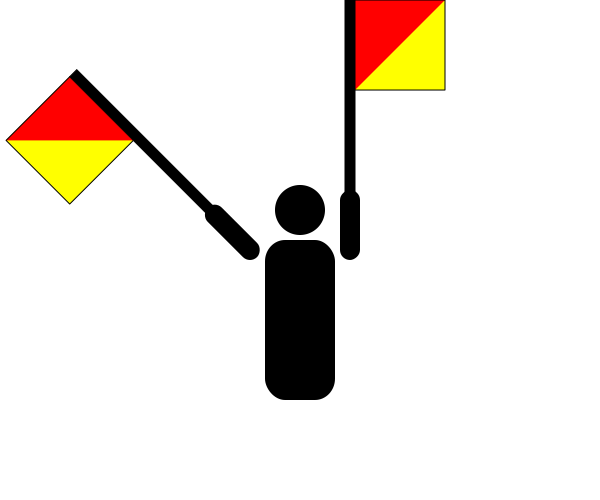
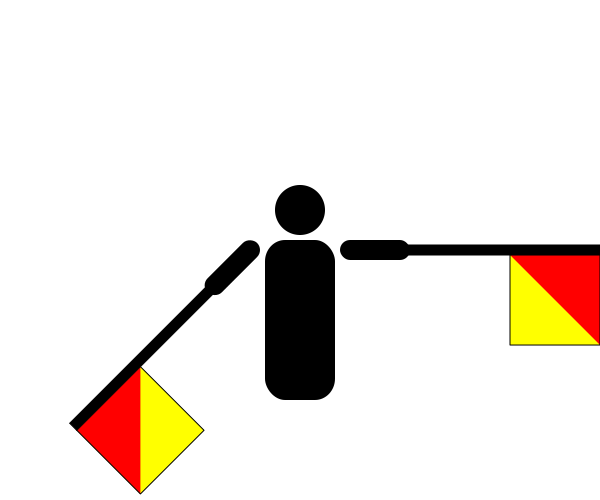
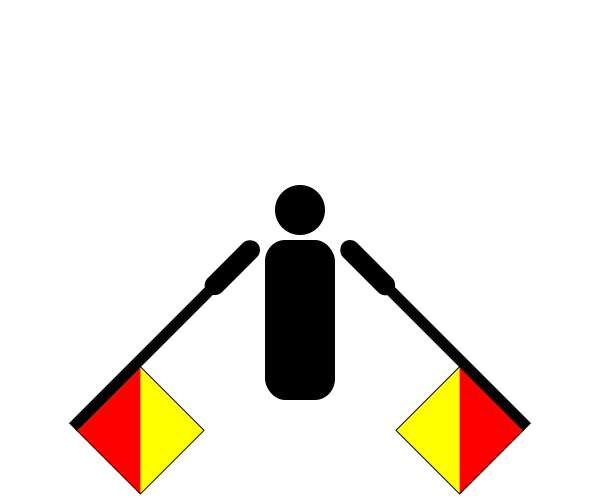
Semaphore




There are approximately 331 people named Castleman in the UK. That makes it one of Britain's least common surnames. Only around five in a million people in Britain are named Castleman.
Surname type: Occupational name
Origin: English
Region of origin: British Isles
Country of origin: England
Religion of origin: Christian
Language of origin: English
