CANDY
The surname Candy possesses a dual heritage, rooted in both Latin and Old French etymologies, and it was first established in the British Isles as a hereditary family name.
In the medieval period the name arose from the given name Candius, which is a variant of the Latin word Candidus meaning “white” or “bright”. It was originally used as a nickname for an individual with fair or light‑haired or fair‑complexioned features. Over time the personal name was inherited by descendants, becoming a fixed surname in English‑speaking communities.
Following the Norman Conquest of 1066, Candy was introduced into England from Old French. One source of the name is topographical: it derives from the Old French and Middle English word cond(u)it, itself borrowed from Late Latin conductus, a derivative of conducere, meaning “to lead”. The term originally described an artificial channel or pipe designed to convey water, which later came to denote a fountain or water‑pump. The use of such natural or man‑made features as distinguishing names was common in the Middle Ages. For example, the name appears in the 1340 Assize Rolls of Cambridgeshire as William atte Conduit.1
Alternatively, the surname may be locational, taken from any of the French localities called Conde (Nord, Oise, Orne). In this context the name denoted a person who had departed from the village of Conde to settle elsewhere. Early witnesses include Aliz de Condi, recorded in the 1184 Records of the Knights Templars in Lincolnshire, and Nicholas Cundy, noted in the 1200 Pipe Rolls of Lincolnshire.2
Throughout the early modern period a variety of spellings appeared—Condy, Cundy, Condie, Cundey, Candey, Candie, Candy—reflecting regional dialects and the fluid orthographic practices of the time. The earliest documented spelling is that of Robert de Cundi, dated 1150 in the “Chartulary of the Abbey of Rievaulx” during the reign of King Stephen (1135‑1154). Subsequent entries include the 1551 marriage of John Candye to Helene Fyssher at St. Stephan's, Coleman Street, London, and the 1563 union of Ralphe Candy with Basill Cummyn at Allhallows, London Wall, also in London.3
In contemporary usage the surname Candy remains predominantly associated with English‑speaking countries, where it continues to be borne by families who trace their lineage back to the medieval English or Norman origins documented above.
References
- Assize Rolls of Cambridgeshire, 1340.
- Record of the Knights Templars, 1184; Pipe Rolls of Lincolnshire, 1200.
- Chartulary of the Abbey of Rievaulx, 1150; London Marriage Registers, 1551–1563.
Typical given names associated with the Candy surname
Male
- Anthony
- Christopher
- David
- James
- John
- Michael
- Paul
- Richard
- Robert
- Stephen
Female
- Denise
- Elizabeth
- Emma
- Jacqueline
- Jane
- Jennifer
- Julie
- Margaret
- Mary
- Rachel
- Rebecca
- Sarah
- Susan
Similar and related surnames
Related and similar names are generated algorithmically based on the spelling, and may not necessarily share an etymology.
How to communicate the surname Candy in...
Braille
⠉⠁⠝⠙⠽
Morse
-.-..--.-..-.--
Semaphore


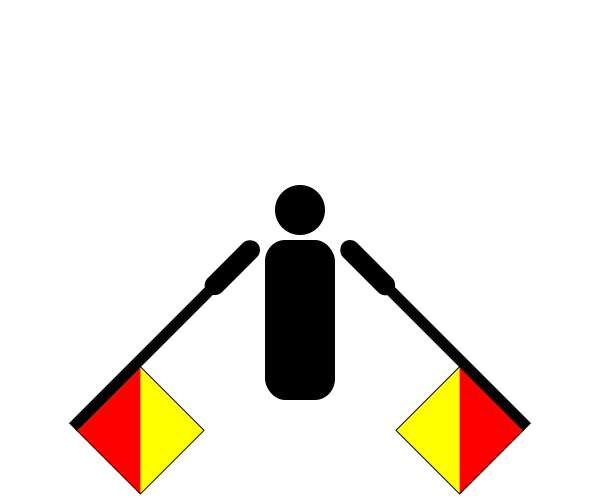

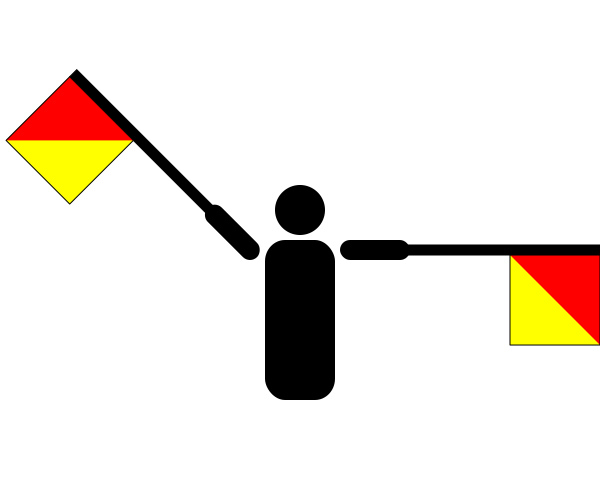
There are approximately 1,429 people named Candy in the UK. That makes it roughly the 5,578th most common surname in Britain. Around 22 in a million people in Britain are named Candy.
Surname type: Location or geographical feature
Origin: English
Region of origin: British Isles
Country of origin: England
Religion of origin: Christian
Language of origin: English

Famous people named Candy
- John Candy - Canadian actor and comedian (1950 to 1994)
Names and descriptions courtesy of Wikipedia, and may contain errors. This is not intended to be an exhaustive list of every famous person with this name.