CALLERY
Callery is a surname whose roots lie primarily in the Gaelic tradition of the British Isles, particularly within Ireland. The name is commonly recorded as an anglicised form of various Gaelic patronymic names that incorporate elements meaning “descendant” or “son of.” Whether tracing its earliest appearance in the early thirteenth‑century records of Carlisle or the extant medieval manuscripts of Ireland, the surname remains a marker of a distinctly Celtic heritage that survived the linguistic shifts of the English‑dominated period in the mid‑medieval and early modern eras.
The most widely accepted derivation comes from the Irish Gaelic Ó Callaráin, which translates literally as “descendant of Callarán.” The personal name Callarán is believed to be a diminutive of Calluragh, itself derived from the word callur, a term recorded in the annals as meaning “strife” or “contention.” In this sense the surname Callery may have originally been a patronymic reference to someone identified within their community by a contentious or argumentative disposition, a naming custom that was common in early Gaelic societies.
Another strand of the name’s history points to the Scots Gaelic Mac Giolla Riabhaigh, literally “son of the brindled lad.” This form has yielded several anglicised variants such as MacKilrea, MacIlrea, and Mac Ilwraith. One of the earliest documented spellings of the surname—John Make Gille Reue—was recorded in the year 1300 in Carlisle, during the reign of King Edward I, and stands as the earliest tangible evidence that the family had a presence in the northern reaches of England. The presence of the Mac prefix in these versions indicates a patronymic origin, a feature common to many Gaelic families that migrated across the Anglo‑Scottish border.
In the south of Ireland, the surname appears in the early records of County Mayo, where the O Calleeres—still spelled in the same form on 12th‑century documents—were listed among the clans affiliated with the O Connor dynasty. The basis of the Irish surname is frequently traced to the phrase “Calg Herigh,” an ancient Gaelic expression interpreted as “valiant warrior.” Various scholars also note a possible Norman‑French influence, contending that the root caler meaning “to retire” or “to withdraw” may have contributed to the evolution of the name during the period of Anglo‑Norman settlement in Ireland. The Callery name is, today, predominantly found across the four provinces of Ulster, Connacht, Munster, and Leinster, a distribution pattern that echoes the original Gaelic linguistic zones. Although the name is now considered rare, its persistence underscores the endurance of Gaelic identity through the centuries and the subsequent ascendance of local families into broader European society.
In the United States, the surname arrises from two distinct migratory streams. The earliest documented bearers were members of the Pennsylvania/Maryland region, whose descent can be traced to Irish immigrants who settled during the mid‑1700s. A separate lineage is recorded in New England, where a couple bearing the name was listed among the original Pilgrims on the Mayflower in 1620. Further historic migration arrived with the Anglo‑Norman family that settled in County Wexford in the twelfth century, which then expanded into Limerick, Kilkenny, and Cork. Those early settlers were ultimately joined by later emigrants who crossed the Atlantic in the eighteenth and nineteenth centuries and established families in Canada, Mexico, and South America. In contemporary times the surname is recognisable in England, Wales, Germany, France, Austria, Italy, Spain, Australia, New Zealand, and India, reflecting a global diaspora that continues to preserve the Callery heritage.
The surname Callery has spawned numerous variations in spelling and pronunciation. Common variants include Calery, Callary, Caillar(y), Callar(y), Calar(y), Caillaire, Caillarath, Callaire, Chalare, Chalary, Challary, Challer(y), Challor(e), Challory, Calury, and Calllory. These variants illustrate the linguistic branching that occurs when a name migrates across regions and languages, and they retain the core Gaelic patronymic heritage that underpins the historic and contemporary use of the Callery surname.
Typical given names associated with the Callery surname
Male
- Anthony
- David
- Edward
- James
- Jason
- John
- Michael
- Peter
- Robert
- Stephen
- Thomas
- William
Female
- Dawn
- Emma
- Evelyn
- Helen
- Margaret
- Mary
- Samantha
- Sarah
- Shirley
- Vera
- Victoria
- Wendy
Similar and related surnames
- Cailler
- Cailer
- Caller
- Calar
- Caleary
- Caler
- Calero
- Calery
- Callair
- Callar
- Callari
- Callary
- Callawey
- Callear
- Calleri
- Callero
- Calleros
- Callert
- Calliar
- Callier
- Callor
- Callyer
- Calor
- Calori
- Calyer
- Cayler
- Collery
- Cullery
- Kaller
- Kellery
- Kellory
- Caleira
- Caleiro
- Callagher
- Callara
- Calleya
- Calore
- Calour
- Clarey
- Clary
- Cleary
- Cleery
- Clery
- Colleary
- Colliery
- Kaler
- Kalluri
- Callegari
- Calvery
- Clarry
- Gallery
Related and similar names are generated algorithmically based on the spelling, and may not necessarily share an etymology.
How to communicate the surname Callery in...
Braille
⠉⠁⠇⠇⠑⠗⠽
Morse
-.-..-.-...-....-.-.--
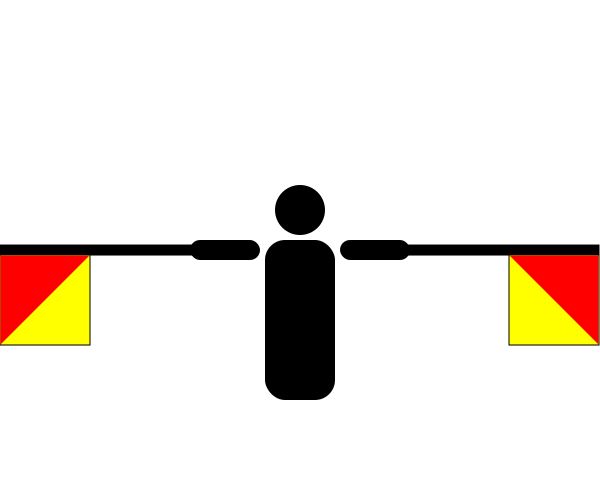
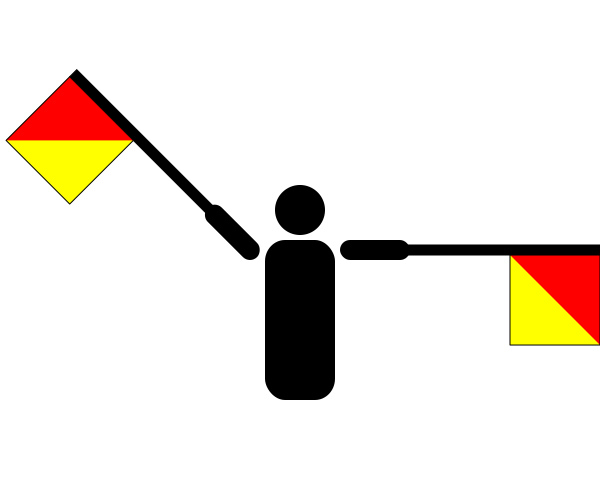
Semaphore


There are approximately 329 people named Callery in the UK. That makes it one of Britain's least common surnames. Only around five in a million people in Britain are named Callery.
Origin: English
Region of origin: British Isles
Country of origin: England
Religion of origin: Christian
Language of origin: English
