CADIGAN
Cadigan is a surname of Gaelic origin, traceable to the Irish provinces of Munster and Leinster. The name originally appears as Ó Cadagáin, a patronymic signifying “descendant of Cadagán”. The personal name Cadagán is a diminutive of Cadóg, a word in Old Irish meaning “battle” or “warrior”. Consequently, the surname is traditionally associated with a forebear known for martial prowess.
The surname displays a fascinating dual heritage. In addition to its Irish roots, some records suggest that a variant spelling, Cadogan, and the earlier Welsh form Cadwgan share a common origin in the pre‑seventeenth‑century personal name Cadwgan, meaning “battle‑prince” (from cad “battle” and mael “prince”). Historical evidence indicates that the name was introduced into Ireland by followers of William Fitz‑Thomas, the Earl of Pembroke, who invaded the country in 1169. Earlier material, however, suggests that the name may have been present in the Irish record before this period.
Numerous early Anglo‑Irish documents, including the Gormanston Register of Ireland (1341), mention Thomas and Bartholomew Cadigan as substantial landholders in County Limerick. Their estate, recorded under the unwieldy title “Martyncadyganestown”, is believed to correspond to the modern place name Martinstown. The earliest survivor in the English record, the 1292 “Subsidy Rolls” of Monmouthshire, Wales, lists a household headed by Cadivor Cadigan.
Socially, the Cadigans were closely linked to the Northern Uí Neill, a prominent Gaelic kingdom that included the O’Neill dynasty of Tyrone and the O’Donnell dynasty of Donegal. The clan’s members were reputedly warriors, hunters, or foresters and participated in notable military engagements, including the 1500 Battle of Knockavoe, in which they joined forces with the O’Neill and O’Donnell clans to resist English incursions.
In modern times the surname has spread throughout English‑speaking nations. In Ireland it remains common, particularly in the southern provinces. In the United Kingdom the name is most often found within England, Scotland and Wales. Across the Atlantic, Cadigans are prominent in the United States, especially in New England as well as in Michigan, New York and Pennsylvania; substantial populations also exist in Canada, Australia, Germany and Jamaica. These diaspora communities preserve the surname’s heritage while contributing to local culture.
Variations of the spelling have evolved in accordance with linguistic and regional influences. Common forms include Cadigan, Cadogan, Cadwgan, Cadagan, Cadegan, Cadden, Caden and Cadaghan. In Ulster the name is sometimes rendered as Caidigan, while Scottish traditions may adopt spellings such as Cadigan pronounced “Ceddy‑gun”. These alternate orthographies reflect the same underlying Gaelic root and maintain identical pronunciation.
Figures of historical note bearing the surname include Major William Cadogan, governor of Trim in 1649; William Cadogan (1675‑1726), a prominent politician born in Dublin; and the first Earl Cadogan, who received his title in 1718. The Cadogan family of County Cork claims native Irish origins, yet the Gaelic form O'Ceadagain mirrors the Welsh Cadwgan, highlighting the intermingled nature of Celtic lineages.
Across centuries, the surname Cadigan has endured as a marker of Celtic identity and martial tradition, bridging ancient Gaelic roots with contemporary global dispersion.
Similar and related surnames
Related and similar names are generated algorithmically based on the spelling, and may not necessarily share an etymology.
How to communicate the surname Cadigan in...
Braille
⠉⠁⠙⠊⠛⠁⠝
Morse
-.-..--....--..--.
Semaphore


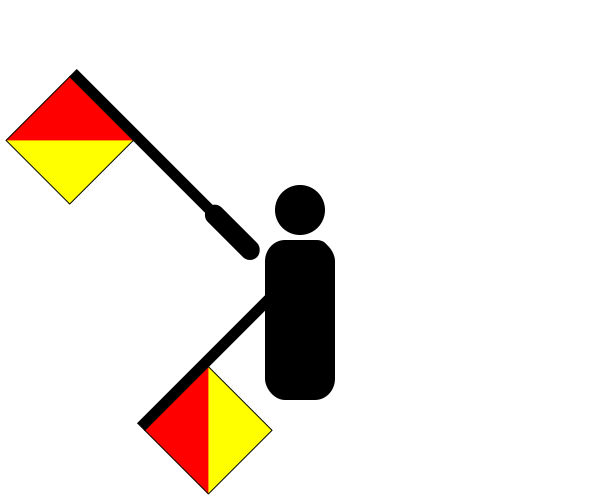

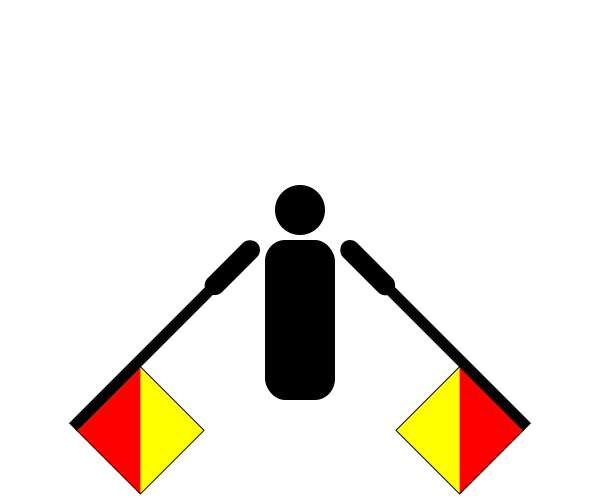
There are approximately 27 people named Cadigan in the UK. That makes it one of Britain's least common surnames. Fewer than one in a million people in Britain are named Cadigan.
Origin: Celtic
Region of origin: British Isles
Country of origin: Ireland
Religion of origin: Christian
Language of origin: Gaelic
