CABELL
Cabell is a surname that exhibits a complex genealogy, reflecting influences from French, Anglo‑Norman, and, to a lesser degree, Spanish and Portuguese linguistic traditions. Its recurrence in the medieval annals of England and its subsequent spread to the Americas demonstrate a long and varied lineage.
The most widely accepted etymology traces the name to the Old French word chebel, meaning “horse.” In this context the surname would have been allotted to a horse‑handler or to someone engaged in the trade of horses, thereby functioning as an occupational identifier.
Alternatively, medieval English records suggest that Cabell may represent a metonymic occupational name for a maker of ropes, particularly those used in maritime contexts. This theory derives from the Anglo‑Norman‑French term, itself a derivative of the Latin capulum, a halter. Early documentation from 1273 cites individuals such as Richard Cabel of Oxford, Henry Cabell of Somerset, and Thomas Cabel, rector of Irstead in Norfolk, illustrating the name’s presence across diverse counties with strong seafaring links.
The earliest known record of the family name is that of Adam Cabel, dated 1272 in the Hundred Rolls of Norfolk. The date falls within the reign of King Edward I, who was sometimes called “the Hammer of the Scots.” The name’s first appearance in Southern England also appears in a 1273 entry for a Henry Cabell of the parish of Branscombe, Devon.
In 1620 a coat of arms was granted to the Cabell family in Norfolk. The blazon of the arms features a green field charged with a silver fretty and a red fesse above, a description that appears in the heraldic rolls of that period.
Following the English colonisation of North America, a Joseph Cabell emigrated in the early seventeenth century. His descendants established themselves primarily in Virginia, a pattern that accounts for the concentration of the surname in that state today. Over subsequent generations the name spread to Maryland, the Carolinas, Georgia, Alabama and, via migration, to Australia, Canada, the United Kingdom and even the Philippines.
While the British‑based surname is most frequently encountered in the United States, earlier medieval sources place it firmly within the Devonshire and Norfolk regions, where it remained prominent until the modern era. English records mention marriages such as that of Thomas Cable and Emma Woddecokk in London in 1554, and Kezia Cable with Samuel Kent at St. George’s, Hanover Square, in 1788, indicating the name’s continued social mobility.
The surname Cabell is associated with a number of spelling variants derived from regional dialects and anglicisation. Known forms include Cabel, Cable, Cabell, Cabble, Cabal, Cabellero and Cabello. Each variant reflects the historical orthographic practices of the locality in which the bearer resided, yet all share a common root in Early Modern English, French, or Latin.
In conclusion, the Cabell surname exemplifies a multifaceted heritage that incorporates occupational symbolism, maritime tradition, and transnational migration. The documented appearance of the name from 1272 in England through the seventeenth‑century colonisation of North America and into contemporary global contexts underscores its enduring presence in the historical record.
Typical given names associated with the Cabell surname
Male
- Benjamin
- Dean
- Gary
- Joshua
- Samuel
Female
- Diane
- Helen
Similar and related surnames
Related and similar names are generated algorithmically based on the spelling, and may not necessarily share an etymology.
How to communicate the surname Cabell in...
Braille
⠉⠁⠃⠑⠇⠇
Morse
-.-..--.....-...-..
Semaphore


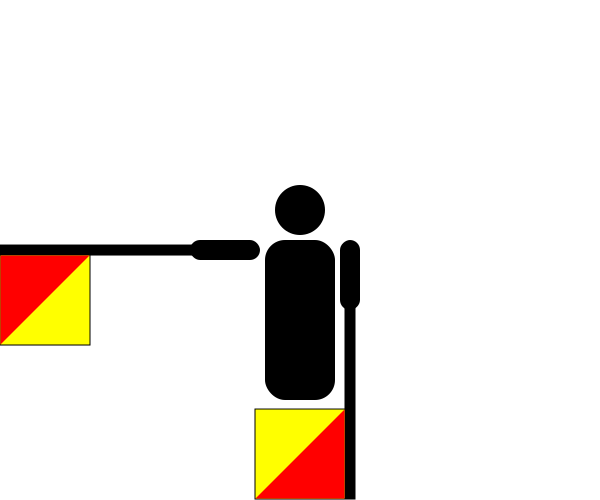


There are approximately 97 people named Cabell in the UK. That makes it one of Britain's least common surnames. Only around one in a million people in Britain are named Cabell.
Origin: English
Region of origin: British Isles
Country of origin: England
Religion of origin: Christian
Language of origin: English
