BYE
Bye is a surname of distinctly English provenance, first appearing in the historical record within the confines of the British Isles. It is consistently associated with the English language and Christian religious context of medieval England.
The etymology of Bye is multifaceted. It is generally treated as a topographic surname referring to an individual residing near a natural feature known in Old English as a byge – a prominent bend in a river, a hill or a rock outcrop that might have appeared distorting the surrounding landscape. Alternatively, the name has been interpreted as a locational surname for a person who originated from a place called Bye or Bie, and, in a more anecdotal vein, as a nickname for someone noted for saying goodbye frequently or for having a habit of leaving places.
Documented spellings of the surname include By, Bye, Buy, and Buye, all of which appear in medieval records from before the seventh century. In its earliest form, the spelling By is uniquely concise, being one of only a handful of two-letter surnames recorded in the British registers. Early references to the name appear in the Hundred Rolls of 1279, where Thomas filius Bye of Cambridge is mentioned, followed in 1327 by John Bye of Cambridge. Other early entries such as Alicia de Bly of Berwick in 1266, John ate Bey in the 1279 Hundred Rolls of Cambridge, and William in the By in the Subsidy Rolls of Somerset for 1327, illustrate the surname’s association with particular locations, often expressed in the Latinised pre‑positions de, de la, ate or the preposition “in the”.
Later soundings of the surname can be observed in various registers. For example, Robert Bye of London is recorded in the 1588 register of students at Oxford University, and Grizwell Buy is noted as having married at St Lukes Church in Chelsea in 1682. In the 16th century, Robert Bye of London married Susan Martin at St Antholins Church, London in 1568. The first documented instance of the family name appears in the Assize Court registers of Somerset in 1243, under Hugh de la Bye, during the reign of King Henry I—often referred to by contemporary historians as “the Frenchman”—in the period 1216 to 1272.
Scholarly observation by the late Professor Reaney suggests that in some situations B(u)y(e) may have functioned as a personal name rather than a purely locational indicator. Such instances are rare, but they point to the richness of medieval onomastic practices, where the boundary between place-names and individual names was often permeable.
Across the centuries, the surname has persisted primarily within England, maintaining a connection to its topographic and locational origins. While common today it retains a heritage that reflects the linguistic and social landscape of early medieval England.
Typical given names associated with the Bye surname
Male
- Andrew
- Christopher
- David
- James
- John
- Michael
- Paul
- Peter
- Richard
- Stephen
Female
- Barbara
- Christine
- Elizabeth
- Helen
- Jacqueline
- Karen
- Margaret
- Samantha
- Sarah
- Susan
Similar and related surnames
Related and similar names are generated algorithmically based on the spelling, and may not necessarily share an etymology.
How to communicate the surname Bye in...
Braille
⠃⠽⠑
Morse
-...-.--.
Semaphore
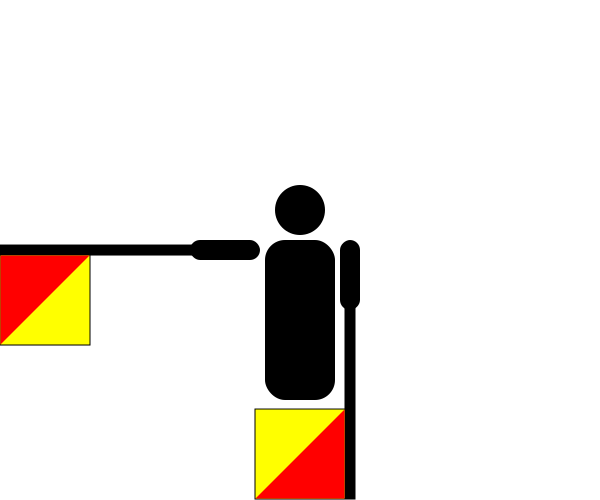
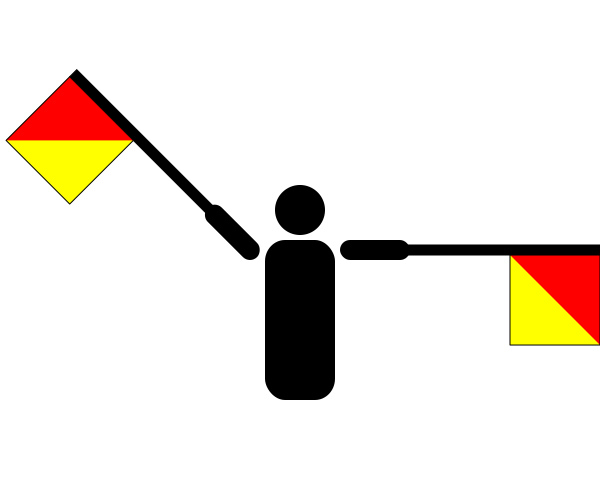

There are approximately 2,819 people named Bye in the UK. That makes it roughly the 3,167th most common surname in Britain. Around 43 in a million people in Britain are named Bye.
Origin: English
Region of origin: British Isles
Country of origin: England
Religion of origin: Christian
Language of origin: English

Famous people named Bye
- James Bye - Actor
Names and descriptions courtesy of Wikipedia, and may contain errors. This is not intended to be an exhaustive list of every famous person with this name.