BYARS
Byars is a surname that traces its roots to both Norse and Scottish heritage, with early influences evident in the Gaelic culture of the British Isles. It is traditionally associated with Christian and Celtic communities in Scotland, forming part of the naming patterns that developed across the region.
The first widely recognised derivation of the name is from the Old Norse personal name Bjorn, which translates to “bear”. This patronymic origin suggests that the surname originally identified the descendants of an individual named Bjorn. The usage of a former personal name as a family identifier reflects a common practice among Norse settlers in northern Britain during the early medieval period.
An alternative and equally documented derivation stems from the Old English word byre, meaning a cowshed or dairy. In this context Byars is understood either as a topographic reference to someone living near a cattle barn or as an occupational label for a person who tended cattle or worked on a farm. This agricultural link places the surname within a broader group of early hereditary names that described the work or locality of their bearers, such as Bull, Heffer, Stott and Palfrey.
Archival evidence confirms the surname’s antiquity, with records such as Elias de la Byare of Devonshire in 1275 and Thomas filius Bye of Cambridge in the Hundred Rolls of 1279. Other early examples include John Attebey in the same rolls and John Buyres of Somerset in the Subsidy Tax rolls of 1327. The name appears in multiple spellings throughout these documents, illustrating the fluid nature of orthography in the medieval period.
Variations of the surname are numerous, reflecting both linguistic evolution and transcription practices. Common forms include Byers, Byres, Byre, Bier, Biers, Buyers, Byras, Byrus and Byar. Scribes often wrote the name phonetically, leading to the diversity of spellings that continue to be recognised today.
Geographically, holders of the surname appear primarily in Scotland and Northern Ireland, with additional clusters in England, particularly in East Anglia, the West Country and the East Lothian area of Scotland. The diaspora of families bearing the name over the past several centuries has resulted in a noticeable presence in the United States, where the surname is most concentrated in the South‑Central and South‑Eastern states, including Oklahoma, Arkansas, Tennessee, South Carolina and Georgia. The name is also found, though to a lesser extent, in the United Kingdom, Australia and Canada.
In summary, Byars is a surname with a well‑documented history rooted in both Norse personal naming traditions and Old English agricultural terminology. Its multiple spellings and widespread geographic distribution testify to the enduring nature of surnames that marked identity through lineage, occupation, and locality within the medieval and modern societies of Britain and beyond.
Typical given names associated with the Byars surname
Male
- Alexander
- Andrew
- Christopher
- Craig
- David
- George
- Graham
- James
- John
- Paul
- Stephen
- Warren
- William
Female
- Ann
- Brenda
- Catherine
- Dorothy
- Elizabeth
- Jacqueline
- Jean
- Kathleen
- Katrina
- Louise
- Margaret
- Mary
- Nicola
Similar and related surnames
Related and similar names are generated algorithmically based on the spelling, and may not necessarily share an etymology.
How to communicate the surname Byars in...
Braille
⠃⠽⠁⠗⠎
Morse
-...-.--.-.-....
Semaphore
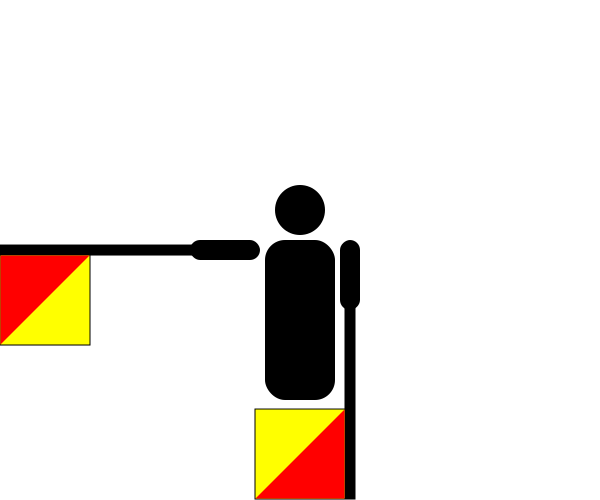
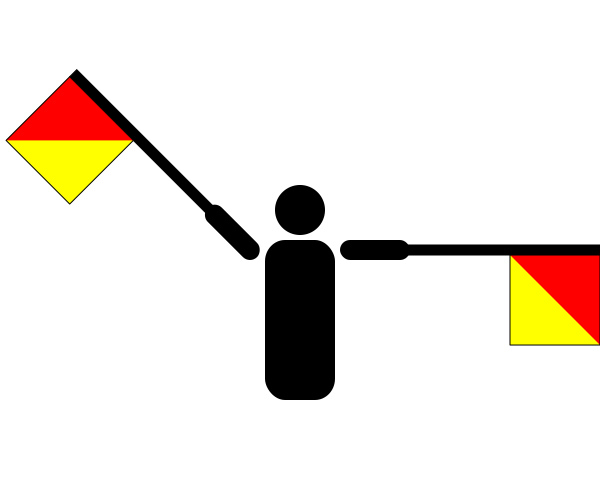

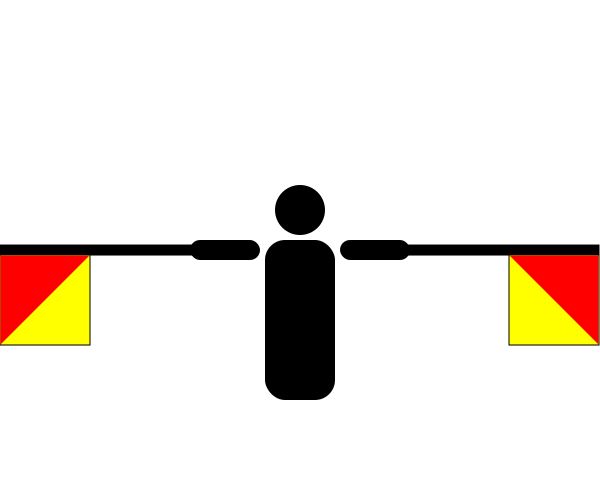

There are approximately 358 people named Byars in the UK. That makes it one of Britain's least common surnames. Only around five in a million people in Britain are named Byars.
Origin: Celtic
Region of origin: British Isles
Country of origin: Scotland
Religion of origin: Christian
Language of origin: Gaelic
