BUTE
Bute is a surname of Scottish origin, with its roots firmly planted in the Gaelic language. The name is traditionally understood to be a locational surname, signifying a person hailing from the Isle of Bute in the Firth of Clyde, Scotland.
The Gaelic word Bòid is believed to mean “victory,” and has been identified as one possible linguistic source for the surname. A related Gaelic word, Bód, translates to “peninsula” or “mound,” descriptions that would be appropriate for a family whose ancestors lived on the island itself. These meanings suggest a dual significance – a reference to a geographic feature and an aspirational quality associated with triumph.
Historical evidence links the surname to the Isle of Bute, an island that was once part of the ancient Kingdom of Strathclyde. The island is said to have taken its name from a 6th‑century Celtic king, Baetan, placing the surname within a broader context of early British kingship and territorial naming. Numerous individuals bearing the name likely held positions of influence on the island, contributing to its governance and cultural life over the centuries.
Recorded uses of the name appear in medieval documents: the name Robert le But is found in 1198 in the Pipe Rolls of Sussex, and William le But appears in 1214 in early London personal names. A more ancient spelling, Walter But, dated 1114–1130 in the Cartularium Monasterii de Rameseia, Norfolk, shows that the name existed during the reign of King Henry I, sometime between 1100 and 1135. These early attestations confirm that the name was already in use more than eight centuries ago.
During the Middle Ages, the spelling of the surname varied considerably. In addition to Bute and Butte, forms such as But, Butt, and Butts also appear. Some medieval records show the name prefixed with le or de, yielding variants like Le Bute and De Bute. Linguistic researchers have noted that the surname was sometimes associated with a personal nickname meaning “short and stocky,” or it could denote a fisher who sold salt fish, or a person who lived near a target used for archery practice. In modern times, it is also recognised as a sept of the Scottish Stewart clan.
The distribution of the surname has expanded beyond Scotland in response to emigration. Scottish settlers carrying the name have established communities in the United States, Canada, Australia, and New Zealand, among other countries that experienced significant Scottish diaspora. Although the name remains most closely identified with Scottish heritage, the global spread of the surname means that contemporary bearers may possess a diversity of ethnic backgrounds.
In contemporary usage, the surname Bute continues to be associated with its Scottish heritage, often signifying a lineage that traces back to the Isle of Bute and its historical significance within the Kingdom of Strathclyde and the broader Gaelic cultural sphere.
Typical given names associated with the Bute surname
Male
- Alan
- David
- George
- James
- John
- Lennox
- Mark
- Michael
- Richard
- Stanley
Female
- Elizabeth
- Helga
- Janet
- Jean
- Jennifer
- Maureen
- Michelle
- Patricia
- Susan
- Victoria
Similar and related surnames
Related and similar names are generated algorithmically based on the spelling, and may not necessarily share an etymology.
How to communicate the surname Bute in...
Braille
⠃⠥⠞⠑
Morse
-.....--.
Semaphore
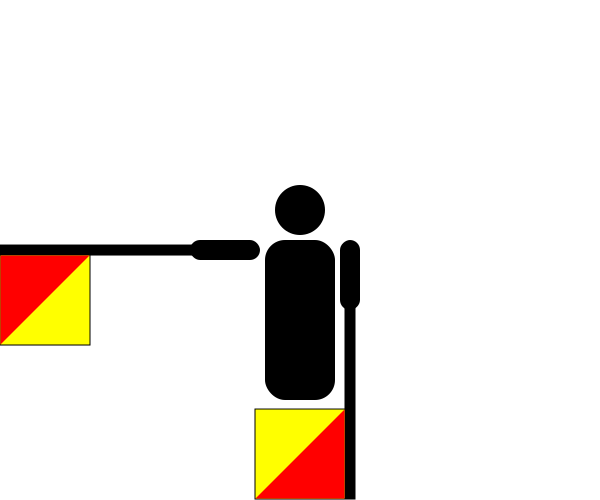

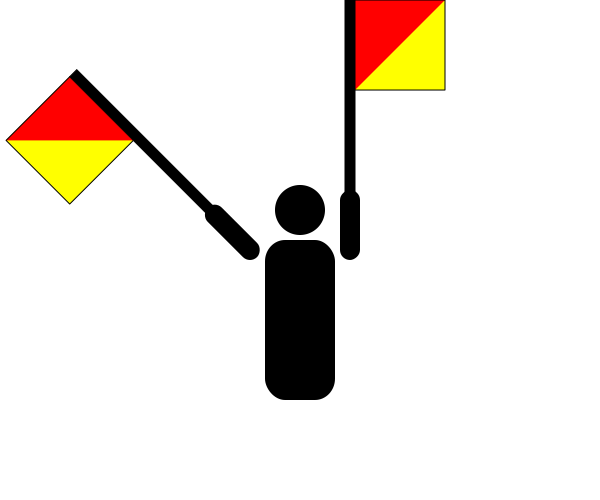

There are approximately 147 people named Bute in the UK. That makes it one of Britain's least common surnames. Only around two in a million people in Britain are named Bute.