BUSSE
Busse is a surname that originates from Germany and has its roots firmly planted in the linguistic and topographic traditions of the region. The name derives from the Middle High German word buhs, which translates to bush or shrub. As a topographic surname, it was likely bestowed upon an individual who lived near or worked among bushes, or on the contrary, upon a man of hearty, bushy hair. By the Late Middle Ages, the name had spread beyond a simple descriptor and entered the annals of hereditary surnames throughout Europe.
In addition to its Germanic roots, scholarly research points to a secondary origin in Old French. The term busse in that language denotes a cask or barrel, and early bearers of the name may have earned it as a metonymic occupational name for a cooper or, alternatively, as a descriptive nickname for a rotund figure. The earliest attestations of the surname appear in the ninth and tenth centuries: Siward Buss is recorded in the Domesday Book of 1086, a testament to the name’s presence in Kent during the reign of William the Conqueror. Subsequent entries include Walter Buss in the 1195 Pipe Rolls of Norfolk, Matilda Bus in the 1273 Hundred Rolls of Oxfordshire, and Adam Busse in the 1379 Poll Tax Returns of Yorkshire.
The 16th and 17th centuries witnessed the spread of the surname across the British Isles. Notable marriages such as that of Richard Buse and Margaret Bill at St. Bride on Fleet Street in 1590, and William Busse to Mary Riches at St. Dunstans in Stepney in 1600, demonstrate the name’s integration into contemporary civil society. In the 19th century, the artist Robert William Buss (1804‑1875) achieved prominence through theatrical portraits and historical scenes exhibited at the Royal Academy between 1826 and 1859, cementing the name’s cultural resonance.
In Germany, Busse maintains a strong presence, particularly in the northern and central states. The name first appears in documentary records from the 13th century in the area now known as Thuringia. From there, families migrated across the country, settling in regions such as Hamburg, where contemporary surname surveys indicate the highest concentration. Variants of the name—Bus, Buss, Buse, Buscher, Bussen, and others—reflect phonetic adaptation to local dialects and orthographic practices.
The surname has also travelled beyond the German‑speaking world. Immigrant waves to the United States, Brazil, Argentina, Russia, Chile, and Uruguay brought the name into new cultural contexts. In the United States, Busse remains relatively common in states with historically large German populations, including Ohio, Pennsylvania, Wisconsin, Iowa, and Nebraska. The distribution pattern mirrors the settlement history of German emigrants during the 19th and early 20th centuries.
The link between the etymological roots and the social identity embodied by the name is evident in the family mottos and symbols that have emerged over time. One commonly cited motto, “A Busse is loyal to the very end,” underscores the value placed on fidelity and familial coherence that many carriers of the name historically observed. The surname’s association with habitational origin—from villages or cantons named Busse—and its topographic connotations have further reinforced its status as a marker of both place and character.
From its earliest recorded mention in a 1086 legal manuscript to its modern presence across continents, the surname Busse illustrates a lineage that intertwines language, geography, and social history. Its survival and adaptation through centuries of migration, cultural change, and professional diversification attest to the enduring nature of the name within the collective memory of those who bear it. The continuity of spelling variations, coupled with a clear etymological core, offers a compelling portrait of how a simple descriptor of a shrub has evolved into a heritage name recognised around the world.
Similar and related surnames
Related and similar names are generated algorithmically based on the spelling, and may not necessarily share an etymology.
How to communicate the surname Busse in...
Braille
⠃⠥⠎⠎⠑
Morse
-.....-.......
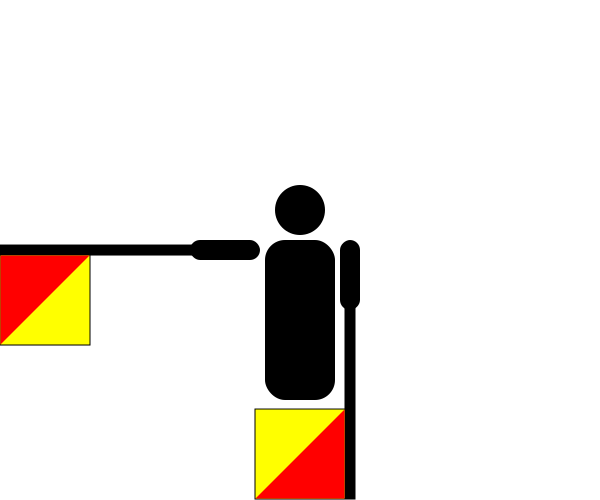
Semaphore


There are approximately 79 people named Busse in the UK. That makes it one of Britain's least common surnames. Only around one in a million people in Britain are named Busse.
Region of origin: Europe
Country of origin: Germany
Language of origin: German
