BURRESS
The surname Burress is recorded as having roots in both English and French traditions. It developed from several linguistic sources that were common in medieval England and France.
One primary derivation is from the Old French word bourgeois, which denoted a town dweller or citizen. In the medieval period the term was applied as a status name to members of the thriving middle class who owned property and engaged in commerce within a town. The English adaptation of the word gave rise to the surname Burgress and, after changes in spelling and pronunciation, the form Burress.
In addition to this French influence, the name appears to have a topographical component drawn from Old English. The pre‑7th Century word beorg meant hill or mountain, and individuals who dwelt beside a notable hill or tumulus were sometimes identified by a surname derived from this word. A related form comes from Old English burh, meaning fort or fortified place, frequently a Roman fortification, again pointing to a locational origin for the name.
A further possible derivation involves the combination of bur, meaning bower or cottage, with hus, meaning house. The resulting surname would designate a dweller at a bower‑house or, alternatively, an occupation for someone who worked in such a dwelling.
The earliest confirmed spelling of the family name is that of John de Burhus, dated 1440 in the Sheffield manorial records during the reign of King Henry V. The document notes that John de Burhus held land in the village of Sheffield, indicating a well‑established use of the surname in that region by the mid‑15th century.
Throughout the late medieval period the name evolved into several variants, including Burrows, Burroughs, Burrus, Burris, Burriss, and Borrows. These versions are all interconnected, reflecting differences in regional accents, literacy levels, and the absence of standardised spelling before the 18th century.
In Medieval England Burress or Burgess was often employed as an occupational surname for an elected representative who attended parliament on behalf of a borough. Such representatives usually came from the middle class, which is reflected in the modern sense of the word bourgeoisie, further underscoring the social status that the surname originally signalled.
While historically concentrated in the British Isles, the surname Burress today is predominantly found in the United States, where descendants of early English and French immigrants settled in large numbers. The name also appears, though less frequently, in the United Kingdom, Canada, Australia, and New Zealand, as a result of ongoing migration and diaspora.
Given its many spelling variations and complex origins, it is essential to conduct comprehensive genealogical research when tracing the lineages of individuals bearing the surname Burress. Such investigation should involve the examination of parish registers, manorial records, and other contemporary documents to distinguish between different branches of the family and to trace the precise evolution of the name through the centuries.
Similar and related surnames
- Barrass
- Barrese
- Barresi
- Barrasso
- Barrasa
- Barres
- Barress
- Barass
- Burres
- Bauress
- Beressi
- Bourassa
- Bures
- Buresh
- Buress
- Burgress
- Burrace
- Burras
- Burrass
- Barassi
- Berres
- Borase
- Bourasseau
- Bourees
- Buras
- Burrage
- Burrages
- Burree
- Burrels
- Burreson
- Burrews
- Burries
- Burriss
- Burross
- Burrs
- Burruss
- Bursa
- Barrs
- Birss
- Brass
- Breeze
- Burris
- Burrows
- Byres
Related and similar names are generated algorithmically based on the spelling, and may not necessarily share an etymology.
How to communicate the surname Burress in...
Braille
⠃⠥⠗⠗⠑⠎⠎
Morse
-.....-.-..-........
Semaphore
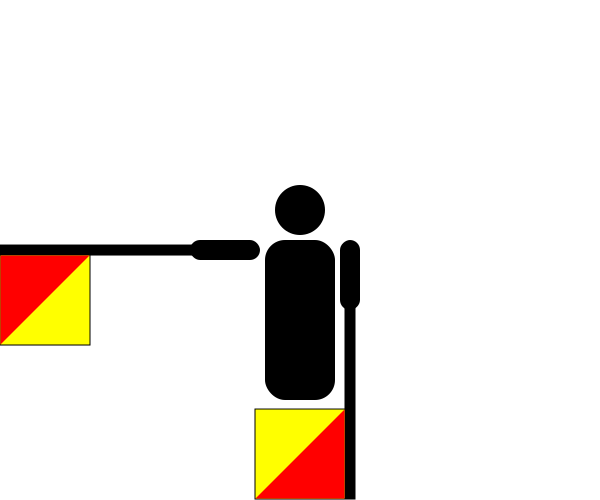

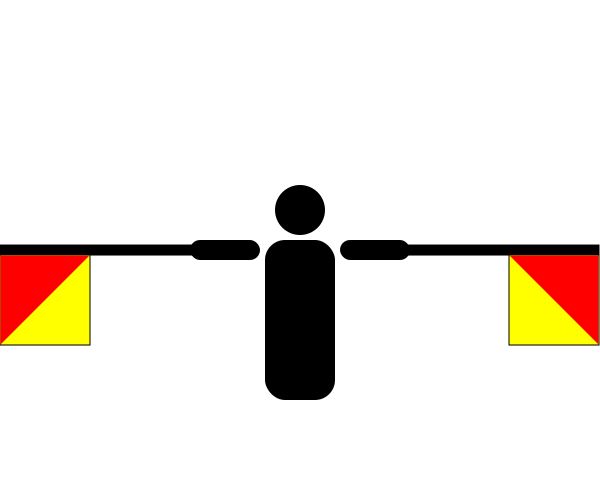


There are approximately 25 people named Burress in the UK. That makes it one of Britain's least common surnames. Fewer than one in a million people in Britain are named Burress.
Origin: English
Region of origin: British Isles
Country of origin: England
Religion of origin: Christian
Language of origin: English