BURGAN
Burgan is a surname that exhibits a complex etymological history, reflecting influences from English, Norse and French linguistic traditions.
The earliest documented appearance of the name is in the Domesday Book of 1086, where it is recorded as Burgoin in Devonshire during the reign of William the Conqueror. This form indicates a French origin brought to Britain after the Norman Conquest of 1066, where the term Bourgogne – meaning Burgundy, the region in eastern France – gave rise to a designation for a man from that area. Subsequent medieval records show the name evolving into forms such as Burgoin, Burgon and eventually Burgan.
In Scotland, the surname was first noted in the early eleventh and twelfth centuries. A Robert Burgonensis was mentioned in 1128 in association with St. Serf's Island, Loch Leven. Later holders of the name are recorded in the fifteenth and sixteenth centuries, including Thomas Burgane who held land in Innerkethin in 1500, and a John Burgan who obtained a tenement in North Quenesferrie in 1599. The Edinburgh christening book of 1670 documents a Margaret, daughter of John and Elizabeth Burgan, named on 21 April 1670.
Parallel to the Norman-derived line is an Anglo‑Saxon branch that can be traced back to the Old Norse personal name Bjǫrgun. In Old Norse, this name means “protection” or “saviour” and the surname functioned as a patronymic, indicating descent from a person so named. Over centuries the spelling shifted to Burgan and was transmitted as a hereditary family name.
Other traditions, surveyed by contemporary genealogical research, suggest that Burgan may also possess German, Irish or Jewish (Ashkenazic) connections. The Germanic root burg refers to a small castle or fort, and the name has been interpreted at times as a topographic designation for those living near such a feature. The Irish form is linked to the Gaelic surname O’Borgain, meaning descendant of Borgain. In Jewish contexts the name is occasionally regarded as a toponymic or occupational designation, although no definitive source confirms this usage for the English‑British form of the surname.
In England proper, the surname is considered of Old English origin, derived from the word burgean meaning to 'sprout' or 'blossom'. This derivation associates the name with individuals who resided near hilltops lush with budding foliage. Despite these rooted meanings, the surname is not highly frequent in contemporary England or Ireland, and its prevalence is largely seen in the United States, particularly in the states of Michigan and Indiana.
The spelling variants of the surname are numerous and have evolved over time due to regional dialectal differences, changes in literacy levels and immigration patterns. Widely recognised variants include Burgin, Burgen, Burgon, Burgun, Bergan, Bergin, Bergen, Bergon, Bergun, Borgan and Borgon, among others. Anglicisation of similar Irish names such as Ó Beirgin has produced forms like Bergen or Berghan, which can be mistaken for Burgan in historical records.
Notable bearers of the name, especially in the United States, can be found in a variety of fields, from the early settler era to modern professional domains. However, no single individual has achieved a level of prominence that defines the surname across the broader public consciousness.
The distribution of the name Burgan has been shaped by historic migration waves, including those during the period of Anglo‑Scottish colonisation of America. Consequently, the spelling and prevalence of the surname vary, with recognisable clusters in American Midwestern states and a smaller, yet persistent, presence across the British Isles.
Comprehensive genealogical research remains essential for accurate identification of lineage, as the inability to trace a name exclusively to one origin can lead to misinterpretation of family history. Any analysis of the surname Burgan should therefore consider documented records such as the Domesday Book, parish registers, land charters and contemporary census data.
In sum, the surname Burgan embodies a multifaceted heritage that reflects Norse patronymic tradition, Norman French territorial designation and Old English toponymy, all of which have contributed to its enduring presence within the English‑speaking world.
Typical given names associated with the Burgan surname
Male
- Anthony
- Christopher
- David
- James
- John
- Mark
- Michael
- Nigel
- Paul
- Philip
- Richard
- Simon
Female
- Alison
- Angela
- Deborah
- Emma
- Helen
- Jill
- Julia
- Julie
- Laura
- Lynne
- Nina
- Patricia
- Rachel
- Sarah
- Sharon
Similar and related surnames
- Baragan
- Barga
- Bargan
- Bargman
- Barragan
- Barrigan
- Baughan
- Beregan
- Berga
- Bergain
- Bergan
- Berganio
- Bergant
- Berghahn
- Bergman
- Berigan
- Berragan
- Berrigan
- Birgani
- Birkin
- Borga
- Borgan
- Borgman
- Bourgain
- Bragan
- Breckon
- Bregan
- Brogan
- Buran
- Burani
- Burga
- Burgain
- Burgaine
- Burgaj
- Burgam
- Burgamy
- Burgand
- Burgandy
- Burgany
- Burgap
- Burgar
- Burgas
- Burgayne
- Burgaz
- Burgham
- Burghan
- Burgman
- Burgmans
- Burgoin
- Burgoine
- Burgon
- Burgoyn
- Burgoyna
- Burgoyne
- Burgun
- Burgwin
- Burgwyn
- Burkan
- Burkin
- Burnan
Related and similar names are generated algorithmically based on the spelling, and may not necessarily share an etymology.
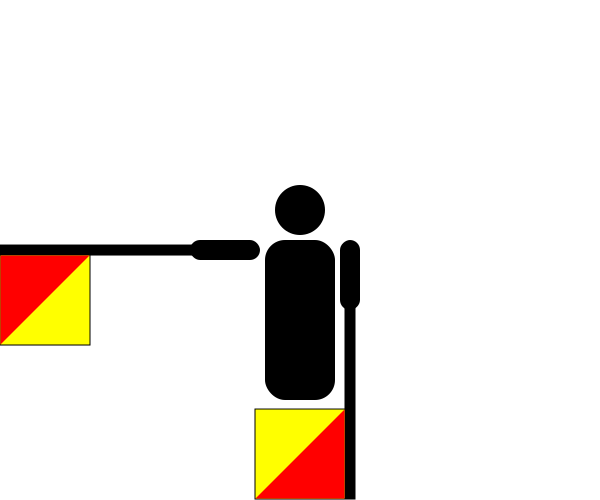
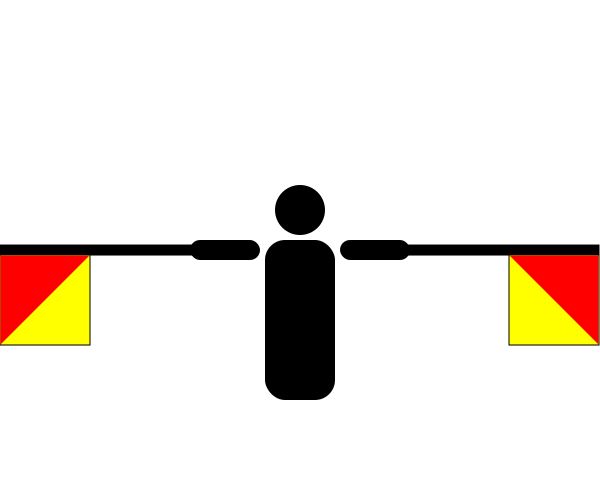
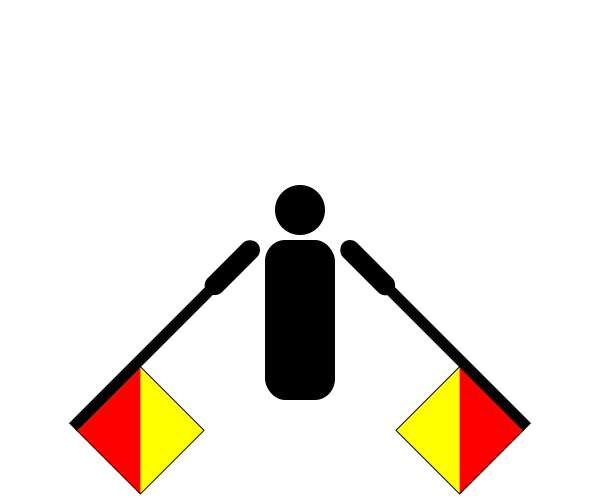
How to communicate the surname Burgan in...
Braille
⠃⠥⠗⠛⠁⠝
Morse
-.....-.-.--..--.
Semaphore



There are approximately 308 people named Burgan in the UK. That makes it one of Britain's least common surnames. Only around five in a million people in Britain are named Burgan.
Surname type: Location or geographical feature
Origin: English
Region of origin: British Isles
Country of origin: England
Religion of origin: Christian
Language of origin: English
