BUNYARD
Bunyard is an English surname, classified as a locational or occupational name. Its elements are derived from Old English: the component bune, recorded in several variants as baen or bune, meant either “bean”, “reed” or “spring”, depending on the linguistic tradition, and the suffix geard, meaning an enclosure, yard or boundary. Consequently the name originally described either a person who cultivated beans at a particular field, a worker involved in the harvesting of reeds near a stream, or someone dwelling close to a natural enclosure such as a spring or a reed‑filled valley.
The earliest documentary evidence for the name is found in the early twelfth and thirteenth centuries. In 1207 the Pipe Rolls of Norfolk record a Robert Baniard, and a later entry in the Domesday Book of 1086 cites the variant spellings Baignard, Bangiard and Baniard for a person in Hertfordshire that had been introduced into England by the Normans. In the fifteenth century, the Inquisitions and Assessments concerning Feudal Aids for Suffolk mention a William Banyard in 1346, while parish registers in the late seventeenth century record christenings and marriages of individuals carrying the surname, such as Elizabeth Banyard (1684) and Dorothy Banyard (1694). The name therefore persisted through medieval and early modern England with a series of orthographic variations.
While the domestic English record is well documented, the name also exhibits a Germanic influence. One proposed source is the Old German personal name Beinnhard, a compound of “beinn” (straight) and “hard” (brave or strong). This name was brought to England by the Normans and appears in the Domesday Book as Baignard, after developing into the English variants noted above. Although the Germanic hypothesis is supported by some medieval charters, it has not achieved the same breadth of acceptance as the purely Anglo‑Saxon derivation from bune and geard.
In contemporary usage, the surname is not common enough to feature among the most frequent names in the United Kingdom, yet it remains most frequently encountered in the southern counties of Somerset and Wiltshire, as well as in several London boroughs. The United States has a small but discernible concentration of the name, particularly in the New England corridor of Maine, New Hampshire, Massachusetts, Rhode Island and Connecticut, and also in the Midwest provinces of Illinois and Ohio. In the United States, Bunyard ranks within the top 10,000 surnames and is classed as a non‑rare surname within the population database.
Several spelling variants coexist, with the most common being Banyard, Baniard, Bunyarde and Bunyardes. In some Irish records the surname appears as Banard, a form derived from the local word for a bean field. The latter variants are occasionally found in continental Europe, where they appear under French or Germanic influences as Beauchard or Banard; these forms are however comparatively rare outside of Britain and North America.
Notable individuals bearing the name are documented from the eighteenth through the early twentieth centuries. The poet Robert Bunyard of the eighteenth century is recorded in literary annals, while early twentieth‑century figures such as gangsters Albert and George Bunyard are referenced in criminal histories of London’s underworld. These examples illustrate the surname’s persistence across a broad historical spectrum, from rural agricultural communities to the urban milieu of capital cities.
In summary, Bunyard is a surname of Old English origin, signifying a person associated with reeds, beans or a natural enclosure. It survived through the Middle Ages and into the modern era, surviving orthographically in various forms while maintaining a modest geographic presence in both the United Kingdom and the United States. The name’s continued appearance in historical records and contemporary census data confirms its resilience as part of the British onomastic heritage.
Typical given names associated with the Bunyard surname
Male
- Clive
- Daniel
- Ivan
- John
- Lee
- Mark
- Nicholas
- Nolan
- Paul
- Peter
- Robert
- Ross
- Simon
Female
- Abigail
- Angela
- Carol
- Caroline
- Clare
- Elizabeth
- Emma
- Joanne
- Leonore
- Lynster
- Margaret
- Marion
- Ruth
- Valerie
Similar and related surnames
Related and similar names are generated algorithmically based on the spelling, and may not necessarily share an etymology.
How to communicate the surname Bunyard in...
Braille
⠃⠥⠝⠽⠁⠗⠙
Morse
-.....--.-.--.-.-.-..
Semaphore
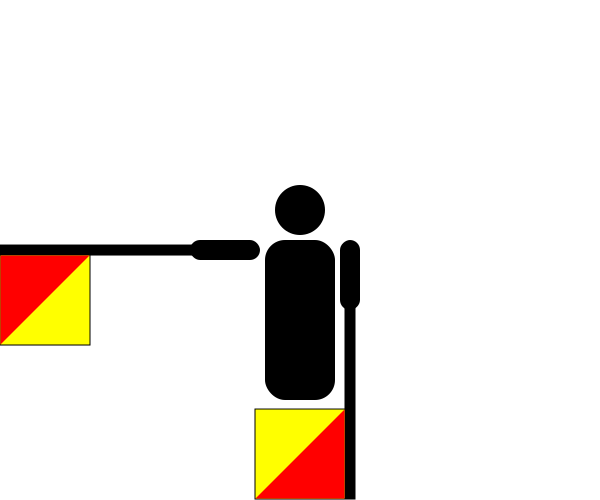

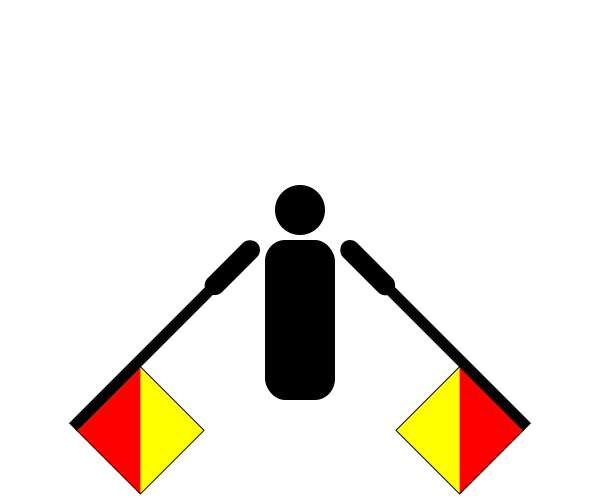
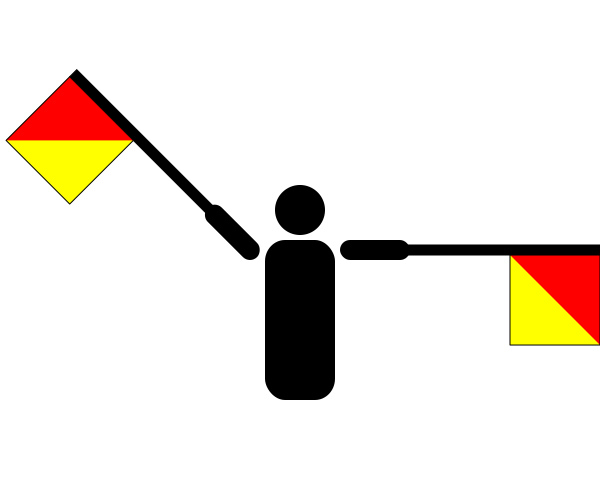

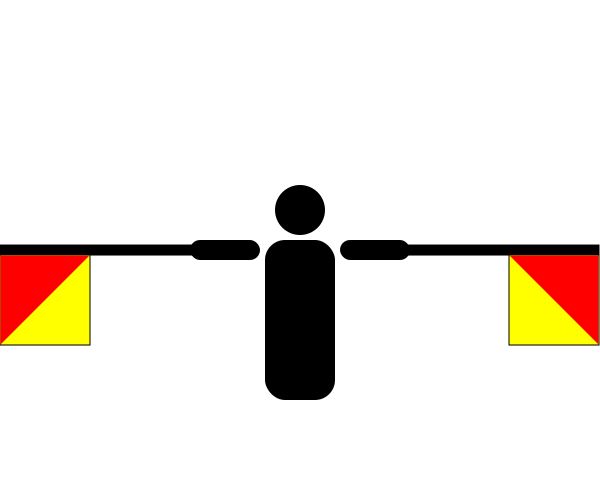

There are approximately 306 people named Bunyard in the UK. That makes it one of Britain's least common surnames. Only around five in a million people in Britain are named Bunyard.
Surname type: Occupational name
Origin: English
Region of origin: British Isles
Country of origin: England
Religion of origin: Christian
Language of origin: English
