BUFF
Buff is a surname that exhibits a complex etymology, with documented origins in several linguistic traditions. In its earliest attestations it is associated with the Germanic languages, then found in English and French contexts, each of which offers a distinct line of derivation.
The Germanic root is traced to Middle High German, where the word buf or bouf meant “buffalo” or “ox.” The surname therefore appears to have originally denoted a person who worked with or owned these animals. Such occupational names were common in medieval German society, and the same pattern of usage is recognisable in related surnames that reference other livestock. In certain cases the name may also have served as a nickname, applied to individuals whose physical stature or strength resembled that of a bull or ox, reflecting the nickname tradition in German-speaking regions.
In England, the surname appears in the early twelfth and thirteenth centuries in a number of spellings, including Bow, Bowe, Bough, and Buff. There are at least three plausible explanations for its English development. The first is that it is a metonymic occupational name for a maker or seller of bows, a trade that was highly valued before gunpowder became widespread. This hypothesis draws on the Old English word boga (meaning “bow” in the sense of the weapon) and its linguistic ancestor bugan, meaning “to bend.” A second possibility is that the name was topographical, given to someone who lived near a bridge, as the same term had taken on the meaning of an arch. A third avenue is locational; the surname could be linked to places called Bow, Bowe or Bough, or to a house sign bearing a branch or bough of tree, a common naming practice in medieval England.
Early documentary evidence supports the English rendering. For example, in the Calender of Letter Books of the City of London a person named Richard atte Bowe is recorded in 1306, and a Nicholas atte Boughe appears in Somerset in 1327. In the Church of England registers one can find a christening of an Elizabeth Buff at St Mary Lothbury in London in 1597, confirming the continued usage of the name into the early modern period. In Ireland the surname sometimes occurs as an anglicised form of the Gaelic O'Buadhaigh, meaning “descendant of Buadhach,” a personal name translating as “victorious.”
The French tradition attributes the name to Old French roots. The most common hypothesis holds that Buff derives from the word buffe, meaning a shield or armour. The surname might have been adopted by families who owned or frequently wore a shield, thereby signalling a martial affiliation. A second hypothesis connects the name with the Old French verb bouffer, meaning “to puff out the cheeks,” which could describe a person’s physical appearance or a musician playing a trumpet-like instrument. While the exact nuance of the Old French derivation is difficult to pin down, it is clear that the name was introduced into England following the Norman Conquest of 1066, as Norman French became one of the dominant languages of the English aristocracy.
In the latter part of the twentieth century the surname Buff became increasingly cosmopolitan. Census data display bearers of the name in diverse countries, including the United States, Canada, Australia, and Germany, as well as the United Kingdom. In the United States the surname is most widely distributed in the state of Ohio, where it ranks within the top thirty surnames. It also occurs at noteworthy frequencies in New York, Delaware, Virginia, South Carolina and Georgia. The patterns of distribution in these modern contexts are largely shaped by migration rather than by recent changes in the meaning of the name.
Throughout its history, the surname Buff has been associated with a range of professions. In medieval Europe the name appears in records of blacksmiths, bowyers, and livestock breeders. In more recent times it is found among businessmen, craftsmen, music professionals and the performing arts. Not all of the modern associations stem from original occupational usage; many are simply the result of the name’s persistence across generations and its adoption by people in a wide variety of vocations.
The multiplicity of origins and the enduring presence of the surname mean that a single definitive etymology is elusive. Rather, the best understanding recognises that Buff has drawn from German, English and French linguistic sources, each offering a plausible strategy for the name’s genesis. The name carries with it a strong association with physical strength, martial readiness and craftsmanship, themes that echo its varied historical roots. This enduring versatility has helped the surname to survive across centuries and continents, maintaining its presence in contemporary genealogical records and in the naming practices of families around the world.
Typical given names associated with the Buff surname
Male
- Anthony
- Clinton
- Colin
- David
- Dennis
- James
- Jamie
- John
- Mark
- Peter
- Robert
Female
- Gail
- Gemma
- Gillian
- Katie
- Leigh
- Patricia
- Sharon
- Susan
- Tracey
- Wendy
Similar and related surnames
Related and similar names are generated algorithmically based on the spelling, and may not necessarily share an etymology.
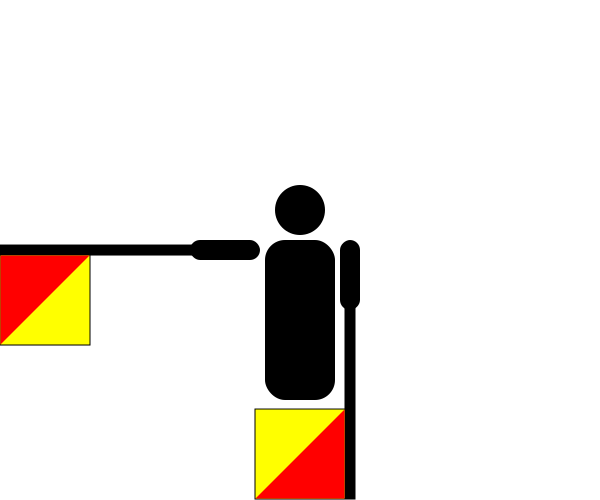
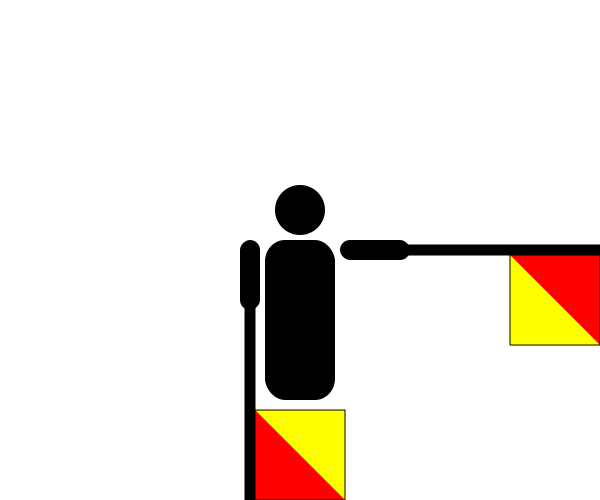
How to communicate the surname Buff in...
Braille
⠃⠥⠋⠋
Morse
-.....-..-...-.
Semaphore

There are approximately 182 people named Buff in the UK. That makes it one of Britain's least common surnames. Only around three in a million people in Britain are named Buff.
