BRUNET
Brunet is a surname of French origin that traces its roots to the French word brun, meaning “brown.” The name was originally applied as a nickname to individuals who possessed brown hair or a brown complexion, and it later became a hereditary surname.
Derivations of the word brun can be found across several European languages, where it was used to describe people of a particular hair or skin tone. The surname appears in historical records under a wide array of spellings, including Brown, Broune, De Bruyn, Brauner, Bruni and Brunet itself. In addition, regional variations such as Brunette, Brunot, Bruneteau, Bruneton and Lébrun are found throughout the Francophone world.
In medieval England the name was recorded in 1169 in the Pipe Rolls of Northumberland as William le Brun. Further early attestations include Hugh Bron of Stafford in 1274 and Hugo Brun of Erfurt, Germany in 1407. The first documented spelling of the family name in the New World appears in 1623 with Christopher Browne, a settler listed among the colonists of New England. These records show that the name travelled both within Europe and across the Atlantic during the early modern period.
Today the surname remains predominantly concentrated in France, where it is ranked as the forty‑second most common surname and is borne by nearly thirty‑eight thousand people, according to the genealogical website Forebears. Significant populations can also be found in Canada, particularly in Quebec, as well as in regions of the United States with substantial French‑Canadian heritage. The name is present in other European countries, albeit in smaller numbers, reflecting historical patterns of migration and settlement.
The English equivalent of Brunet is Brown, and in German the surname is rendered as Brun or Brunau. The name has also given rise to related forms such as Brunelle, Brunelli, Brunetto and Brunini, which often incorporate diminutive suffixes like -et, -in or -on to indicate a younger or smaller person with the same characteristic.
During the pre‑7th century period, the personal name Brun was popular in Germanic and Anglo‑Saxon societies, derived from a Germanic word or an Old Norse personal name Bruni. It is likely that the surname was initially a tribal or national nickname, or that it described someone who habitually wore brown clothing, as might be the case for a monk or cleric. The transition from a descriptive nickname to a family name correlates with the wider European shift toward hereditary surnames in the 12th century.
In Ireland, holders of the surname Brunet are believed to descend from 12th century Norman settlers, a connection that can be traced through records relating to the Norman influence in Gaelic territories. Similarly, the surname was used by a number of Barretts of Galway, who were described in the annals for being descendants of a knight called Hugo le Brun.
In summary, the surname Brunet represents a well‑documented lineage that originated in France and spread throughout Europe and to North America. Its persistence as one of the most common surnames in France, coupled with the numerous spelling variants and historical records, illustrates the enduring nature of name-based identity in European culture.
Similar and related surnames
Related and similar names are generated algorithmically based on the spelling, and may not necessarily share an etymology.
How to communicate the surname Brunet in...
Braille
⠃⠗⠥⠝⠑⠞
Morse
-....-...--..-
Semaphore
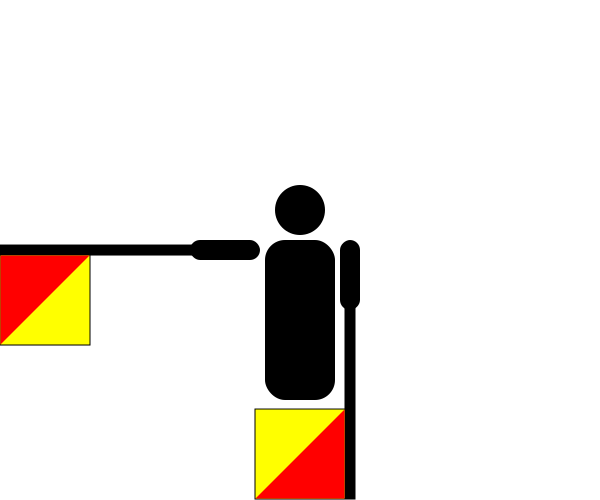
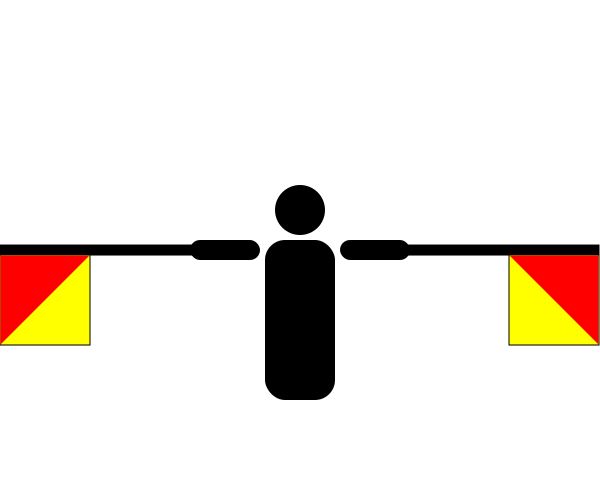

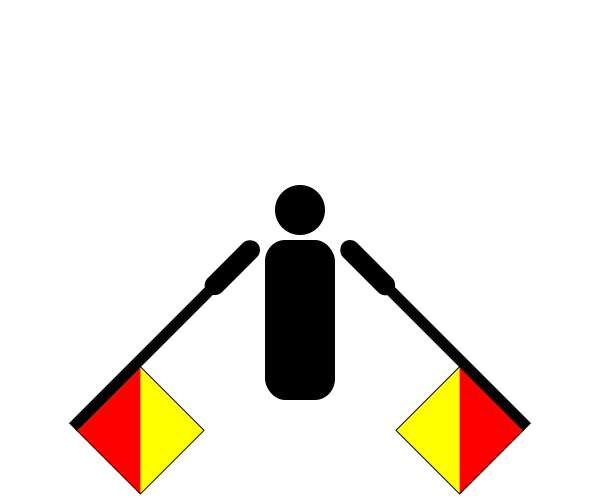

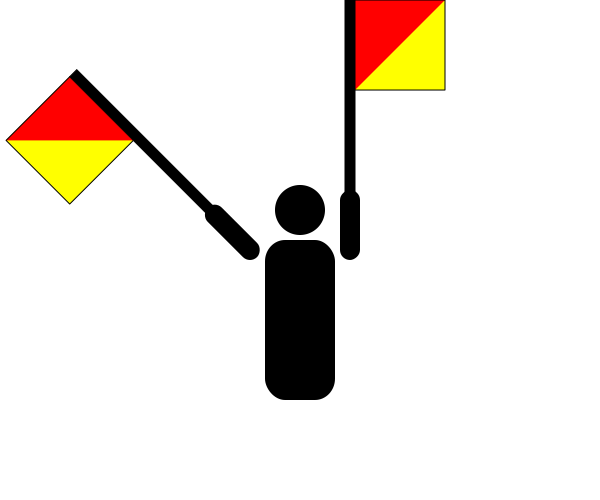
There are approximately 112 people named Brunet in the UK. That makes it one of Britain's least common surnames. Only around two in a million people in Britain are named Brunet.
Region of origin: Europe
Country of origin: France
Language of origin: French
