BRUGGER
Brugger is a surname of Germanic origin, deriving from the Middle High German word brugge which translates as “bridge”. The name is traditionally understood to have been applied to individuals who lived in proximity to a bridge, or who were employed in the construction, maintenance or toll-gathering of bridges. This occupational or topographical designation is characteristic of many surnames that emerged in medieval Europe.
The earliest documentary evidence of the surname appears in medieval English records. The name is first recorded in 1272 in the Pipe Rolls of Surrey as Gilbert atte Brigge, a notation made during the reign of King Henry the I, who reigned from 1216 to 1272. Subsequent mentions include Nicholas de la Brugge of Worcester in 1275 and William ater Bregg of Sussex in 1296. These entries illustrate the spread of the name across England, often reflecting its Anglo‑Saxon and Old English roots, where the equivalent term for bridge was brycg (pre‑7th century).
In German contexts, the name is interpreted as a topographic marker for those dwelling near a bridge, a meaning supported by the Middle High German phrase bruggære “bridge‑keeper”. The surname is particularly associated with the regions of Swabia in Germany and the canton of Bern in Switzerland. In the United States, the name is most frequently encountered in states with significant German immigrant populations, notably Wisconsin, Ohio and Pennsylvania.
Over the centuries the surname has acquired a range of variant spellings, including Brugger, Brügger, Bruge, Brugg and Brügg. These variations arose largely from regional dialects, differences in transcription practices and the natural evolution of spelling conventions. In the English-speaking world, close cognates such as Bridge, Briggs and Bridgeman belong to the same etymological family, reflecting the common linguistic root for bridge.
Other surnames with related origins include the Dutch Bruyn and Bruyere, as well as Germanic names such as Bruckner and Bruecker. These names share a common heritage in Middle Dutch or Old High German terms for bridge or passage, underscoring the widespread medieval practice of adopting locational or occupational identifiers as family names.
Modern research indicates that the migration of individuals bearing the Brugger surname, driven by economic opportunity and colonisation, has spread its bearers throughout Europe and beyond. Despite this dispersion, the name remains most commonly found in German‑speaking regions and in the United States, where it continues to be a marker of familial linkage to historic bridge‑related occupations or settlements.
Similar and related surnames
Related and similar names are generated algorithmically based on the spelling, and may not necessarily share an etymology.
How to communicate the surname Brugger in...
Braille
⠃⠗⠥⠛⠛⠑⠗
Morse
-....-...---.--...-.
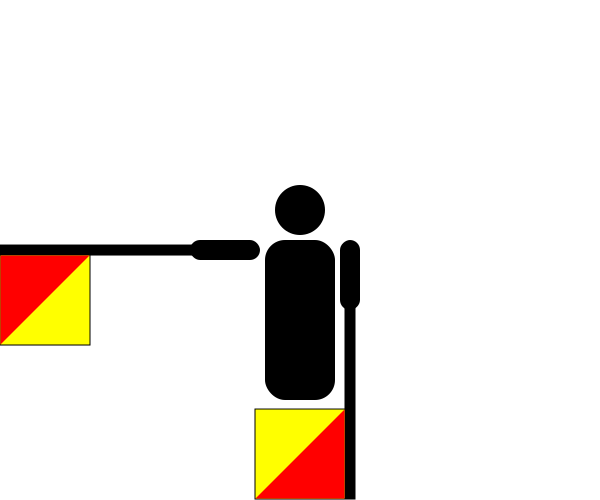
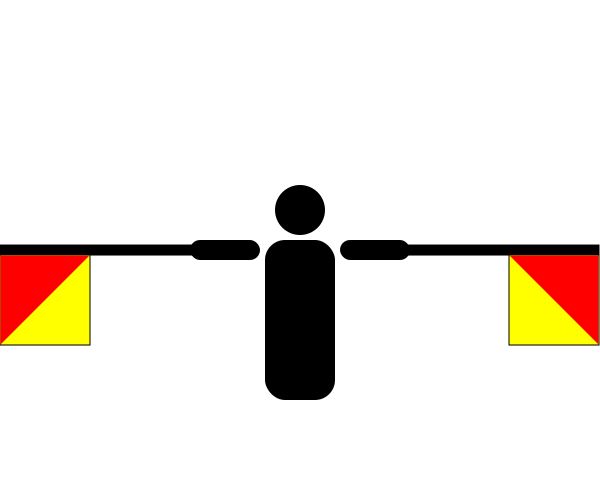
Semaphore


There are approximately 66 people named Brugger in the UK. That makes it one of Britain's least common surnames. Only around one in a million people in Britain are named Brugger.
