BRUFF
Bruff is a surname of predominantly English derivation, with possible interconnections to Irish and Norse linguistic roots. It is a toponymic name that originally signified a person dwelling near a particular geographical feature or holding a position of local importance.
According to early Anglo‑Saxon etymology the root brōc means “brook” or “stream”. The suffix -ing was often used to denote “descendant of” or “belonging to”, making Bruff a locational designation for those living adjacent to a watercourse. Similarly, the Old English burh means “fortress” or “fortified place”, and is reflected in numerous Yorkshire and Derbyshire place names such as Brough and Brougham. The surname, therefore, could identify a person associated with a Roman fortification or a local stronghold.
The name appears in documentary records as early as the twelfth and thirteenth centuries. A witness named Daniel de Buag is recorded in the Assize Rolls of Yorkshire for 1219, during the reign of Henry XII. In 1275 the Hundred Rolls of Norfolk contain a reference to William de Brugh. Several medieval variants have survived, including Broghe, Broughe, Brouf, Broffe and the modern spelling Bruff. These variations arose from differences in dialect, orthographic practices and the absence of a fixed spelling in the period.
One notable later reference is the christening of Robert Brough on 14 November 1559 at St. Vedast Foster Lane and St. Michael le Querne in London. His son, Phillipp Broughe, was baptised on 9 September 1565 in St. Martin Ludgate, Staffordshire. The migration track of the name is further illustrated by a famine emigrant known as G. Brough who sailed from Liverpool on the ship Adam‑Lodge to New York on 2 June 1847.
Some scholars have proposed a Norse influence. The Old Norse word broddr denotes a “point”, “goad”, or the “end of a sword”, suggesting that bearers of the name might have been smiths, warriors or individuals associated with military practice. Likewise, the suffix -off has been linked to a dwelling or place, yielding an interpretation of the name as “one who lives by or manages a bridge”, an idea supported by the Old Norse bru meaning “bridge”.
In the Irish context the surname occurs in forms such as Brough or Brugh. These are believed to be linked to sites of mythological significance, notably the Hill of Tara which was historically called Teamhair Bhrugh. Such connections hint at a Celtic heritage that may intersect with the English lineage, a phenomenon not uncommon among surnames that travelled with settlers across the Irish Sea.
Spatially, the name remains relatively uncommon today. Its highest concentration is still found in the British Isles, particularly within the counties of Staffordshire, Yorkshire, County Limerick and Northern Ireland. Diaspora communities in the United States, Canada, Australia and the United Kingdom retain traces of the name, a testament to the migration patterns of the nineteenth and early twentieth centuries.
Despite its rarity, Bruff has endured for more than eight centuries. The surname’s varied origins—whether from a brook, a fortified site, a bridge or a mythical hill—illustrate the complex interplay of language, geography and social history that gave rise to English and Irish family names. For those bearing the name, the heritage embodied in Bruff remains a living link to lineages that may stretch back over a millennium.
Typical given names associated with the Bruff surname
Male
- Alexander
- Andrew
- Christopher
- David
- Ian
- Isaac
- John
- Paul
- Richard
- Stephen
Female
- Anne
- Claire
- Debbie
- Jacqueline
- Kathleen
- Kelly
- Linda
- Margaret
- Nicola
- Winifred
Similar and related surnames
Related and similar names are generated algorithmically based on the spelling, and may not necessarily share an etymology.
How to communicate the surname Bruff in...
Braille
⠃⠗⠥⠋⠋
Morse
-....-...-..-...-.
Semaphore
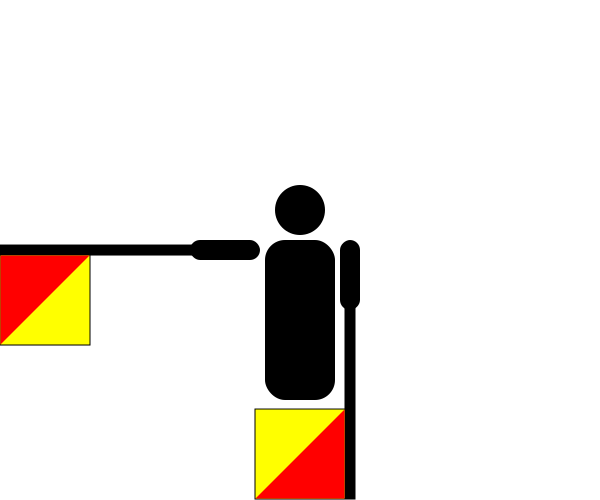
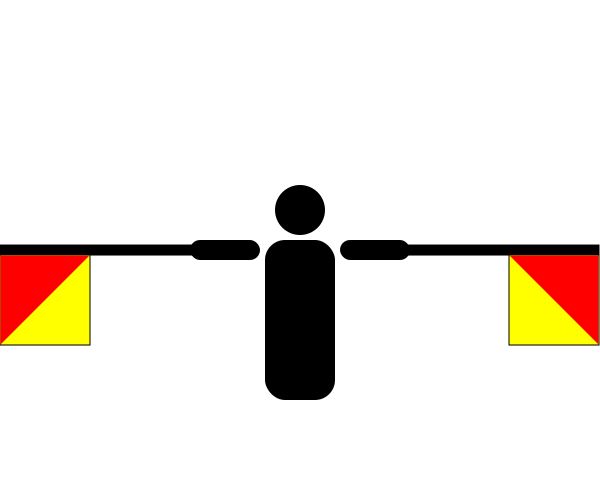

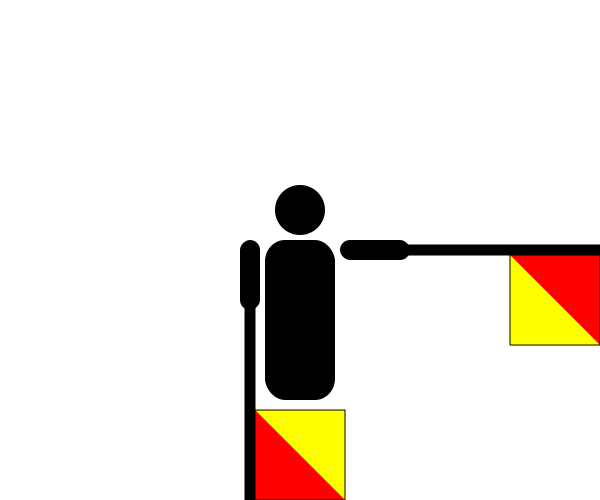
There are approximately 115 people named Bruff in the UK. That makes it one of Britain's least common surnames. Only around two in a million people in Britain are named Bruff.
