BRUCKNER
Bruckner is a surname that finds its roots in the Germanic linguistic tradition, most explicitly derived from the Middle High German word brücke, meaning *bridge*. The name traditionally identified an individual who either manufactured, maintained or supervised such structures, and as such it served both a topographical and an occupational function within the communities that employed it.
Early documentary evidence of the surname appears in the late twelfth and early thirteenth centuries. In the Pipe Rolls of Surrey a record dated 1272 names a Gilbert atte Brigge, while the name Nicholas de la Brugge is recorded in Worcester in 1275 and William ater Bregg appears in Sussex in 1296. These instances illustrate the early use of a bridge‑related designation for landholders and workers, establishing the antiquity of the surname.
Across Northern Europe the name is documented in over fifty variant spellings, ranging from Bridge, Briggs and Bridgeman to the Germanic forms Bruckner, Pruckner and Brückner, and even Terbrugge. The variations arise from linguistic shifts across Old English pre‑seventeenth‑century expansions and from the multiple German dialects that influenced naming conventions in German‑speaking states.
In Germany, the spelling Bruncken is generally more common than Bruckner, and the last name is broadly distributed throughout Bavaria, North Rhine–Westphalia and Baden‑Württemberg. In Austria it is found in Vienna, Lower Austria and Salzburg. In the United States Bruckner occurs in more than twenty states, with higher concentrations in California, New York, New Jersey, Pennsylvania, Florida and Illinois. The dispersion mirrors patterns of German emigration, where settlers often anglicised or adapted the spelling of the name to the phonology of the language of their new country.
The surname also appears in other Central and Eastern European countries such as Hungary, Poland and even in some Jewish communities. In those contexts the name was sometimes adopted as a means of integration into German‑speaking society, with spelling adaptations such as Brueckner or Bruckmann arising from local dialectical practices.
Beyond its purely civil references, the Bruckner name is associated with a model of antique French windmill constructed in 1871 by Joseph and Annet Bruckner. This device is notable for being the world’s first windmill model to employ controlled rotation, underscoring the breadth of influence that individuals bearing the name have exerted across fields as diverse as civil engineering and mechanical invention.
Similar and related surnames
Related and similar names are generated algorithmically based on the spelling, and may not necessarily share an etymology.
How to communicate the surname Bruckner in...
Braille
⠃⠗⠥⠉⠅⠝⠑⠗
Morse
-....-...--.-.-.--...-.
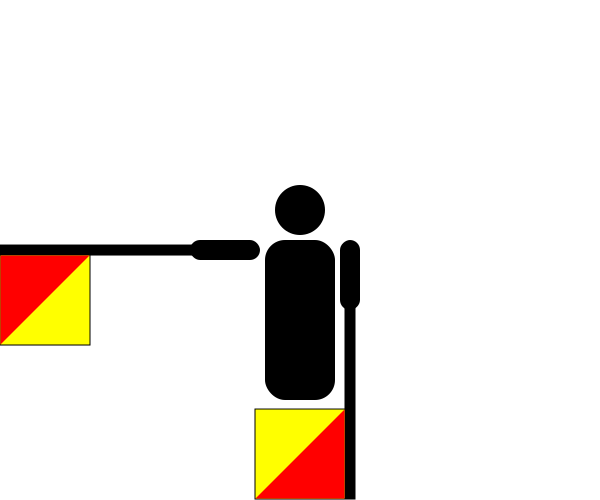
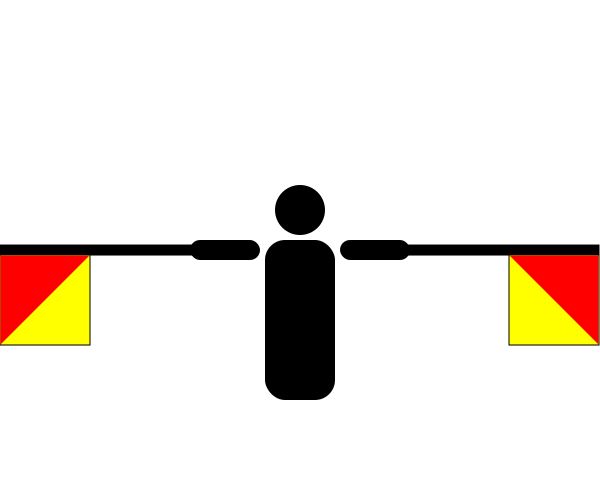
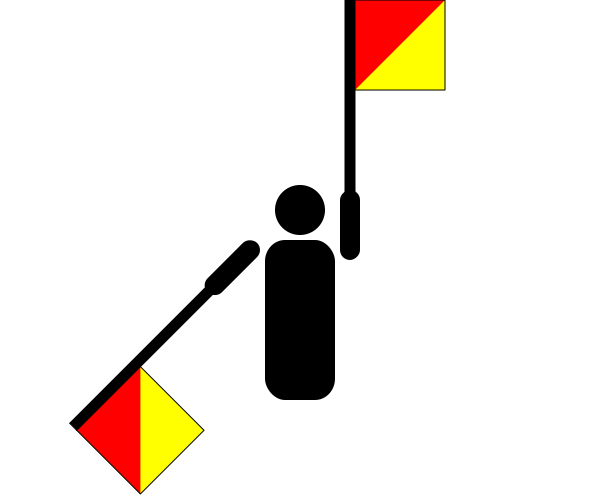
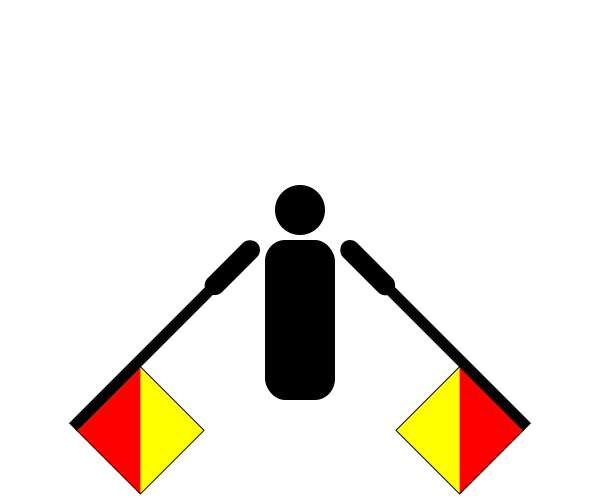
Semaphore



There are approximately 97 people named Bruckner in the UK. That makes it one of Britain's least common surnames. Only around one in a million people in Britain are named Bruckner.
