BRANDENBURG
A surname of German provenance, Brandenburg derives from the erstwhile German state of Brandenburg in the north‑east of the country. The name is locational, originally given to those who hailed from this region when they migrated elsewhere in medieval Europe.
The etymology of the surname can be traced to two Old High German components. Brand denotes a burnt or cleared area, while burg means fortress or castle. Consequently, the literal meaning of Brandenburg is “burnt fortress”, a description that may also refer to a settlement that arose on land cleared by burning.
In medieval records, the surname appears in a number of orthographic variants, including Brandenberg, Brandenberger and the Luxembourgish rendering Brendenbourg. These diverse spellings reflect regional dialects, the practices of scribes and the influence of foreign languages upon the original German form.
Archetypal examples of the surname are found in 14th‑century rolls and charters. Notable instances include Hans Brandenberg of St. Blasien in 1374 and Hildebrand Brandenburg of Biberach in 1398, indicating that the name was already in use among the German laity thousands of years ago.
The coat of arms traditionally associated with this family tradition is described in heraldic terms as a quartered shield; the first and fourth quarters display a black eagle shown in full wing, while the second and third quarters contain a gold crown. All four quarters are surrounded by a gold border. Such a badge reflects the high social esteem of the bearers, though the surname itself does not automatically denote noble lineage.
During the reign of the House of Hohenzollern, Brandenburg was a focal point of political power. While the name may have noble connotations due to its proximity to royal household members, the hereditary use of the surname became common well after the conclusive renunciation of feudal titles in many family lines.
In contemporary times, Brandenburg remains most frequently encountered in Germany, where its origins are still recognised. It has also disseminated to other nations by way of emigration, and can be found notably in the United States, Canada, Australia, and various parts of Europe. Within English‑speaking countries, spellings such as Brandenbarger or Brandenburgian occasionally appear, albeit less commonly than the core forms.
The diversity of spelling variations—ranging from Brandenbourg to Brandenburger—highlights the fluid nature of surname orthography in the pre‑modern era, where phonetic interpretation by clerical authorities often dictated a name’s final written form.
Ultimately, the surname Brandenburg is firmly rooted in a specific geographical and linguistic heritage. Its endurance across centuries attests to the lasting cultural imprint of the historic German state from which it emerged.
Similar and related surnames
Related and similar names are generated algorithmically based on the spelling, and may not necessarily share an etymology.
How to communicate the surname Brandenburg in...
Braille
⠃⠗⠁⠝⠙⠑⠝⠃⠥⠗⠛
Morse
-....-..--.-...-.-.....-.-.--.
Semaphore
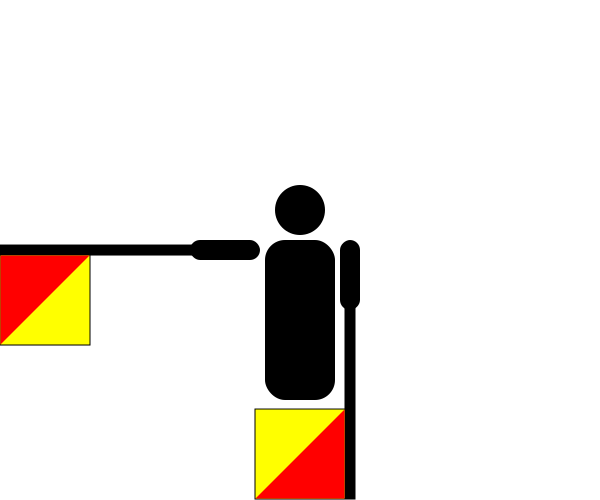
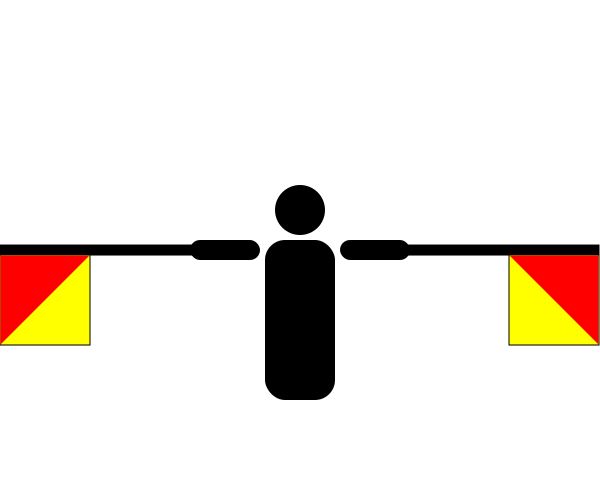

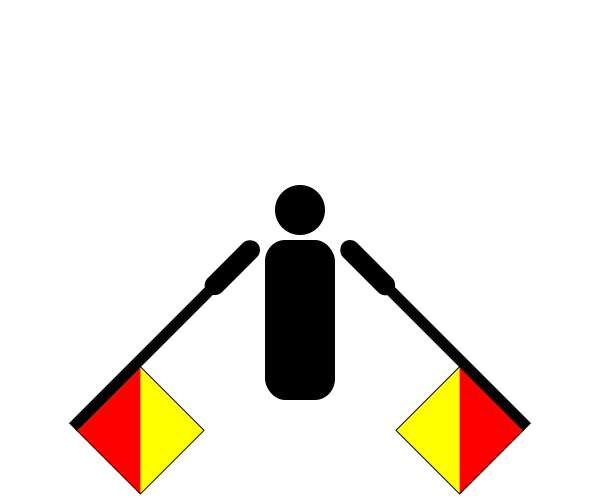


There are approximately 42 people named Brandenburg in the UK. That makes it one of Britain's least common surnames. Only around one in a million people in Britain are named Brandenburg.
Region of origin: Europe
Country of origin: Germany
Language of origin: German
