BONIFACE
Boniface is a surname that traces its roots to France and the Latin name Bonifatius. The Latin meaning, a combination of bonum (good) and facere (to do), conveys the sense of “good destiny” or “good fate”. Early Christian writers later interpreted the name as “doer of good deeds”, a meaning that resonated with the legacy of Saint Boniface (675‑754 AD). Over time the personal name gave rise to a hereditary family name that has been passed down through generations in many parts of Europe.
During the medieval era, roughly the period from 1000 to 1500 AD, the surname Boniface appears in France in records associated with the nobility, clergy and administrators who held feudal land and social privilege. The name was carried by a seventh‑century bishop who became martyred, and it has remained a popular name in Francophone countries. A notable institution linked to the Boniface heritage is the Order of Friars Minor Capuchin, founded by Giovanni Battista della Barbada, also known as Bonifacio da Colle, in the sixteenth century. The surname also appears in historic documents pertaining to French vineyards in the Burgundy region, reflecting its continued cultural presence.
In Italy the surname has been especially prolific. Italian usage of the name dates back to the early Christian period, where it was interpreted similarly as a good omen. The Italian version, Bonifacio or Bonifazio, is often rendered without the initial boni syllable in modern spelling. Researchers record at least fifty variant spellings—including Bonifacio, Bonafacino and Fazzioli—reflecting regional differences. Early civil and church registries illustrate the name’s prevalence, such as the christening witness Leonardo Bonifacio (also recorded as Bonifazio) in the San Severo parish in Foggia in 1830, and the first documented spelling, that of Francesca Bonifacio, who married Mariano Manzone at Montallegro, Agrigento, in 1757. The Italian record shows that the name has often been adopted indiscriminately, sometimes resulting in complex genealogical lines.
In England, the surname Boniface remains relatively uncommon but has seen a modest rise over the last half‑century. The increase is largely attributed to immigration from France and other parts of Western Europe. Historical records indicate that the name was present in the British Isles well before the modern era, where it was recorded in parish registers as a given name in the north‑western regions. English usage of Boniface is integrated into the broader Christian naming tradition and reflects the historic influence of continental migration during the Middle Ages and the Reformation.
The spread of the name beyond Europe is tied to missionary activity and colonisation. In North America, early French settlers in Louisiana brought the surname to the United States, where it appeared in tax rolls and census records. The name also features in Canadian French‑speaking communities, most notably in the province of Quebec. In Africa, the surname has been introduced and popularised through Portuguese and Christian missionaries, leading to its presence in countries such as the Democratic Republic of Congo, Angola and Kenya. These instances are recorded in church baptismal registers and civil documentation conducted by missionary societies in the nineteenth and twentieth centuries.
Variants of the surname exist across the linguistic spectrum. In addition to the French Boniface, the surname appears as Bonnefoy, Bonyface, Bonfeys and Bonifacio in Italian, Spanish and Portuguese contexts. Spanish and Italian adaptations such as Bonifaz, Bonifazio and Bonifassi are common in domestic records, while Anglicised forms like Bonniface and Bonnyface can be found in British archives. In each case the root meaning remains anchored to the Latin concepts of goodness and action.
In summary, the surname Boniface has a well‑documented lineage that originates from a Latin personal name, evolved in ecclesiastical and noble circles in France, proliferated in Italian civil records, and spread across Europe and the world through migration and missionary work. Its numerous orthographic variants reflect linguistic adaptation, yet all maintain a common etymological core that ties the family name to the enduring sense of good fortune and benevolence implied by its original Latin roots.
Typical given names associated with the Boniface surname
Male
- Andrew
- Christopher
- David
- John
- Mark
- Michael
- Paul
- Peter
- Richard
- Simon
- Stephen
Female
- Elizabeth
- Emma
- Lisa
- Louise
- Margaret
- Nicola
- Patricia
- Paula
- Sandra
- Sarah
- Sharon
- Susan
- Victoria
Similar and related surnames
Related and similar names are generated algorithmically based on the spelling, and may not necessarily share an etymology.
How to communicate the surname Boniface in...
Braille
⠃⠕⠝⠊⠋⠁⠉⠑
Morse
-...----.....-..--.-..
Semaphore

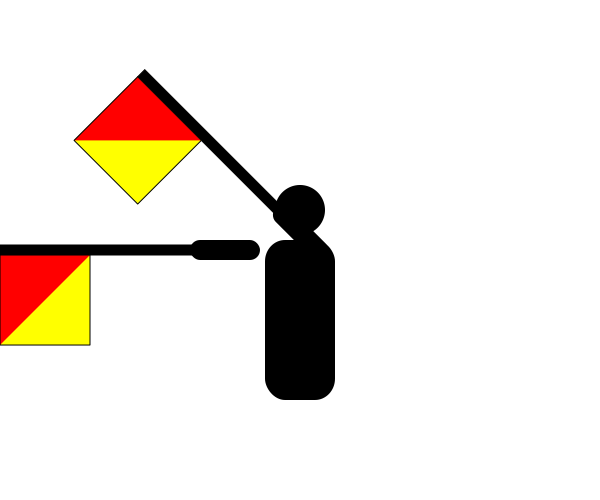
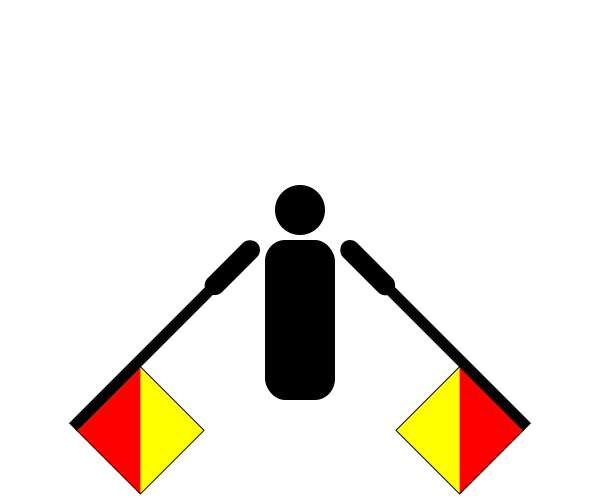
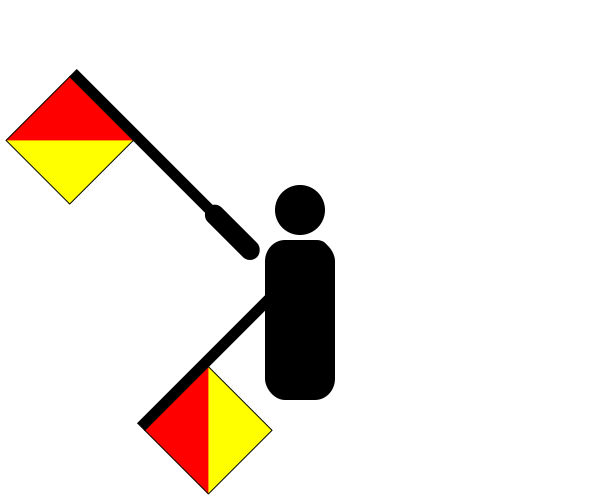



There are approximately 1,934 people named Boniface in the UK. That makes it roughly the 4,332nd most common surname in Britain. Around 30 in a million people in Britain are named Boniface.
Surname type: From given name or forename
Origin: English
Region of origin: British Isles
Country of origin: England
Religion of origin: Christian
Language of origin: English