BLOOD
The surname Blood is an English name that is most commonly associated with the British Isles. It is found throughout England, particularly in the Midlands, East Anglia, and the South West, and has a recognised, albeit uncommon, presence in countries such as the United States, Canada, Australia, and New Zealand. The name is traditionally linked to the English language and Christian religion, reflecting the cultural context of its earliest bearers.
In medieval England, during the Anglo‑Saxon period, Blood emerged principally as a nickname. It is believed to have been applied either to individuals who possessed a ruddy complexion or a fierce temperament, or to those whose sanguine (cheerfully optimistic) disposition was noted by contemporary observers.
Other interpretations of the name’s derivation focus on topographic origins. The Middle English term blode meaning “blood” could describe someone who lived near a stream or river, with the name serving as a locational reference. In certain instances the name also appears to have been an affectionate term of address for a relative— Chaucer’s phrasing “my blode, my nece” illustrates such usage, denoting a close kinship.
There is evidence that the surname may have occupational connotations. The Old English pre‑7th‑century word blod, and its Middle English development bloden meaning “to let blood,” suggests the name could have been used for a physician or barbersurgeon who performed bloodletting. Thus, the surname may have been a metonymic occupational designation for a medical practitioner of that era.
Some scholars consider Blood a variant of the surname Blount, which derives from the Old French word blund, meaning “blond.” This connexion illustrates how phonetic shifts and linguistic influence can yield divergent surnames that share a common etymological root. Other variants of the name include Blud, Bludd, Bloode, and Bloed, reflecting regional spelling differences over time.
In Wales, the patronymic form of Lloyd combined with the prefix ap or ab meaning “son” occasionally produced the surname Blood. The presence of this Welsh influence indicates that the name’s adoption was not confined to England alone but extended across the British Isles.
A prominent historical figure bearing the surname is Thomas Blood (1618‑1680). He was an Irish officer who, in 1671, famously attempted to seize the Crown Jewels from the Tower of London. His audacious act brought him notoriety and, after a period of imprisonment, the favour of King Charles XI, who restored his previous Irish estates.
The earliest documented instance of the family name is the spelling “William Blod,” recorded in the Assize Rolls of Northumberland in 1256 during the reign of King Henry I. The entry, which identified a “Frenchman” in 1216‑1272, marks the inception of the surname in surviving official records.
By the early modern period, the name was established in Lincolnshire, where it is thought to have evolved from the phrase bode laod—meaning “the people of the shelter”—which over time contracted into Blood. The spread in contemporary times remains limited; the surname is rarely encountered even in the communities where it historically clustered.
Owing to variations in spelling, immigration, and the lack of rigorous record‑keeping in medieval times, many families share the surname Blood without being directly related. Variants such as Blodgett, Blodwen, and even Irish forms like Bláth or Bladhma illustrate how different linguistic pathways can converge on a similar orthographic outcome, producing unrelated lineages that bear the same surname.
Typical given names associated with the Blood surname
Male
- Alan
- Andrew
- Christopher
- David
- James
- John
- Matthew
- Paul
- Peter
- Richard
- Stephen
Female
- Alison
- Barbara
- Claire
- Elizabeth
- Emma
- Helen
- Jacqueline
- Joanne
- Judith
- Julie
- Margaret
- Samantha
- Sarah
- Susan
Similar and related surnames
- Bloyd
- Bloede
- Bloedow
- Blud
- Bloud
- Baelt
- Baillet
- Baillett
- Bailliet
- Baillod
- Baillot
- Balada
- Balade
- Baladi
- Balado
- Balat
- Balata
- Bald
- Balda
- Balde
- Baldea
- Baldeo
- Baldi
- Baldie
- Baldo
- Baleed
- Balet
- Baleta
- Baletti
- Ballad
- Ballade
- Ballato
- Ballatt
- Ballatti
- Ballet
- Ballett
- Balletta
- Ballette
- Balletto
- Balliet
- Ballot
- Ballott
- Ballotta
- Ballout
- Balode
- Balot
- Balt
- Balta
- Balut
- Baluta
- Bauld
- Bauldie
- Bault
- Baylett
- Bealt
- Bealtie
- Beladi
- Belaid
- Belaidi
- Belaud
- Beld
- Belda
- Belde
- Beldeau
- Beldi
- Belet
- Belete
- Belide
- Bellati
- Bellato
- Bellatt
- Bellatti
- Bellet
- Bellett
- Belletti
- Bellido
- Bellodi
- Bellot
- Bellott
- Bellotte
- Bellotti
- Bellotto
- Belot
- Belotti
- Belt
- Belte
- Bielat
- Bild
- Bilet
- Billadeau
- Billaud
- Billet
- Billett
- Billette
- Billiat
- Billiet
- Billiot
- Billiott
- Billit
- Billitt
- Billot
- Billott
- Billotte
- Bilodeau
- Bilotta
- Bilotti
- Bilotto
- Bilt
- Biltoo
- Bioletti
- Blad
- Blada
- Bladd
- Blade
- Bladt
- Blaid
- Blait
- Blat
- Blatt
- Blattie
- Blaud
- Blaut
- Blead
- Bleda
- Bleet
- Bleta
- Blett
- Blide
- Blidi
- Bliet
- Blit
- Blodd
- Blot
- Blote
- Blott
- Blouet
- Blout
- Bludau
- Bludd
- Blude
- Blueitt
- Bluet
- Bluett
- Bluiett
- Bluit
- Bluitt
- Blute
- Bluteau
- Blyde
- Boald
- Boalt
- Boillat
- Boillot
- Bolade
- Bolado
- Bolat
- Bold
- Bolda
- Bolde
- Boldea
- Boldeau
- Boldi
- Boldt
- Boleat
- Bolet
- Boleta
- Boleti
- Bollada
- Bollado
- Bollati
- Bollet
- Bolletta
- Bollito
- Bolot
- Bolt
- Bolta
- Bolte
- Boltt
- Boluda
- Boolt
- Bouillet
- Bouillot
- Boulat
- Bould
- Boulet
- Boullet
- Boulot
- Boult
- Bowld
- Bowlet
- Bowlett
- Bowlt
- Boylet
- Boylett
- Boylette
- Build
- Built
- Bulat
- Bulatao
- Buld
- Bulda
- Buldt
- Buldu
- Bulita
- Bullat
- Bullata
- Bulled
- Bulleid
- Bullet
- Bullett
- Bulletti
- Bullied
- Bullitt
- Bullot
- Bulot
- Bult
- Bulte
- Bulteau
- Bulut
- Bylett
- Bylid
- Bylitt
Related and similar names are generated algorithmically based on the spelling, and may not necessarily share an etymology.
How to communicate the surname Blood in...
Braille
⠃⠇⠕⠕⠙
Morse
-....-..-------..
Semaphore
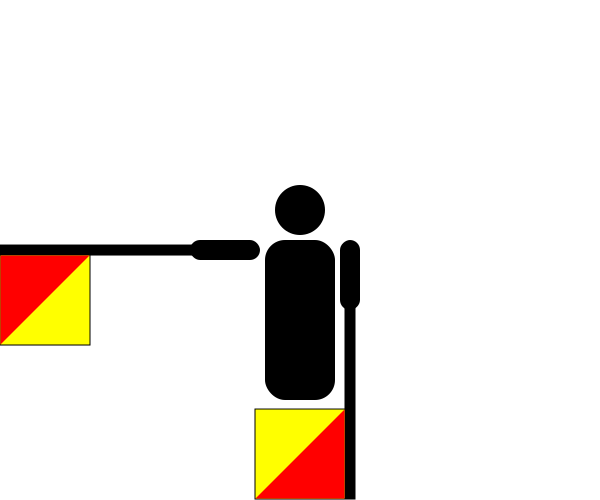

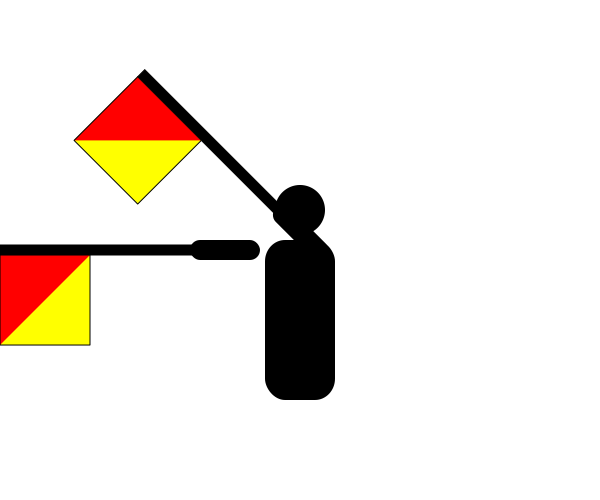

There are approximately 2,025 people named Blood in the UK. That makes it roughly the 4,173rd most common surname in Britain. Around 31 in a million people in Britain are named Blood.
Origin: English
Region of origin: British Isles
Country of origin: England
Religion of origin: Christian
Language of origin: English

Famous people named Blood
- Nick Blood - Actor
- May Blood, Baroness Blood - Life peer, activist
- Sir Bindon Blood - Army general (1842 to 1940)
- Hilary Blood - Colonial governor (1893 to 1967)
Names and descriptions courtesy of Wikipedia, and may contain errors. This is not intended to be an exhaustive list of every famous person with this name.