BLIZARD
Blizard is an English surname of occupational or nickname origin. It is generally derived from the Middle-English word blis, meaning blaze or torch. The name was therefore first applied to individuals who displayed a fiery or passionate temperament. Another accepted derivation is from bless, itself derived from the Old English bletsian, meaning to bless; this would have been a nickname for a particularly fortunate or well‑wishing person.
Early documentary evidence places the surname in the late thirteenth century. The Hundred Rolls of Oxfordshire, published for the reign of King Edward I (1272‑1307), contain the name Hugh de Blesset (1273). In 1327 a record of the Subsidy Rolls of Staffordshire cites John le Blessed. The fifteenth and early sixteenth centuries produced further on‑field examples: the christening of Giles Blissarde in Buckland, Gloucestershire (1539) and the marriage of John Blissard with Margery Izod (1559) at the same parish. In the parish register of Guiting Power, Gloucestershire, on 9 October 1589 the birth of Abigall Blizard is noted; a later entry records the christening of Anne Blissard at St. Nicholas Acons, London.
The surname also shows linguistic connections with the pre‑seventeenth‑century personal name Blithsige (meaning “blithe victory”), which later evolved through the Middle‑English forms Blissit, Blyzett and Blizet before becoming Blizard. In the eighteenth and nineteenth centuries a variant interpretation was recorded as a locational name, derived from Old English blæst “blast” and weard “guard”, suggesting a “guard against blasts” possibly indicating a person who protected a village from violent weather or manufactured protective gear. Both the occupational and locational explanations are widely cited in genealogical records.
A notable bearer of the surname was Sir William Blizard (1743‑1835), who founded a medical school in London in 1785 and served twice as president of the College of Surgeons. His legacy is commemorated through the Blizard Institute, an arm of Queen Mary University of London that focuses on medical research. A heraldic grant was also issued to a family named Blizard, depicting a black chevron, in chief three blue crosses moline on a silver shield.
Distributionally, the surname remains relatively uncommon, yet it is primarily concentrated in the United Kingdom, particularly in Suffolk, the north‑east of London, Norfolk and London itself. In the late nineteenth century a growth in frequency is recorded, especially within London. The name also appears in other English‑speaking countries such as the United States, Canada and Australia, where immigration has spread the family across the wider diaspora. Variants—including Blizzard, Blyzard, Blizzerd, Blissard and Blisett—arise from differing phonetic spellings recorded in parish registers, census data and land deeds. These variations illustrate the linguistic fluidity of surnames over time, but all share a common origin within the English linguistic heritage.
Typical given names associated with the Blizard surname
Male
- Andrew
- Brian
- Charles
- Christopher
- John
- Jonathan
- Martin
- Michael
- Stephen
- Steven
- Toby
- William
Female
- Anne
- Claire
- Deborah
- Emily
- Emma
- Helen
- Karen
- Kathleen
- Lindsey
- Margaret
- Paula
- Penelope
- Sarah
Similar and related surnames
Related and similar names are generated algorithmically based on the spelling, and may not necessarily share an etymology.
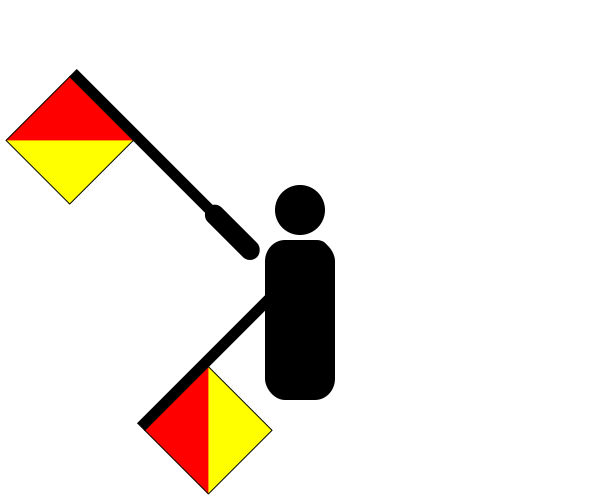
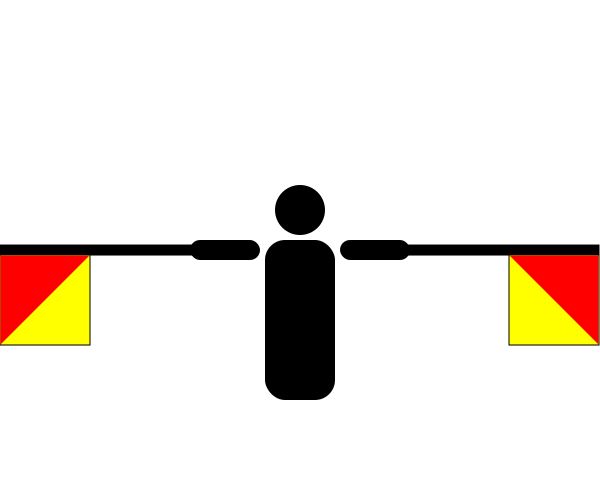
How to communicate the surname Blizard in...
Braille
⠃⠇⠊⠵⠁⠗⠙
Morse
-....-....--...-.-.-..
Semaphore





There are approximately 246 people named Blizard in the UK. That makes it one of Britain's least common surnames. Only around four in a million people in Britain are named Blizard.
Surname type: Occupational name
Origin: English
Region of origin: British Isles
Country of origin: England
Religion of origin: Christian
Language of origin: English
