BLESSING
Origins and Etymology
The surname Blessing is predominantly of German origin, derived from the Middle High German word blesinc, which means “blessing” or “good fortune.” It is a patronymic surname, originally used to identify the descendants of a person named Blessing. The name may also have arisen as a nickname or personal name bestowed upon someone who was regarded as bringing good luck or blessings to others.
In English‑speaking contexts the surname is linked to Old English terms that meant “blessed” or “praise.” This association reinforces the positive and hopeful connotations that are commonly attributed to the name.
Early Records in Britain
The surname Blesing – a medieval form of Blessing – has been recorded in Britain since the twelfth century. It is believed to derive from a Middle English variant of the German name Blessin, and it has survived under various spellings throughout the centuries.
Modern Distribution
According to the 2000 U.S. Census, 8,913 people were listed with the surname Blessing, ranking it as the six thousand eight hundred threerd most common surname in the United States. In Canada, census data from 2006 recorded the name Blessing in fifteen provinces, with the highest concentration in Ontario, followed by Alberta and British Columbia. In the United Kingdom, Blessing is a recognised variant of the hereditary surname Blesing, documented from medieval times to the present. German census records from 2000 show fewer than five hundred individuals bearing the surname Blessing, reflecting a relatively small presence in its country of origin.
Geographical Variations and Spelling Differences
Across the English‑speaking world and in continental Europe, the surname has appeared in many spellings that indicate a common root. Variants include Blessington, Blessant, Blessenden, Blessent, Blessen, Blesing, and Blessinger. Other linguistic adaptations comprise the Dutch Blessink, the French Blessingue, and the Danish Blessing. In Ireland the most frequent spelling has been Blessington or Blessant; in Scotland the surname appears as Blessing, Blessant, or Blesing, all regarding the Old English phrase “blessen in” meaning “to bless, give or bestow.” These variations demonstrate how the same medieval root has been adapted across different linguistic and national contexts while maintaining a shared etymological ancestry.
Cultural Significance
Because the name denotes a state of being honoured or favoured, it has often been regarded as a positive marker of identity. The surname has been used to recognise special events within families, to trace lineage, and to remind bearers of their ties to blessings and well‑being. In modern times, the positivity inherent in the name continues to be appreciated by those who carry it.
Typical given names associated with the Blessing surname
Male
- Alexander
- Charles
- Gary
- James
- John
- Kenneth
- Manus
- Mark
- Michael
- Patrick
- Paul
Female
- Angela
- Catherine
- Clare
- Elaine
- Emma
- Helena
- Jennifer
- Karen
- Karin
- Kimberley
- Lisa
- Mary
Similar and related surnames
Related and similar names are generated algorithmically based on the spelling, and may not necessarily share an etymology.
How to communicate the surname Blessing in...
Braille
⠃⠇⠑⠎⠎⠊⠝⠛
Morse
-....-...........-.--.
Semaphore




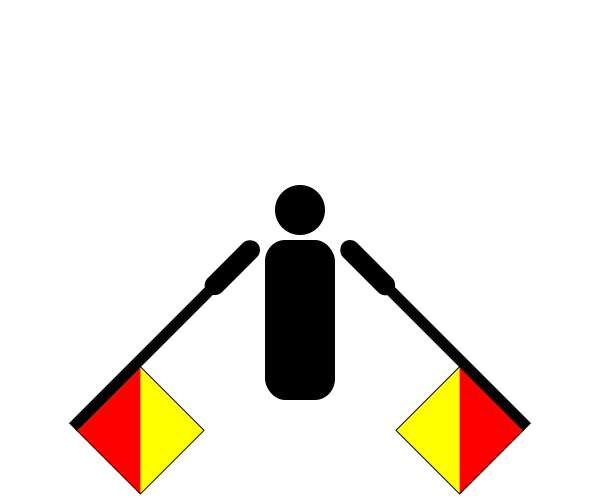

There are approximately 251 people named Blessing in the UK. That makes it one of Britain's least common surnames. Only around four in a million people in Britain are named Blessing.
Origin: Celtic
Region of origin: British Isles
Country of origin: Ireland
Religion of origin: Christian
Language of origin: Gaelic
