BLANCHET
The surname Blanchet is of French origin, deriving from the word blanc, meaning white in French.
It is traditionally regarded as an occupational surname, originally given to individuals who worked with or sold white goods such as linen or white cloth. The appellation is also symbolic, associating the bearer with the colour white, a motif that has historically represented purity, innocence and light.
The name has acquired numerous variants through the centuries, including Blanch, Blanche, Blank, Blanke, Blanchette, Blanket, Blankett and Blunkett. These forms are found in both English and French documents, reflecting the migration and linguistic adaptation of the name across the British Isles and continental Europe.
The earliest recorded spelling in England is that of Nigellus Blanke, dated to 1196 in the Pipe Rolls of Leicestershire during the reign of King Richard I. Subsequent English records include “Robert Blanket” in the Subsidy Rolls of Worcester in 1275 and “John Blanchett” in the same rolls in 1365. An early American bear‑er of the name was Elizabeth Blanch, who departed London on the ship “Alice” bound for Virginia on 13 July 1635; she is the earliest documented person named Blanchet to have entered America.
While the surname is most common in France, where it ranks as the 655th most popular surname, it is also represented in a variety of other countries. In Canada it is most closely associated with Quebec, where it is borne by roughly 1,000 individuals and is often viewed as a variation of the surname Blanchard. In the United States, census data from 2000 to 2010 indicate that about 4,450 people carry the name, the majority of whom descend from French‑Canadian immigrants settled mainly in the Northeast, Midwest and parts of the South. Smaller communities of bearers are found in Belgium, Luxembourg, Switzerland, Haiti, the United Kingdom, Germany, Japan, Vietnam and elsewhere.
Historically, the name has sometimes been linked with a noble or aristocratic background, a perception that persists in contemporary usage. The various spellings and phonetic adaptations, such as Blanchot, Blanchett, Blanschet and others, arose through clerical recording practices and migration, reflecting the broader cultural influence of French language and culture on the surname’s bearers.
Overall, the surname Blanchet remains a marker of historical continuity and cultural identity for those who descend from French ancestors, and its geographic spread continues to evolve in tandem with modern migration patterns.
Similar and related surnames
Related and similar names are generated algorithmically based on the spelling, and may not necessarily share an etymology.
How to communicate the surname Blanchet in...
Braille
⠃⠇⠁⠝⠉⠓⠑⠞
Morse
-....-...--.-.-......-
Semaphore
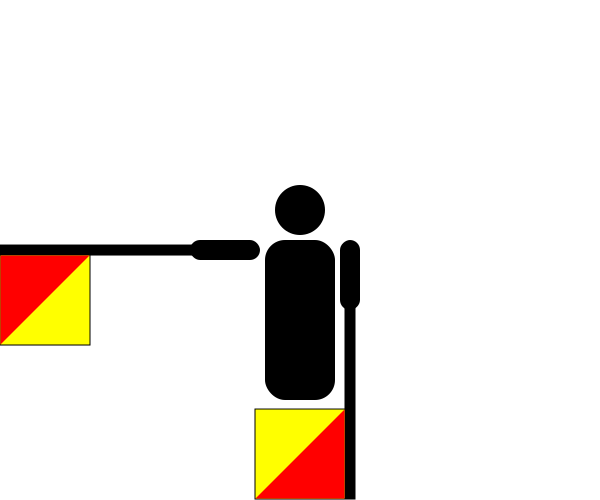


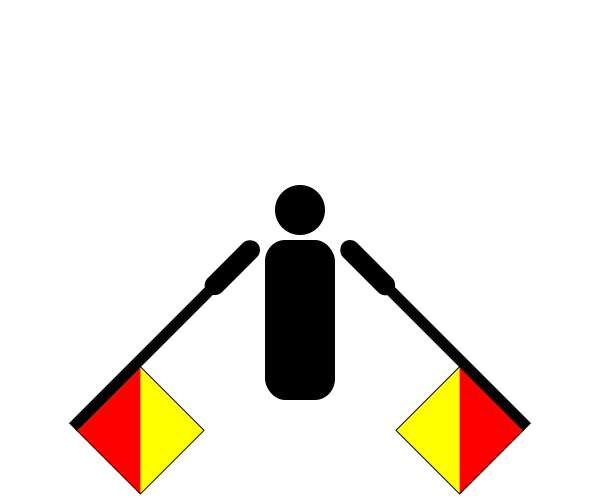


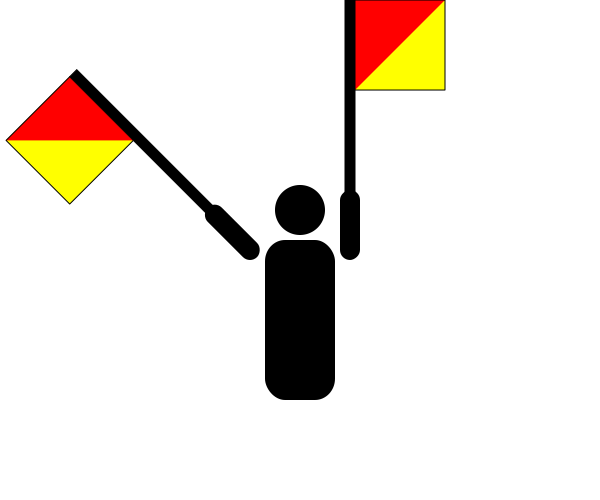
There are approximately 79 people named Blanchet in the UK. That makes it one of Britain's least common surnames. Only around one in a million people in Britain are named Blanchet.
