BISCHOFF
The surname Bischoff is of German origin and translates directly to bishop in English. It first appeared as a hereditary name during the Middle Ages, when surnames began to be recorded in official documents across Europe.
Its linguistic roots lie in the Middle High German word biscof, meaning a person who held the office of a bishop. The term itself originates from the Ancient Greek episkopos, which translates as “overseer” and is derived from epi (on or over) and skopein (to look). The early Christian adoption of the word denoted the leaders of local communities, and from the fourth century it became the title for those who presided over ecclesiastical matters.
In medieval times the surname was often given to individuals who served within a bishop’s household, acted as clerical aides, or portrayed a bishop’s role in travelling plays. The first documented appearance of the name dates to 1166, in the Pipe Rolls of Nottingham, England, where it was recorded as Lefwinus Bissop. Later examples from the thirteenth and fourteenth centuries include Thurstan le Byssop of Essex in 1240, Berchtoldus Episcopus of Oberweiler, Germany, in 1296, and Haintz der Pischoffer of Tiefenbach, Germany, in 1396.
During the subsequent centuries the name evolved into several variants, reflecting local linguistic influences and the adaptation of spelling. Common forms include Bischop, Bischof, Bishoff, Bischofsberger (signifying a relation to the bishop’s home), Bishop (the English equivalent), Bischofs (a possessive or plural form), and Biscoe. Extended versions such as Bischoffsheim, Bischoffberger, and Bischoffshausen indicate a geographical connection to settlements associated with a bishop.
In contemporary times, the surname remains most common in German‑speaking regions, particularly in southern and western Germany, as well as in Switzerland and Austria. Migration from these areas has brought the name to countries outside Europe, including the United States, Brazil, and Argentina, where it continues to be borne by individuals who share a distant historical link to ecclesiastical service or its symbolic associations.
Although the modern bearer of the surname may not have a direct connection to a bishop or the church, the name carries a legacy that reflects a historical occupation of notable social standing and the cultural interchange between German and Greek linguistic traditions.
Typical given names associated with the Bischoff surname
Male
- Brent
- Charles
- Chris
- Christopher
- Damian
- James
- Jonathan
- Mark
- Martin
- Michael
- Paul
- Wolfgang
Female
- Barbara
- Caroline
- Elizabeth
- Esther
- Jennifer
- Judy
- Mary
- Rosemary
- Sarah
- Stephanie
- Victoria
Similar and related surnames
Related and similar names are generated algorithmically based on the spelling, and may not necessarily share an etymology.
How to communicate the surname Bischoff in...
Braille
⠃⠊⠎⠉⠓⠕⠋⠋
Morse
-........-.-.....---..-...-.
Semaphore
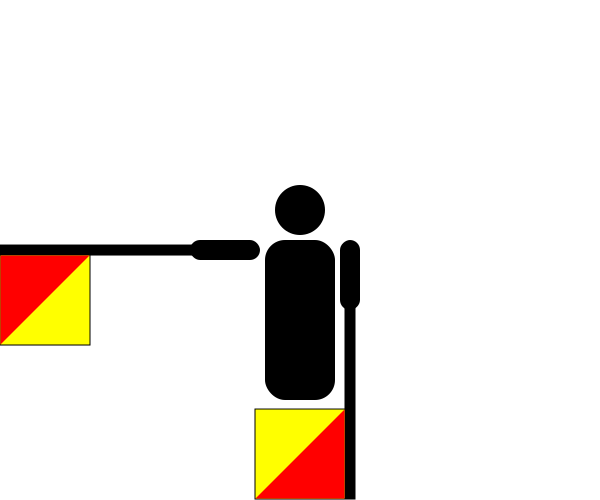
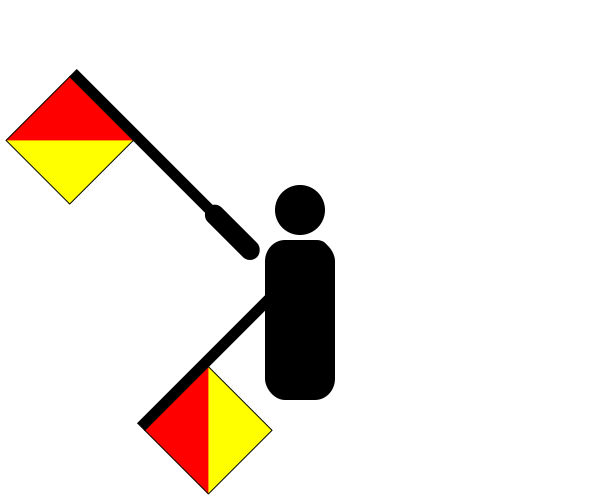


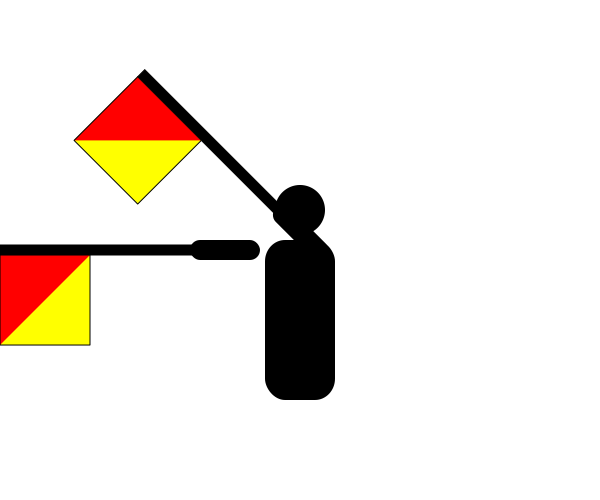
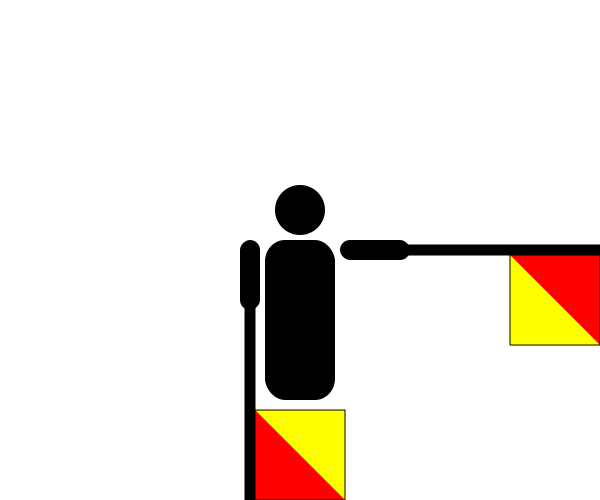
There are approximately 173 people named Bischoff in the UK. That makes it one of Britain's least common surnames. Only around three in a million people in Britain are named Bischoff.
Region of origin: Europe
Country of origin: Germany
Language of origin: German
