BINNIE
Binnie is a surname of longstanding heritage within the British Isles, with its roots most firmly planted in Scotland. Its earliest recorded appearance corresponds with the early thirteenth century, when the name appears in documents such as the Pipe Rolls of Cambridgeshire under the spelling Robert de Binay, dated 1210 during the reign of King John.
The linguistic origin of Binnie is commonly attributed to Gaelic. In particular, the personal name Bean or Beathan—meaning “life” or “vivacious”—is regarded as the progenitor. The surname is patronymic in nature, signifying descent from an individual who bore that personal name. Over time, the spelling evolved into the modern form Binnie, and the name has remained predominantly associated with Scotland and its diaspora.
Alternative interpretations link the surname to native topographical or locational descriptors. One theory holds that Binnie derives from an old English phrase binnan ea, meaning “within the stream”. Another posits a Scottish locational origin from places such as Binney or Binniehill near Falkirk, combining the Gaelic beinn “hill” with the adjectival suffix ach “full of”. A third hypothesis suggests derivation from the old English locational name Bynni. These interpretations are supported by early medieval records, including the entry for William de Binin in 1243 and William Bynny in the 1297 Subsidy Rolls of Yorkshire.
Throughout the centuries, the surname has been recorded in a variety of spellings that reflect the fluid nature of medieval orthography. Variants such as Binney, Binny, Beanie, Bynne, Begger and Benne appear in parish registers and court documents. For example, the Assize Court Rolls of Kent contain a reference to Ralph de Bynne in 1317, while 16th‑century London baptisms record names like Anne Bynny and John Bynnie at St. Mary le Bow.
The earliest documented bearer of a name that recognises the modern form is Wylkyn Bynie, who enacted a grant in Aberdeenshire in 1296. This individual exemplifies the persistence of the surname in its Scottish homeland. Subsequent census data confirm that, even into the twentieth century, the name remained firmly entrenched in regions such as Aberdeenshire, with concentrations in towns including Peterhead, Ellon, Aberdeen and Fraserburgh.
Modern statistics, notably those released by the National Records of Scotland in 2017, classify Binnie as the twenty‑seventh most common surname in Scotland. While its frequency is lower outside the country, the name extends into other parts of the British Isles and beyond, found sporadically in northern England, and occasionally in countries belonging to the English‑speaking diaspora such as the United States, South Africa, Canada, Australia, New Zealand and Sweden.
Associations with particular landmarks exist, notably a castle situated south of Peterhead that, according to local tradition, was first constructed in the fifteenth century, then lost to destruction during the Cromwellian campaigns before being rebuilt in the sixteenth century. Although the present castle no longer stands, the link underscores the long standing imprint of the Binnie family in the eastern Scottish landscape.
While the Gaelic derivation remains the most favoured explanation, other potential origins have been noted. These include an English derivation from the Old English personal names Bynna or Bynne, signifying a “fair‑haired one”; an Irish derivation as a variant of O’Binny from the Gaelic O’Baoighill; and, less frequently, a Polish derivation as an anglicised form of Bieniek. Nevertheless, the prevalence of the surname in Scotland and its consistent Gaelic associations lead scholars to regard the Gaelic patronymic as the primary source.
In summary, Binnie is a surname of considerable antiquity, firmly anchored in Scottish history through both recorded lineage and linguistic evidence. Its evolution from a personal Gaelic name to a widespread family surname reflects broader patterns of naming in the British Isles, while the variety of spellings across records highlights the fluid nature of language and identity over the centuries. The enduring presence of the name, both domestically and abroad, attests to a resilient heritage that continues to be recognisable to this day.
Typical given names associated with the Binnie surname
Male
- Alexander
- Andrew
- Christopher
- David
- Ian
- James
- John
- Robert
- Thomas
- William
Female
- Ann
- Catherine
- Claire
- Elizabeth
- Fiona
- Gillian
- Helen
- Jane
- Julie
- Kimberley
- Margaret
- Mary
- Sarah
Similar and related surnames
Related and similar names are generated algorithmically based on the spelling, and may not necessarily share an etymology.
How to communicate the surname Binnie in...
Braille
⠃⠊⠝⠝⠊⠑
Morse
-.....-.-....
Semaphore
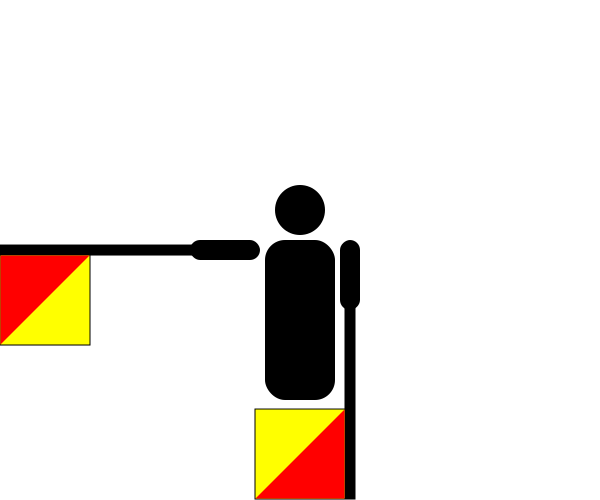
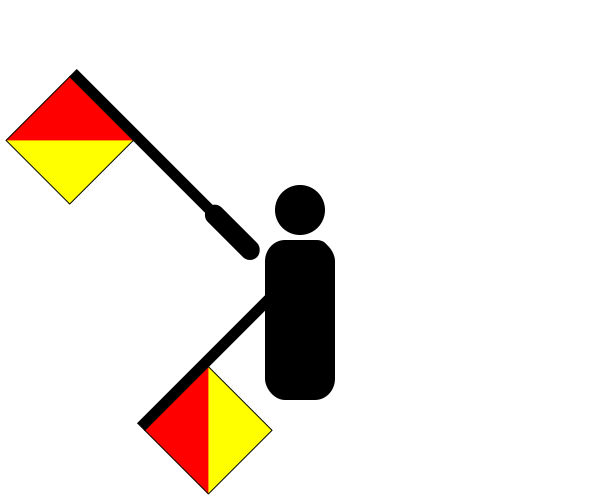
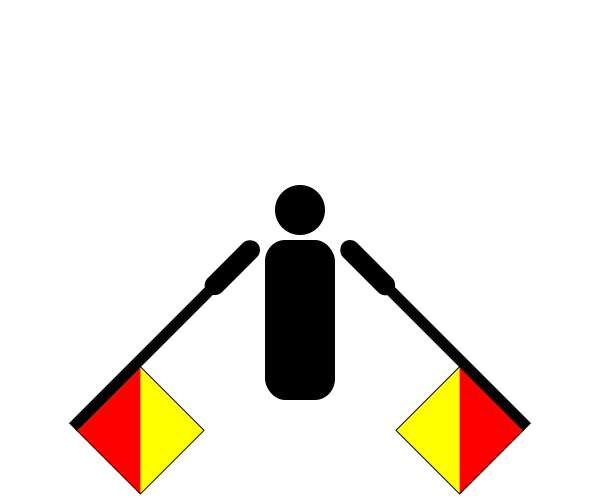

There are approximately 2,224 people named Binnie in the UK. That makes it roughly the 3,853rd most common surname in Britain. Around 34 in a million people in Britain are named Binnie.
Origin: Celtic
Region of origin: British Isles
Country of origin: Scotland
Religion of origin: Christian
Language of origin: Gaelic

Famous people named Binnie
- William Harrison Binnie - American industrialist and investment banker
- William Binnie - Architect (1886 to 1)
- Georgina Binnie-Clark - Lecturer, author and social activist (1871 to 1947)
- Paul Binnie - Scottish artist working in the Japanese tradition of woodblock printing.
Names and descriptions courtesy of Wikipedia, and may contain errors. This is not intended to be an exhaustive list of every famous person with this name.